
-
 June 22, 2026, 5:32 pm
Last Updated on August 7, 2026 9:26 am by André Lemos | Published: June 22, 2026
Well, the Knicks are the last team to go in the Season Wrap series, and that’s generally a pretty good sign.
How’d It Go?
It went quite well to say the least.
It didn’t always feel that way, though. The Knicks fired Tom Thibodeau after last season’s playoff ouster, taking a bold step to remove the coach who had helped bring the team back to prominence even if there was an overwhelming sense that Thibodeau would not be able to get the group over the hump. The real questions was if they could find a coach that would be an improvement on Thibs or if the Knicks were just changing for the sake of change. They opted for Mike Brown, most recently dismissed by the Sacramento Kings after the feel-good Beam Team era ended just as quickly as it began. While the Knicks were always at the center of Giannis Antetokounmpo rumors, they opted against blowing up the roster in order to see if a new voice could get an undeniably talented group to break through.
The Knicks won their first two games and lost the next three, only to reel off five straight blowout victories. The season had a few fits and starts where the Knicks showed you just how good they could be while mixing in flashes of underwhelming play. They lost eight of their first 10 games in January and then won eight straight to get back on track. The biggest issue throughout the season was the ongoing change of systems brought about by the coaching staff. Karl-Anthony Towns in particular felt the brunt of the adjustment and his performance in the first half of the season reflected those struggles. There were too many nights when Towns was not involved for one reason or another, and he wore that frustration for all to see. Brown was not afraid to dial back on KAT’s minutes in favor of Mitchell Robinson and Josh Hart and while there was still some degree of over-relying on Jalen Brunson, the Knicks generally went with a more egalitarian approach to their games.
That made better use of a bench that included Miles McBride, Jordan Clarkson, Tyler Kolek and eventually Jose Alvarado. The Knicks’ signing of Guerschon Yabusele was a flop but their backcourt depth was tremendous and helped keep the top players’ minutes down in the regular season after years of Thibodeau pushing the entire group to the top of the minutes leaderboard. That ended up being a critical factor in New York’s postseason run as they authored a slew of comeback victories and seemed to get better deep into games and series, wiping out their first three opponents with ridiculous closeout games and rallying for a double-digit comeback in each of their Finals wins. A fresher version of the Knicks, who still had the experience of playing massive minutes in their history, was too much for opponents to handle.
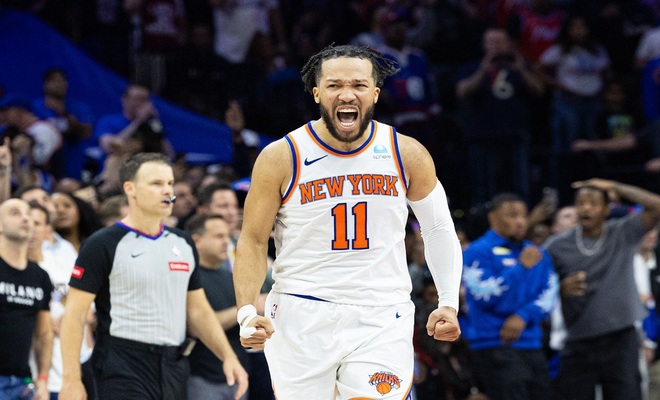
The playoffs were a great showing for the entire team. They dropped two games to Atlanta but snapped into form and finished off that series with ease, powered largely by Towns. He put up a pair of triple-doubles and got on a real roll as Brown involved him more in the action. We knew it was in his back pocket given how Brown’s Kings teams made use of Domantas Sabonis, and they ended up going to that well to great effect in the first round. From there it was a demolition as the Knicks swept both Philadelphia and Cleveland. Towns, Brunson, OG Anunoby and Mikal Bridges all had their moments in the sun while Hart and Robinson were both instrumental in the victories even without huge box score presence every night. In the Finals, KAT was excellent against Victor Wembanyama and the Knicks stayed cool in the face of constant early deficits, earning four impressive wins where they simply regrouped after the first haymaker and overtook San Antonio right before the buzzer. OG Anunoby saved Game 4 with a miracle tip in and Jalen Brunson capped it all off with a 45-point explosion in the clincher. After 53 years, the Knicks became champions again.
Coaching
Mike Brown ended up being the big change needed for the Knicks to hit paydirt. The season-long back-and-forth with Towns’ deployment was the bump in the road but obviously everyone got it figured out in time for KAT to deliver the best run of his career in the playoffs. The Knicks ended up 7th in defensive rating, fourth in offensive rating and fifth in net rating. They were near the bottom of the league in pace which makes a lot of sense given how many points they got from Brunson isolating and probing, and did their best to control the glass and limit turnovers. The Knicks were near the top of the board in terms of limiting opponent second-chance and fastbreak points and typically won the possession game. Between that, Brunson’s late-game proficiency and the fact that the Knicks were top-5 in 3-point percentage, and you see an easy recipe for success.
The Knicks were a slightly better rebounding team under Brown than the final year of Thibodeau’s tenure and were a significantly better defensive team. Some of that can be tied to more usage — and better health — for Mitchell Robinson but the team wasn’t wildly different from one year to the next, which isn’t a shock given the lack of change in key personnel.
The most notable year-over-year difference is that the Knicks became a lot more inclined to shoot from deep. This season, 42.8% of New York’s field goal attempts were from 3-point range, ranking 12th in the league. In 2024-25 they were 28th in the category at just 38.2%. An updated offense that made use of the team’s shooting prowess helped them put points on the board without overtaxing any one player in particular and helped the Knicks avoid quite as many grind-it-out affairs.
Of course, Brown hit all the right buttons in the playoffs, and the team clearly had belief that they could overcome just about anything. They stuck together and showed guts time after time in the face of adversity. Their lack of panic was in part a reflection of Brown’s demeanor and while he did try to lobby for more favorable officiating in the playoffs, that storyline was quickly dropped as the Knicks dominated the headlines with their comeback ability.
Ultimately, the Knicks brought in Brown to freshen things up and create a more collaborative environment. He used the bench to better effect throughout the season and even into the playoffs (hello, Landry Shamet) and empowered guys other than Brunson to create shots for themselves and each other. It kept the entire team engaged from wire to wire even as KAT struggled to find his exact role and paid off in the postseason, when pretty much everyone on the roster had a key contribution on the path to a championship. In essence, Brown helped prepare the Knicks to have more than one way to play under the brightest lights. There wasn’t a ton of margin for error here given the implications of another early playoff exit but that’s all hypothetical now. Brown played a big part in winning and NBA Championship, which is ultimately the highest compliment you can give a coach.
The Players
 Jalen BrunsonPG, New York Knicks
Season Team GP GS MPG FGM FGA FG% FTM FTA FT% 3PTM 3PTA 3PT% PTS REB AST STL BLK TO 26-27 NY 1 1 34.0 6.0 19.0 31.6 8.0 8.0 100.0 1.0 3.0 33.3 21.0 5.0 3.0 0.0 0.0 2.0 25-26 NY 74 74 35.0 9.3 19.9 46.7 4.8 5.7 84.1 2.6 7.1 36.9 26.0 3.3 6.8 0.8 0.1 2.4 24-25 NY 65 65 35.4 9.0 18.5 48.8 5.7 6.9 82.1 2.3 6.1 38.3 26.0 2.9 7.3 0.9 0.1 2.5 ADP: 22.1 / 23.4 (Yahoo/ESPN) | Total Value: 29/31 (8/9-cat) | Per-Game Value: 47/47 (8/9-cat)
It was not unreasonable to worry about Brunson working with a coach other than Tom Thibodeau given the way he was allowed to compile a ton of stats on sheer volume in years past. As fate would have it, Brunson’s playing time did fall, but only by 0.4 minutes per game as Mike Brown leaned just as heavily on New York’s heart and soul as his predecessor. While the Knicks changed their style of play a little bit there wasn’t a ton different for Brunson, and if anything the team veered a little too much into Brunson-ball at times. Brunson traded some assists for some 3-pointers but that was the only real movement across the box score. While it was great to see that Brunson didn’t lose much of anything as a result of the coaching change, he also failed to improve which once again left him short of his ADP. It wasn’t quite as extreme if you were punting the defensive stats but Brunson doesn’t have quite enough juice to become a real top-20 threat. We’re set up for another year of him getting overdrafted after his playoff performance.
But what a performance it was, as Brunson led the Knicks to the championship, took home the Finals MVP and cemented his name in Knicks history. It wasn’t always the prettiest and Brunson simply wasn’t needed to take down Philadelphia and Cleveland but he was fantastic in the Finals against the Spurs. His crowning achievement is dropping 45 in the Game 5 clincher, scoring nearly half of his team’s 94 points on the night. That was just the culmination of his work as Brunson scored 30, 20, 32 and 36 points in the first four games of the series, including multiple fourth-quarter flurries as the Knicks came back from double-digits in each of their four victories. There was an air of inevitability about the whole thing as Brunson coolly chipped away at San Antonio’s leads before delivering dagger buckets in the closing minutes night after night. He’s a legend in New York and just put together one of the very best Finals performances in recent memory.
Karl-Anthony TownsPF, New York KnicksSeason Team GP GS MPG FGM FGA FG% FTM FTA FT% 3PTM 3PTA 3PT% PTS REB AST STL BLK TO 26-27 NY 1 1 24.0 6.0 9.0 66.7 4.0 7.0 57.1 3.0 4.0 75.0 19.0 12.0 1.0 1.0 2.0 4.0 25-26 NY 75 75 31.0 6.9 13.8 50.1 4.8 5.5 85.8 1.5 4.1 36.8 20.1 11.9 3.0 0.9 0.5 2.5 24-25 NY 72 72 35.0 8.9 16.9 52.6 4.7 5.7 82.9 2.0 4.7 42.0 24.4 12.8 3.1 1.0 0.7 2.7 ADP: 11.9 / 12.8 (Yahoo/ESPN) | Total Value: 13/11 (8/9-cat) | Per-Game Value: 22/25 (8/9-cat)
Towns was the player we were most curious about under the new coaching staff but even with the playing time set to come down, there were reasons for optimism given the way Mike Brown got the most out of the talented Domantas Sabonis in Sacramento. He clearly understands how to use his bigs as offensive fulcrums and Towns offers much better shooting and defense than Sabonis. It should’ve been a match made in heaven and while the Knicks’ ultimate glory papers over everything, this was not always a smooth ride. KAT’s number wasn’t getting called quite as much as he was used to and the body language wasn’t always great as a result. Frustrating often manifested in lazy frustration fouls and there were too many nights where Towns took himself out of the action. He had 26 games under 30 minutes after logging just 15 such appearances the year prior. To compound matters, Towns’ shooting was in the gutter — relatively speaking — for much of the year. It made him an obvious buy-low but days turned into weeks turned into a couple months where Towns just could not get shots to drop at the usual rate. He entered the All-Star break with a line of 19.8 points, 11.9 rebounds, 2.9 assists, 0.9 steals, 0.6 blocks and 1.6 3-pointers per game on .466 shooting, good for top-30 value. Obviously it’s not the end of the world given where he was in the rankings, but it was just not the type of production that his ADP demands.
Towns managed to heat up down the stretch as the Knicks hit their stride, returning top-10 value after the All-Star break thanks to 20.6 points, 11.8 rebounds, 3.3 assists, 0.9 steals, 0.4 blocks and 1.4 triples on .579 shooting. His shot volume dipped a little but the efficiency was a life-saver for fantasy GMs. KAT’s career-low in blocks didn’t help but the fact that so much didn’t go his way and he still finished as a second-rounder just speaks to his talent. Any frustrations with his deployment were a thing of the past come playoff time as Towns had a number of massive games along the title run and played Victor Wembanyama about as well as anyone could. The Knicks let Towns do a little more playmaking and it really opened up the offense; the Sabonis-style scheme put Towns at the center of the action and he rewarded Brown’s faith with two postseason triple-doubles and three playoff games of 10 assists in total. It wasn’t Towns’ best fantasy season but it was most certainly his best as a pro. While you could spin this as the team’s title overshadowing some real deployment concerns, you can just as easily credit Towns for sticking with it and making some sacrifices for the sake of the team before rising to the challenge when the Knicks needed him most.
OG AnunobySF, New York KnicksSeason Team GP GS MPG FGM FGA FG% FTM FTA FT% 3PTM 3PTA 3PT% PTS REB AST STL BLK TO 26-27 NY 1 1 32.0 3.0 12.0 25.0 3.0 3.0 100.0 1.0 9.0 11.1 10.0 5.0 0.0 1.0 1.0 2.0 25-26 NY 67 67 33.2 5.8 12.0 48.4 2.7 3.3 82.8 2.3 6.1 38.6 16.7 5.2 2.2 1.6 0.7 1.8 24-25 NY 74 74 36.6 6.6 13.9 47.6 2.5 3.1 81.0 2.3 6.2 37.2 18.0 4.8 2.2 1.5 0.9 1.4 ADP: 65.8 / 74.4 (Yahoo/ESPN) | Total Value: 41/37 (8/9-cat) | Per-Game Value: 48/35 (8/9-cat)
Anunoby didn’t seem to be impacted by the coaching change as his stat line was about the same as last year’s despite a decrease in playing time. That’s actually a good thing, as Anunoby did more with less and also scored more efficiently. A few more minutes per game and it’s possible that Anunoby would’ve cracked the second round of the fantasy rankings but we have a hard time imagining that fantasy GMs are complaining about what they got. He played in a reasonable amount of games with only two multi-game absences all season and had way more peaks than valleys over the course of the campaign. Anunoby was so consistently productive that you could easily take his work for granted; a random single-digit scoring game stuck out more than his many, many contests of high-teens scoring with a handful of defensive stats and 3-pointers.
He saved his very best work for the playoffs and was brilliant in the Finals. Anunoby put himself into Knicks lore and NBA history with a stunning tip-in to complete a ridiculous Game 4 comeback and was a dominant two-way force throughout the postseason as the Knicks romped to the title. It was a great season from wire to wire and Anunoby also managed to sail past his ADP as the cherry on top. One of the most impactful players in the league, the stats are rolling in to match all of the under-the-hood aspects that have made Anunoby a favorite of hardcore hoop heads for years.
Mikal BridgesSF, New York KnicksSeason Team GP GS MPG FGM FGA FG% FTM FTA FT% 3PTM 3PTA 3PT% PTS REB AST STL BLK TO 26-27 NY 1 1 33.0 2.0 8.0 25.0 0.0 0.0 0.0 0.0 2.0 0.0 4.0 3.0 1.0 0.0 1.0 0.0 25-26 NY 82 81 32.8 5.8 11.7 49.0 1.0 1.2 82.7 1.9 5.1 37.1 14.4 3.8 3.7 1.3 0.8 1.0 24-25 NY 82 82 37.0 7.2 14.4 50.0 1.2 1.4 81.4 2.0 5.6 35.4 17.6 3.2 3.7 0.9 0.5 1.6 ADP: 76.8 / 59.4 (Yahoo/ESPN) | Total Value: 26/16 (8/9-cat) | Per-Game Value: 67/43 (8/9-cat)
This is just a sneak peek of the Season Wrap. The entire roster is covered, as well as the Fantasy Star, Letdown, One to Watch and One Burning Question for this team. You’ll need to have an Ethos 360, All-Sport or NBA FantasyPass membership. Click here to learn more and sign up! Premium Access Required
📢 Want More? 📢
📡 Download the SportsEthos App to get real-time alerts and updates:
Get the SportsEthos App (iOS App Store) Get the SportsEthos App (Google Play)
 Follow us on Twitter: @EthosFantasyNBA
Follow us on Bluesky: @ethosfantasynba.bsky.social🏆 Join our premium community built on integrity, competition, and winning. Let’s crush this season together.
Get the NBA FantasyPass!Join the SportsEthos team! Fill out an application by clicking here!
- About the Author
- Latest Posts

Mike graduated from Boston University’s Dual Degree Program with a BA in Economics and a BS in Business with Concentrations in Marketing and Operations Management. He is a faithful supporter of Toronto sports and the Detroit Lions and is always ready to be let down. Tweet to him @Mike_Pandador, but if you badmouth Jose Calderon you might get blocked.
 NBA FantasyPass HomePage
 Go to 2025 NBA Draft Guide
 Go To NFL FantasyPass
 Go To MLB FantasyPass
 Go To WagerPass
 Go To DFS Pass
 In-season Bruski 150
Blurb Feed
Live Injury Report
Discord
ROS Projections/Rankings
The Layup Line
Pickups of the Night
Daily Projections
Working The Wire
The Week Ahead
Buy Low/Sell High
H2H Matchup Breakdown
Trade Analyzer
My Team Breakdown
Weekly Projections
Depth Charts
Streaming Schedule
Schedule Grid
Dynasty Rankings
Dynasty Check-In
In-season Bruski 150
Blurb Feed
Live Injury Report
Discord
ROS Projections/Rankings
The Layup Line
Pickups of the Night
Daily Projections
Working The Wire
The Week Ahead
Buy Low/Sell High
H2H Matchup Breakdown
Trade Analyzer
My Team Breakdown
Weekly Projections
Depth Charts
Streaming Schedule
Schedule Grid
Dynasty Rankings
Dynasty Check-In
