
 2024 Draft Guide Home
 Go To NBA FantasyPass
 Go To NFL FantasyPass
 Go To MLB FantasyPass
 Go To WagerPass
 Go To DFS Pass
 Bruski 150
SportsEthos 2026 Fantasy Basketball Draft Guide
Fantasy Basketball Draft Guide 2026: Rookie Impact Report
Last Updated on October 7, 2026 6:06 pm by Mike Passador | Published: September 8, 2026
Introduction
The 1984, 1996 and 2003 NBA Drafts changed the landscape of the NBA and are etched in history as the best the league has seen. But there’s one stark difference between them: while 1996 and 2003 were preceded or succeeded by mediocre drafts, the 1984 Draft was followed by another bonanza of stars in 1985, headlined by Patrick Ewing, Karl Malone, Chris Mullin and Joe Dumars.
Draft Day is always special in the fantasy community, but it bears special meaning when we see history in the making. Last year’s draft produced three top-75 rookies – the most since 2017! Furthermore, Dylan Harper became a rising star in the playoffs and Cedric Coward showed glimpses of being the next great wing. With the hype surrounding the 2026 Draft, we could be headed for another 1984 – 1985 pairing. Discovering fantasy gems and betting on our guys becomes even more fun when we’re witnessing historic greatness, but we need to keep our expectations in check. To cite the same wise-man as in last year’s article – “for 75% of the players drafted today, their value will never be as high as it was today.” But hey, it’s the 25% that makes it fun. Can lightning strike twice?
History
Notes:
y-axis indicates number of rookies
Top-50 = player(s) who finished 1-to-50 (dark blue)
Top-75 = player(s) who finished 51-to-75 (orange)
Top-100 = player(s) who finished 76-to-100 (green)
Top-150 = player(s) who finished 101-to-150 (light blue)
All data gathered from Basketball Monster’s per-game rankings.
Players like Joel Embiid, Ben Simmons and Chet Holmgren were treated as rookies in their first playing season, as they were in the NBA.
Data from 2014 to 2024 extracted from the 2025-26 NBA Draft Guide: Rookie Report.
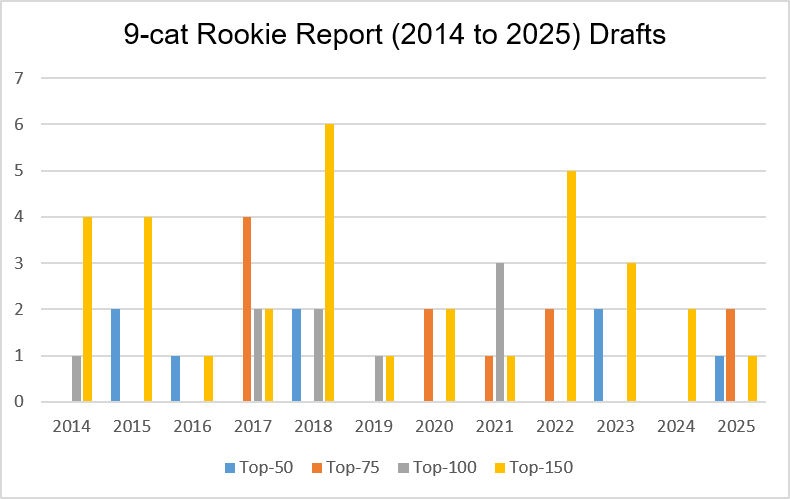
Since 2014, we’ve had an average of five rookies per year ranking in the top-150 and 1.6 rookies in the top-75 in 9-cat. Cooper Flagg, V.J. Edgecombe and Kon Knueppel doubled that upper echelon number last year. Looking back, Flagg’s hype was validated by his 42nd 9-cat rank, but V.J. and Kon reached their outcomes in unorthodox fashion.
Between 2020 and 2025, Victor Wembanyama, Chet Holmgren, Jalen Williams, Walker Kessler, Scottie Barnes, Tyrese Haliburton and LaMelo Ball are the only players who ranked in the top-75 in their rookie season.
Those players fit into three buckets: rim protectors with varying degrees of offensive responsibility (Wemby, Chet, Kessler); offensive engines with high usage rates (Ball and Haliburton); efficient perimeter players who are defensive stats merchants (Jalen and Scottie).
V.J. and Kon simply don’t fit.
For Edgecombe, we need to go back to 2017 to find similar statistical production, when Donovan Mitchell averaged 20.5 points, 3.7 assists, 2.4 threes and 1.5 steals per game. For comparison, V.J. averaged 16.0 points, 4.2 assists, 2.0 threes and 1.4 steals per game. The big difference is that Mitchell was undoubtedly the Jazz’s top offensive option in 2017-18, while Edgecombe had to share the court with Tyrese Maxey, Joel Embiid and Paul George, slotting into a secondary role.
As for Knueppel, he’s the poster boy for the new era in the NBA ushered in by Steph Curry. The Hornets sharpshooter obliterated Keegan Murray’s previous rookie record for most threes made, with 273 threes to Keegan’s 206. He broke the record in his 59th game! Kon ranked 5th in the NBA in threes made per game and he has the best FG% out of everyone ranked in front of him – Stephen Curry, Luka Doncic, LaMelo Ball and Michael Porter Jr. That’s uncharted territory in NBA history.
And then there’s Flagg, who can fit both into the “offensive engine” and “efficient perimeter player” bucket. If you want to roster him in his sophomore season, you’ll need to spend one of your top-two picks.
If we zoom out and look at the top-150 in 9-cat, the 2025 rookie class remains unorthodox. The typical big man archetype of FG%, rebounds and blocks wasn’t present in this range. Dereck Lively, Zach Edey and Kel’el Ware are recent examples of this successful player type, but this year’s best candidate was Ryan Kalkbrenner, who ranked 154th as a result of losing his starting job to Moussa Diabate after a solid start. Instead, we were gifted with the Guard-in-a-Center-body archetype in the top-150 in 9-cat – Derik Queen!
Again, we need to turn back the clock to find a fitting comparison. Alperen Sengun played only 20.7 minutes per game in his rookie season, contributing 9.6 points, 5.4 rebounds, 2.6 assists, 1.7 combined steals + blocks, 47.4 FG% and 71.1 FT%. Queen was a much better fantasy asset due to a bigger opportunity and better efficiency, playing 25.0 minutes per game and posting 11.7 points, 7.1 rebounds, 3.7 assists, 1.9 steals + blocks, 47.3 FG% and 79.5 FT%. Adjusting for minutes played, the similarities are eerie and a good omen for Queen’s sophomore season, as Sengun ranked 83rd in 9-cat the following season.
What happens when we move to 8-cat and get turnovers out of the equation?
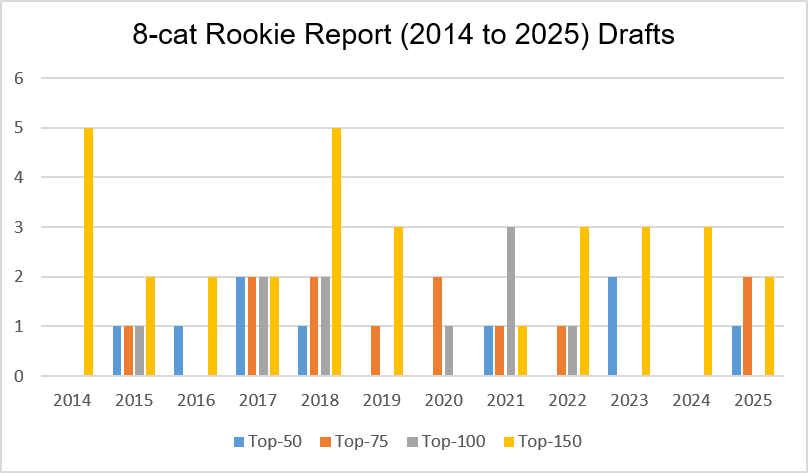
What changes when we look at 8-cat rankings? Both the top-150 and top-75 numbers improve! We get an average of 5.2 top-150 and 1.8 top-75 ranked rookies per year. Typically, those ranking improvements are attached to top-tier rookies with high usage rates. For instance, Paolo Banchero ranked 209th in 9-cat and 136 in 8-cat, Anthony Edwards ranked 118th and 100th, Cade Cunningham ranked 91st and 48th and Luka Doncic ranked 100th and 56th, respectively. Both A.J. Dybantsa’s and Darryn Peterson’s rookie seasons could draw parallels to their fellow top-three picks.
Not to sound like a broken record… but again, the 2025 Draft remains unorthodox. Cedric Coward is the lone rookie who jumped into the top-150 in 8-cat, despite averaging only 1.7 turnovers. His shooting efficiency was stellar for a rookie, posting 47/34/84 shooting splits and providing solid value all over the board with 13.6 points, 1.5 threes, 5.9 rebounds and 2.8 assists. Coward could have been in the Jalen Williams and Scottie Barnes bucket if his defensive stats followed his real-life defensive production. Instead, Coward’s steals and blocks remained on par with his college production, where he had a mediocre 1.9 STL% and 3.7 BLK% in mid-major conferences.
Dylan Harper, who projects to be one of the league’s next great guards, struggled fantasy-wise in his rookie year. Harper ranked 209th in 9-cat and 194th in 8-cat, falling short of our graph by 44 spots. Sophomore Harper will undoubtedly be much higher in our projections, but it leads us to a major point of emphasis that needs to be explored the article.
Perhaps the most valuable piece of information for the 2026 NBA Draft is the steady statistical production of rookie guards. Or should I say, lack thereof. Darius Acuff Jr., Mikel Brown Jr., Keaton Wagler, Kingston Flemings and Brayden Burries are all high-profile guards coming into the league, but the immediate production of Tyrese Haliburton and LaMelo Ball is extremely rare. The common pathway for NBA guards is to struggle with efficiency and turnovers early on, leading to negative value on most fantasy rosters. Last year there was no better example than Jeremiah Fears, who ranked 226th in 9-cat, 170th in 8-cat and 136th if you exclude FG% and FT% from 8-cat rankings.
The Blueprint
Notes:
Data is relative to 9-cat rankings
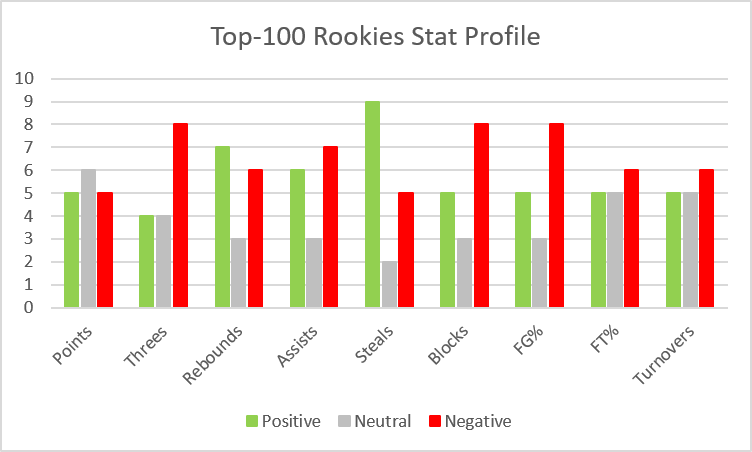
y-axis on graph indicates frequency of positive, negative or neutral Z-score statistical occurrence
Positive Z-score = > 0.2 (green)
Negative Z-score = < -0.2 (red)
Neutral Z-score = < 0.2 and > -0.2 (grey)
Data gathered from Basketball Monster’s per-game rankings.
*Only in 8-cat
**Ranked 101 in 8-cat
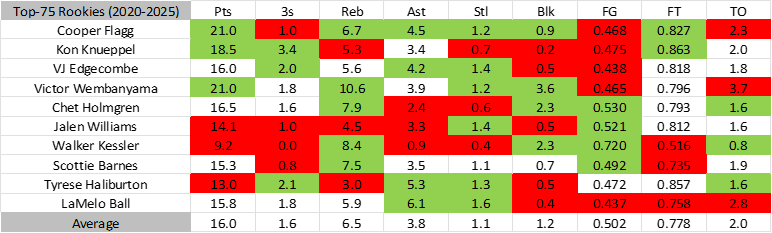
We’ve seen how many rookies we expect to be fantasy relevant and their pathways there, but is there a statistical blueprint to find them?
The easiest starting point is where not to find them. Points, threes and FT% are the categories with the lowest frequency of positive contribution. If we exclude the unorthodox 2025 NBA Draft, points were only positive with Victor Wembanyana, triples with Haliburton and there were no positive FT% contributions from seven different players. The connection to the last paragraph of the History segment is clear – points, threes and FT% are attached to guard production and high-usage players who tend to have a significant negative contribution in percentages and turnovers in their rookie seasons.
Even when looking solely at the assists category, the players with positive contributions tend to be negative in FG% and turnovers. The exception is Tyrese Haliburton, who has a 4.14 assist-to-turnover ratio for his career. To put that number into perspective, these are the career AST/TO ratios of the following Hall-Of-Fame guards: Magic Johnson, 2.48; Steve Nash, 2.54; John Stockton, 3.74; CP3, 3.88. With at least four point guards and six guards taken in the top-10 of the 2026 NBA Draft, it’s important to note that most guards won’t be fantasy relevant in standard leagues. Leave the points, threes, assists and FT% to veterans unless you plan on punting hard.
So which players should we target? The all-around production of Cooper Flagg and elite big man statistical production of Victor Wembanyama and Chet Holmgren yielded top-50 rookie seasons, but their draft day price was right on par with those returns. This year, Cam Boozer slots perfectly into that mold. Out of the nine rookies analyzed, six were positives in at least one of FG% or FT% and more than half were positives in rebounding. The only player who was a clear negative in both percentages was LaMelo Ball. As a prospect, Boozer is heralded for his efficiency and rebounding prowess. In the last 16 years, Boozer is the only college player to post at least a 20% defensive rebounding percentage, 10% offensive rebounding percentage and shoot over 60% on twos, 38% on threes and 78% from the line. And that doesn’t even consider his playmaking, where Boozer is the only player over 6’4’’ to have an assist percentage over 25% and turnover rate lower than 15% since 2010. Boozer’s expected production in rebounding, efficiency and all-around game with low turnovers is the epitome of a great rookie blueprint, but his price will mirror that.
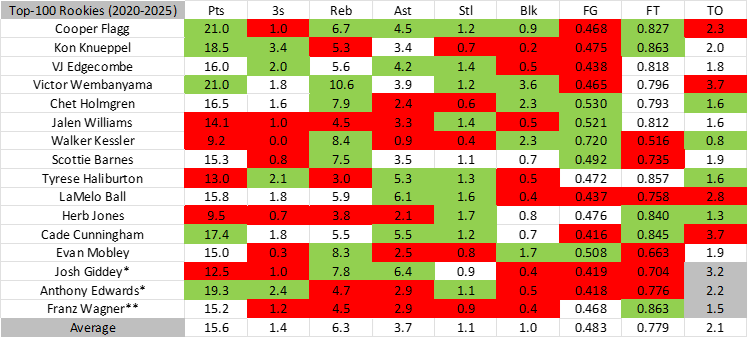
Extending the list to the top-100, we see two very different player styles entering the panorama.
Firstly, there’s the aforementioned top-tier rookies with high usage rates – Cade Cunningham and Anthony Edwards. Darryn Peterson and A.J. Dybantsa could become fantasy relevant following this blueprint, with positive contributions in points, threes and FT% despite the typical high-usage rookie blunders – FG% and turnovers. Typically, this coincides with a higher 8-cat and build-specific value focusing on counting stats.
And then there’s the defensive stats merchants, headlined by Herb Jones and Walker Kessler. Besides lifting the value of the other players in this list, steals and blocks provide an avenue for rookies to be fantasy relevant right of the gate. For next season, Caleb Wilson may be the one driving the defensive stat bandwagon.
The verdict? Target rebounds and defensive stats, fade points, threes and assists and focus on efficient rookies. Position-wise, efficient wings and bigs have a better track-record than guards, with high-usage guards ranking dead last in our rookie target scale. Here’s a cool graph to back it up!
Hits and Misses
Before jumping into our 2026-2027 look-ahead, let’s briefly analyze the glaring hits and misses from last year’s rookie report.
Hits
Cooper Flagg
Projected: Top-50 Upside
Result: 42nd 9-cat rank
V.J. Edgecombe
Projected: Top-100 Upside
Result: 60th 9-cat rank
Ryan Kalkbrenner
Projected: Deep-League Option
Result: 154th 9-cat rank
Misses
Khaman Maluach
Projected: Top-100 Upside
Result: 457th 9-cat rank
Kon Knueppel
Projected: Top-150 Upside
Result: 66th 9-cat rank
Derik Queen
Projected: Honorable Mention
Result: 144th 9-cat rank
2026-27 Look-Ahead
Top-50 Upside
The Rookie Impact Report helps you evaluate first-year players better. Want the full overview? You’ll need to have an Ethos 360, All-Sport or NBA FantasyPass membership. Click here to learn more and sign up!(opens in new tab) Premium Access Required
- About the Author
- Latest Posts

