
 2024 Draft Guide Home
 Go To NBA FantasyPass
 Go To NFL FantasyPass
 Go To MLB FantasyPass
 Go To WagerPass
 Go To DFS Pass
 Bruski 150
SportsEthos 2026 Fantasy Basketball Draft Guide
Fantasy Basketball Draft Guide 2026: Contract-Year UFAs
Last Updated on October 7, 2026 6:07 pm by Mike Passador | Published: September 30, 2026
The logical conclusion to draw from human nature is that when something valuable is on the line, people tend to enhance their performance. Translating to basketball terms, players in contract years should be expected to elevate their play to reap the benefits, be it in the form of a new opportunity or financial gain. But is this real or just an offseason tale?
The NBA has an immeasurable amount of variables for us to simplify the aforementioned performance improvement, but fantasy-wise we can narrow it down to 9-cat rankings and see the big picture. Unfortunately, this doesn’t take into account that the best players usually don’t reach free agency (FA), nor an article like this one, as they’ve signed contract extensions previously. Most of the players we’ll analyze this year and have analyzed in years prior are aging veterans, players on prove-it deals, young players who are still adapting in the league and big expiring contracts. When taking this into account, the results you’ll read here aren’t underwhelming: they’re natural.
That’s why we’ll delve into the past to find the most valuable Contract-Year UFAs for this season. Besides looking at formulas to find the diamonds in the rough, we’ll look for the deep-league sleepers and UFAs to avoid at value.
Bird Rights, named after Larry Bird, allow teams to go over the salary cap to re-sign their own free agents. Those rights are gained when a player plays three seasons for one team. A player’s Bird Rights are lost when a player changes teams via free agency, is waived and unclaimed (aside from the rare situation in which he re-signs with the team that waived him and played three seasons) or has his rights renounced by his team. That means that Bird Rights are retained even if a player is traded. A player with Bird Rights can sign a five-year deal up to the max with his current squad, regardless of what the team’s salary cap situation is.
Early Bird Rights are a lot like regular Bird Rights, only the time frame is condensed to two seasons instead of three. Pretty much all of the same rules apply, with the main difference being the type of contract that Early Bird players can get for their next deal (a two-year minimum with a four-year max, and a maxed out at 175% of a player’s previous salary or 105% of the league average salary, whichever is greater). Luckily there are no Early Bird Rights players who were lining themselves up for a max contract.
Contract-Year UFAs History
This looks at the player’s 9-cat rank in their UFA season, compared to their best rank in the past three or four seasons and their rank “last season,” that is, before their UFA season. The color key below is meant to highlight whether or not the UFA season ranked first, second or third among those criteria.
Player Notes:
Green = UFA season rank > Last 3 or 4 years best rank and Last season rank
Yellow = Last 3 or 4 years best rank > UFA season rank > Last season rank
Red = Last 3 or 4 years best rank and Last season rank > UFA season rank
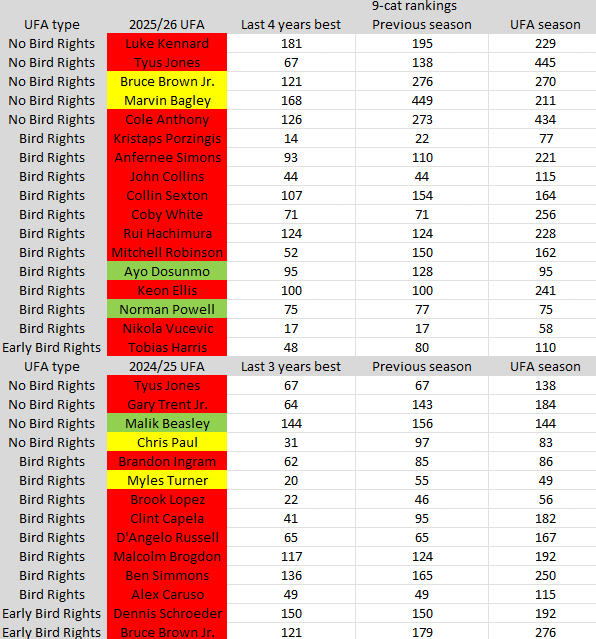
Out of the 31 players analyzed in our last two seasons’ articles, only three had their best season in a three- or four-year span and only seven outproduced their previous season rank in their contract years. That makes for a grim 23% of players who improved their ranks in their UFA contract year, not an ideal scenario to start with.
Will this year be the same? Despite the low hit rate, there are examples of success. That means we need to figure out who might be worth targeting and who should be faded. Let’s look into the players and see who fits the positive mold and who we expect to follow the historical pattern.
No Bird Rights
Nikola Vucevic, Orlando Magic
After several years of consistent fantasy production, Nikola Vucevic lands in Orlando, where he first blossomed as a player, for the veteran minimum.
The Magic have Wendell Carter Jr. locked in as their starting center and Goga Bitadze lurking as the only other true big on the roster. Nevertheless, Vuc fits seamlessly in terms of what the Magic need, bringing in a scoring punch off the bench and the occasional floor-spacing stint with some of Orlando’s creators — Paolo Banchero, Franz Wagner and Desmond Bane. Evidently, that role won’t translate into the fantasy masterpieces that Vucevic has given us throughout his career. His perennial double-double with solid efficiency is not in the realm of possibilities, so we should expect production similar to his tenure with the Celtics last season. Vuc played 21.1 minutes per game and averaged 9.7 points, 6.6 rebounds and 1.1 threes, but his efficiency lagged at a 43.9 FG% and 78.9 FT%. For comparison, since the 2022-23 season, Vuc never dipped below 48.7 FG% and 80.5 FT%, so we could see a positive regression there in Orlando.
As we’ve seen in the list given in the introduction, Father Time is undefeated and Vuc is destined to be another red name in the table. Entering his age-36 season, Vucevic could still provide value as a late-round or deep-league big, especially when WCJ misses time, but we can’t ask for much more.
Andre Drummond, New York Knicks
Want to get access to the 2026-27 SportsEthos Fantasy Basketball Draft Guide and continue reading this article? You’ll need to have an Ethos 360, All-Sport or NBA FantasyPass membership. Click here to learn more and sign up! Premium Access Required
- About the Author
- Latest Posts

