
 2024 Draft Guide Home
 Go To NBA FantasyPass
 Go To NFL FantasyPass
 Go To MLB FantasyPass
 Go To WagerPass
 Go To DFS Pass
 Bruski 150
SportsEthos 2026 Fantasy Basketball Draft Guide
2025-26 Bruski 150 Review
If you're just here for the results, the quick version is that it was another dominant year. But as always, we dig into the details and post everything transparently, because this process is the reason we win and receipts are good for everybody.

Somehow it worked out that this year I am releasing this B150 review right at the precipice of fantasy hoops draft season. So you guys are catching me in the adrenaline portion of the program!
Aside from being knee-deep in this upcoming B150 release, everything going on with the website and our new tools and offerings – this is a moment for all of us to celebrate over here.
When we started this operation back in 2016, the goal was to help build a stronger fantasy sports industry. We believed serious fantasy content needed a sustainable foundation, and advertising alone was never going to support the level of work, talent and coverage we wanted to provide.
So we built around a much simpler idea: create premium content worth paying for, earn the trust of the people using it, and reinvest that support back into making the product better. The Bruski 150 was at the center of that from the beginning, and ten years later that philosophy matters more than ever.
The way people discover and consume sports content has changed dramatically. Social platforms and algorithms now determine an enormous amount of what gets seen, and Twitter, YouTube and other platforms can be incredibly useful for reaching people. But building an entire business around chasing those algorithms is a very different proposition. Reach can disappear overnight, algorithms change, and revenue rarely follows attention at the same rate. Across sports media, we continue to see talented people lose jobs while more and more content competes for the same pieces of attention.
That doesn’t mean the opportunity is disappearing, though. In many ways, it means the opportunity is getting bigger, because when everyone is fighting for another impression, another click or another few seconds of attention, genuinely valuable work has an opportunity to stand apart.
That is where our focus has always been. Our job is to keep producing work people genuinely value, and that requires more than simply creating more content because an algorithm rewards volume. It means investing in great analysts, innovating, using advanced tools, building strong processes, working professionally, being accountable for the results and constantly looking for ways to improve. It also means doing the work that people never see, because premium content only works as a model if the product actually earns that premium.
Social platforms matter, and we absolutely want to succeed on them, but we view them as distribution rather than the foundation of what we do. The product is the work, and the relationship we build directly with the people who trust that work is what gives us the ability to keep improving it.
Few things represent that philosophy better than the Bruski 150. The annual Bruski 150 review is one of the most important parts of my process because it forces me to put everything under the microscope. What worked? What didn’t? Where was I right? Where was I wrong? What can be improved? The results obviously matter, but so does showing the work behind them. That transparency and accountability are a big part of why people continue to trust the Bruski 150, and they are also why this review is so important to everything that comes next.
By the time you’re reading this, I’ve already completed my review of the entire league and moved deep into the final stages of producing this season’s Bruski 150. Everything we learned last season is already being put back into the next one, and that same cycle applies across SportsEthos. Every dollar we’ve earned through our premium products has helped us continue investing in the people, analysis, website, tools and technology behind them. We want to keep making SportsEthos more useful and we have more coming that speaks directly to the core of the fantasy sports experience: better tools, better information and better ways to make decisions.
Ultimately, that is what all of this is supposed to help you do: figure it out and, of course, win. Ten years after we started, the goal is still the same: build something valuable enough to last, keep making it better, and leave the fantasy sports industry stronger than we found it.
Thank you for taking the time to read and for being a part of this great journey of ours called SportsEthos.
Now let's look at the damn results!
General Results
Aside from a second-straight and fifth lifetime FSWA Writer of the Year nomination, it was another dominant season. We have always judged the ranks against my old friends at RotoWorld because of their history within this industry and it's also a big signal that reaches a lot of people. And it was another rankings win, pushing that record up to an undefeated 11–0 over the last decade+. The margin of victory was right around what it has always been but interestingly they only had a general rankings set, not split into separate eight and nine category ranks. Assuming a proper shift in values, the data doesn't really move too much but it's not ideal. I will need to think over how I do this going forward but that's a next year issue.
The big story was how dominant the nine category rankings were and when you adjust for impact of a given ranking the B150 played like a 66 to 70% advantage.
On the ground I had another NFBKC Main Event win, four overall cashes, and the best overall regular season record in 30-DEEP.
That's good for three titles and 11 cashes in the last three seasons.
Early in drafts we made a lot of our runs on Donovan Mitchell and Scottie Barnes. From there we had a cluster of players including one of my favorite calls of the past few years, Desmond Bane, who became a fade for many in Orlando and early in the season he was also an acquirable Buy Low monster. They needed what he had and everything else was gonna move around that injuries or not.
Then some usual suspects dropped by in Trey Murphy and Derrick White, who became boring and very valuable. This was a season where just good old-fashioned solid rankings brought back some huge values. In a deeper leagues Nickeil Alexander-Walker was a league winner rather than WWPOY.
And then so many of my classic B150 plays hit with Collin Gillespie completely off the radar landing as a fourth-round play, Reed Sheppard somehow besting the market with what I would call an easy rank and one of my favorites in Neemias Queta jumping half the board.
Hell, we even had old friend Julian Champagnie appropriately ranked ahead of everybody last season for a classic half/almost full draft jump and I thought I was really fading him down at 200.
Also, as usual, there was one big miss and this year it was Adem Bona taking the first half of the season to become playable and Joel Embiid somehow surviving and even thriving after a truly brutal start, only to succumb to the injuries again. Jordan Poole's rank kills me because I didn't even like him but I just couldn't see total career implosion against what should have been an easy rotation to do well in.
It felt like the rest of my misses hurt me in my own competitions more than the board as a whole. I didn't enter the season as huge fans of Zach LaVine or Christian Braun or even Herb Jones, who I have always had high in ranks because the numbers and this methodology take you there. They just had clear paths to the numbers if they didn't implode and Braun got really hurt and I should've known better to impute more Kangz into my thinking there.
Coby White getting clobbered by the calf injuries hurt me in a lot of spots so hopefully you were able to dodge some of these. I had Trae Young high in eight cat and that's a smoke em if you got em situation. Like a lot of us, I got hit by the Josh Giddey and Steph Curry buzzkills.
Overall, my sense was that a ton of mid round picks went our way based solely on having sound structural analysis. Not the spectacular take but the more workmanlike stuff where roles and production were just easy. We hit on 60% of the top 50 in 9-cat formats. In the aggregate rankings, it was a 52-58% margin between eight and nine cat and then using the methodology below to assess impact that's where the real strength of the Bruski 150 kicks in. After impact ratings these ranking wins play more like 66-70%. I highly encourage you to get all nerdy in the methodology sections below.
Of course, I tip my cap to RotoWorld for doing better than most out there. They are a market leader and have had several tremendous analysts. They are a great benchmark for so many different reasons.
In the end, this is where we want to be year after year and then within this baseline we have two out of every five seasons that climb even higher. Last year, we won 54-55% of the time straight up and the impact rating played like 68-78%. This felt true as last season was as big of a tidal wave as I've seen in high stakes action and it actually felt like it was a down season. So I guess I'm still chasing the proverbial big wave🏄♂️.
Now, let's get deeper into the analysis!
Get the ranks that have dominated
the fantasy basketball industry for over a decade.

The Bruski 150 Evaluation Process
In a truly grueling and inane exercise, we look at the Bruski 150 to find out how we did in a few different lights but ultimately come up with some easy head-to-head analysis of the B150 ranks vs. Rotoworld's ranks (*Note: As mentioned in the open, they only had general ranks without a differentiation between 8- and 9-cat, we're just living with this for this season and reviewing how to assess next season). We also attempt to add some deeper meaning and value to the analysis by weighting ranking wins and losses by the impact they have, which has both qualitative and quantitative evaluations. In each of these ranking analysis I welcome anybody to offer a counterpoint, but the key for making this fair and worthwhile is to be brutally honest with the assessments (which also keeps me well on the side of fair so I can just let this fly and know it's legit).
What we’re looking to determine is which rank was the smarter rank, accounting for the totality of the situation.
The first and broadest analysis is a rank-by-rank assessment which determines an overall record between the two sites. After all, each of the ranks matter in some context so zooming out to see what the aggregate win-loss records are is a good way to show an overall strength of ranks. It also keeps a few good or bad ranks from swinging the analysis.
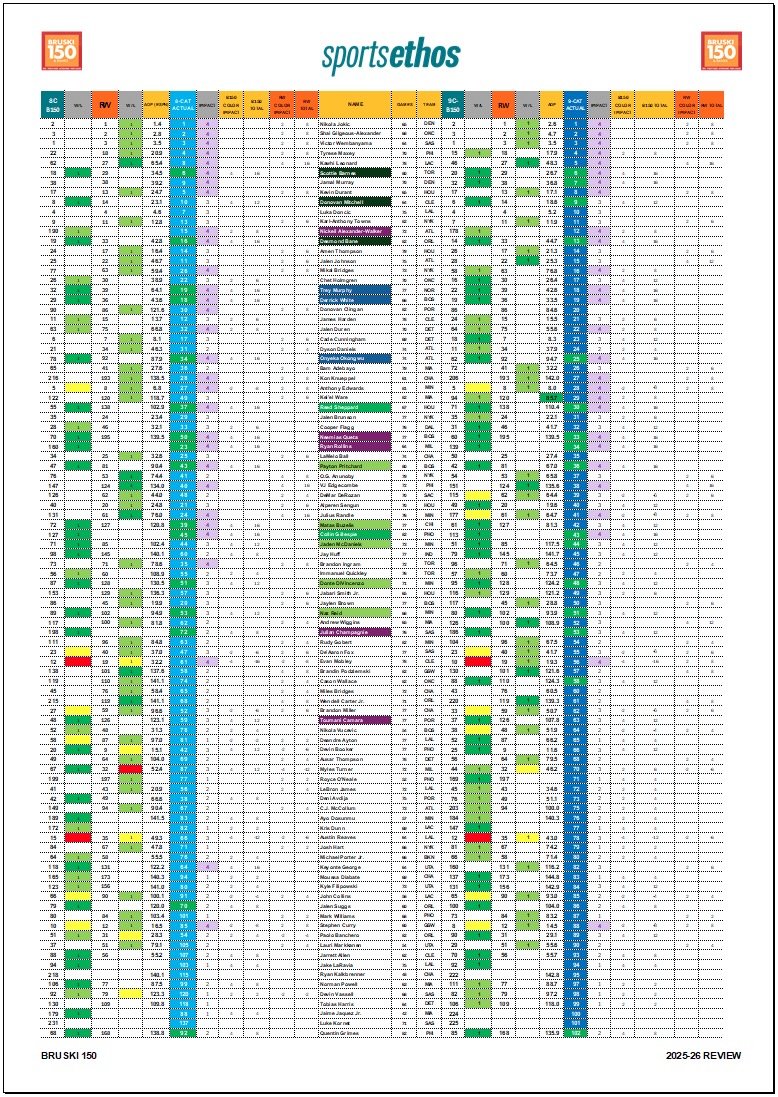
Then we look at the ranks while accounting for how important a given prediction was. First we do this by assigning an impact rating. Then when looking at the ranks in relation to ADP, we’re looking for how likely or unlikely was a site’s followers to get the good (or bad) pick, which we end displaying on the graphic below by color (it's just easier to read that way). Therefore, we call that the color rating.
We multiply the impact rating with the color rating to create a spectrum of outcomes that are a dart throw at emulating year-long profit and loss scenarios, which are the essence of preseason rankings.
So in summary:
• Head-to-Head win/loss totals for the aggregate picture
• Impact Ratings give a more quantitative weighting for predictions and Color Ratings allow for ADP, rank differences and common sense to create a qualitative rating for predictions.
• To create this Impact Score we have a simple scoring system that multiplies these two ratings together and then aggregates the data set
Diving Deeper Into the Evaluation
COLOR RATINGS
The color schemes are:
• Dark Green (massive win involving a player that performed very well relative to ADP and/or the other site, easily had opportunity to draft/avoid that player)
• Green (a general rankings win, better positioned to draft or miss a player who over/under performed, when evaluating both sites and ADP)
• Yellow (painful loss, rankings prediction put drafters in likely position to move the needle backward with their team)
• Red (brutal loss, rankings prediction hurt drafters in significant ways, missing the mark badly when chance wasn’t a factor)
Another way to look at it might be:
• Dark Green (you did a real good thing)
• Green (you beat the other site/ADP in a way that wasn’t totally negligible)
• Yellow (your rank moved the needle backwards for squads)
• Red (you did a real bad thing)
How they get scored:
• Dark Green (+4)
• Green (+2)
• No Color (1)
• Yellow (-2)
• Red (-4)
Not all prediction wins are created equally. Some are dumb luck and have massive impact, which isn’t the sign of a good prediction, and other great predictions have smaller impacts but deserve more credit. If there was an uncontrollable event not tied to obvious injury risk, that may not get an assessment. In cases where a player without known injury risk is performing as a win and then bad luck hits, nine times out of 10 that's going to result in a win for the better predictor there (rather than strict allegiance to final rank).
On this front we want to look at the nature of injuries. Were they something that we could have known about? Were they factored into the draft situation as a risk-reward play? If a player got extremely lucky due to unforeseen injuries ahead of him, we’re not trying to reward or punish predictions as much as we would a prediction that’s based on known variables — one that reflects greater understanding of stat sets, usage rates and the like.
Mix that all up and then everything gets weighed out in context, but at its core these color ranks are measuring how much gain and loss occurred in terms of pure value.
Each rank and evaluation is given the type of scrutiny you’d want to have if you could turn back time and do it all over again.
As we go further down in the draft, when player values start to bunch up, the grading loosens up a tiny bit and color grades won’t reward mild differences. At the same time a sleeper that can crawl up into early round value would get rated as a high impact.
Again, the key to this is to be brutally harsh with myself and give my competition benefit of the doubt when evaluating these predictions.
It’s entirely possible I have screwed up on a piece of logic in an example in an attempt to be expedient. I’m pretty sure any shifting results will be within a reasonable margin of error and not take away from the findings.
If you see anything hugely off, just let me know and I'm happy to make adjustments.
IMPACT ANALYSIS
The impact analysis seeks to determine whether the prediction put the drafter in the position for a gain, avoid a loss and to what degree — and then it aggregates that for the entire prediction set.
As for the impact analysis itself, it is also qualitative to some degree but it does trend toward ‘just the facts.’ It's qualitative in the sense that if a prediction win didn't beat ADP, that's not a very impactful play, which happens when ADP actually wins out (it happens!). From there, we’re measuring how much distance was there between the predictions and the results.
That scale from 1-5 — it’s really just 1-4 as a grade of 5 is for Hall of Fame level needle-movers that occur maybe once in a season if they occur at all. Let's look at the scale:
5: Historical result
4: Prediction leads to extremely important high-end production, or a large number of rounds in the ballpark of a half-draft or greater of increased (or decreased) value for their fantasy GM
3: Prediction leads (or loses) very important high-end production, or results in gaining or losing a significant number of rounds of value (in the 4-8 range depending on how early or late the player in question was drafted)
2: Prediction secures substantial increased (or decreased) value for their fantasy GM (2-4 rounds worth of value dependent upon the facts)
1: A basic head-to-head win that doesn't meet the criteria above is a 1
No players from the last two years received the fabled ‘5.’ Only one player got a 5 a few seasons ago and that was James Harden who nearly lapped the entire field in 8-cat.
Finally, Here are the Receipts
***CLICK THE IMAGE TO CHECK IT OUT***
You made it this far ... now get the ranks that have dominated
the fantasy basketball industry for over a decade.
- About the Author
- Latest Posts

I’m a father, husband and friend. Also, a high stakes fantasy basketball player and I’ve been working in fantasy sports since the turn of the century. Before founding SportsEthos, I spent nearly a decade at Rotoworld building their NBA operation, where we won the FSGA award for Best News and Analysis Site regularly. I cut my teeth in the reporting world at ProBasketballTalk.com on the Kings relocation story, developing sources in Sacramento and throughout the NBA. I’ve won two FSWA Basketball Writer of the Year awards and been nominated four times. I started SportsEthos to help this industry evolve so content producers can have some long-term security and customers can get a better product.