
-
 September 12, 2026, 2:43 pm
Last Updated on September 12, 2026 2:43 pm by Paul Williamson | Published: September 12, 2026
With the prevalence of analytics in baseball, fans have become more effective evaluators of what constitutes a “good” pitcher, with many using stats from strikeout to walk ratio, to FIP, SIERA and xERA, to fastball velocity. Even just a layman’s glance at the colors of the bubbles on a savant page gives fans a solid idea of whether a pitcher is effective, beyond results based stats themselves, equating the luck of a pitcher to the disparity between his expected stats and ERA. The idea being, anyone can fluke a good ERA for a few weeks, but over the course of a full season and beyond, the analytics always win.
Until now.
The National League Cy Young race looks to be largely set, with frontrunner Jacob Misiorowski blazing triple digit heat towards an MLB leading 1.97 ERA, 0.79 WHIP and 38.3% strikeout rate. 2024 winner Chris Sale appears to be the likely runner up, owning outstanding peripherals and a 2.10 ERA, good for second in the league. Beyond that, a field of Cristopher Sanchez, Michael King, Jesus Luzardo, Yoshinobu Yamamoto, Nolan McLean and Chase Burns figure to earn some plaudits for great seasons with strong underlying data, but there is one pitcher with an ERA better than all of them who bucks the trend, sporting plenty of blue savant circles, a 92 MPH fastball and a 4.32 xERA to his 2.55 ERA over 173 IP.
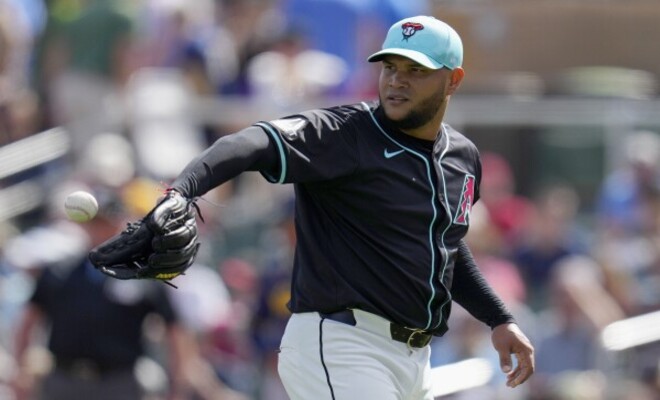
Eduardo Rodriguez started his 2026 off better than just about any pitcher in the world, pitching Venezuela to their first ever World Baseball Classic title, including his brilliant 1-run performance against the United states in the final. The sentiment towards that outing was one of American disappointment that their lineup of galacticos was so easily handled by a pitcher who posted an ERA over five in each of the last two seasons, but as the season progressed, his performances appeared like less of an aberration and more of a legitimate improvement.
Still, under the hood, Rodriguez was running well below league average strikeout and walk rates, giving him a 4.49 xFIP and a 5.12 xERA through the first half of the season. He still made the All Star team thanks to his 2.29 ERA, but the common opinion among fans and analysts was to chalk his ERA up to luck, implying or outright stating that his numbers would balloon in the second half.
Well, it’s September, and they haven’t ballooned. His second half ERA now sits at 3.05; heavily skewed by a 2.2 IP outing against the Cardinals, and still very strong regardless. Interestingly, his peripherals have improved quite a bit, holding a 3.14 xERA and 3.06 FIP (although a 4.21 xFIP), yet he still is overperforming those numbers. On the surface, this appears to be a case of riding good luck into good performances-it’s not unheard of, having a pitcher experience good results for the first time in a while, and building off of that confidence to improve the performances to a point where the results become sustainable-this appears to be at least partially applicable for Rodriguez.
The still bloated xFIP number can be attributed to his finesse/pop up heavy style, as xFIP normalizes HR/FB rate, essentially saying that every pitcher will give up home runs at the same rate as each other relative to fly balls allowed. Certain pitchers, generally soft-tossing finesse pitchers like Rodriguez, routinely overperform xFIP, making it worth disregarding in his case.
So, what improved to turn these peripherals around? As mentioned before, the improvement in strikeout and walk rates is there, but relatively minor. His quality of contact numbers have improved starkly, however. E-Rod’s 9.6% barrel and 37.2% hard hit rates against him in the first half have been blown out of the water by his 3.3% barrel rate and 25% hard hit rate against in the second half. His strand rate (percentage of runner that reach base but do not score, generally regarded as a luck based statistic) was an ballooned 87.8% in the first half, and fell to a sustainable 75.2% in the second. Still, his second half peripheral gains do not completely explain his incredible performance until the break, but there is one controversial statistical area that does.
Leverage stats are controversial in that they are presumed by many to normalize over larger sample sizes; naturally, single season leverage stats operate on much smaller sample sizes than more traditional splits, like left/right or home/away. There is also a philosophical element, in the belief that every player is fully locked in and trying their best all the time, thus making any added adrenaline from a big spot irrelevant, but that isn’t how every player works, and Rodriguez appears to be part of that unique bracket that dispels that idea. To mitigate the small sample that leverage stats operate on, simply using process based statistics to explain leverage discrepancies is more reliable than face stats, and huge surface and beneath surface discrepancies exist with him.
Rodriguez’s season FIP with the bases empty is 4.21 and his xERA 4.97. With runners on- 3.20 and 3.58. With runners in scoring posiion- 2.39 and 2.72. With RISP, his barrel rate against drops to 4.5%, and his strikeout rate spikes to 23.8%. Interestingly, his walk rate climbs to 9.5% with RISP, which offers a great insight into why his strikeout and damage limitation numbers are so much better.
With runners in scoring position, he nibbles. His shadow zone rate (pitches just on/off the corner) increases by more than 10%, as does his shadow zone swing rate, and he does it with changeups, his best swing and miss pitch, and his best pitch by xwOBA. The trade off is a slight tick up in walk rate, but his precision is able to buy him enough swings to get out of jams, especially because he fills up the strike zone for most of the game. Keep in mind, the same doubt of leverage statistics exists in many front offices and with some managers, so teams have been reluctant to adapt and become more passive with RISP.
His overall better numbers since the break are more attributable to execution than any minor changes in pitch usage, feeding the notion that his improvements are confidence related, and his current levels of peripheral overperformance are far more sustainable than many realize. It is important to note that he is 33 years old, but in the short term, even extending to next year, there’s no reason why E-Rod can’t put up another season of ~3 ERA baseball, which at his volume (close to 200 IP pace) is immensely valuable, both for the Diamondbacks and for fantasy owners.
Don’t treat him like a dynasty castaway; if you like analytics, he’s a statistical outlier who’s able to dial up his best pitches in the biggest spots to mitigate damage. If you don’t: he’s got that dog in him, and that should be enough to take a flyer on a guy who almost everyone has written off as having a fluke season, when in reality, it isn’t a fluke at all.
Click here to join us on Discord!
And Follow us on Twitter by clicking here
Join the SportsEthos team by filling out an application by clicking here
Follow Nathan at @nbakerngb- About the Author
- Latest Posts

 MLB FantasyPass Homepage
 Go To NBA FantasyPass
 Go To NFL FantasyPass
 Go to MLB 2025 Draft Guide
 Go To WagerPass
 Go To DFS Pass
Working the wire
Fantasy Baseball streamers
Anthony's “Week in Review”
Paul's “Call to the Pen”
Weekly FAAB Pickups
Blurb feed
Buying, Selling/Rising, Falling
Larry's Weather Report
Who's Hot, Who's Not
Nathan's Player Profile
Prospect Hot Sheet
Dynasty Breakdowns
Williamson 300
AK Dynasty 300
Top 100 Prospects Update
Go To DFS Pass
Working the wire
Fantasy Baseball streamers
Anthony's “Week in Review”
Paul's “Call to the Pen”
Weekly FAAB Pickups
Blurb feed
Buying, Selling/Rising, Falling
Larry's Weather Report
Who's Hot, Who's Not
Nathan's Player Profile
Prospect Hot Sheet
Dynasty Breakdowns
Williamson 300
AK Dynasty 300
Top 100 Prospects Update