
 2024 Draft Guide Home
 Go To NBA FantasyPass
 Go To NFL FantasyPass
 Go To MLB FantasyPass
 Go To WagerPass
 Go To DFS Pass
 Bruski 150
SportsEthos 2026 Fantasy Basketball Draft Guide
Fantasy Basketball Draft Guide 2026: Second Half Sensations
Last Updated on September 14, 2026 11:22 am by Mike Passador | Published: September 14, 2026
Every season we get a collection of players who climb up the rankings over the course of the campaign, and a few who make a notable surge right in time for the fantasy playoffs. Recency bias has a powerful pull and while many managers who are fantasy basketball obsessed can resist the urge to buy into a big spike in production, it’s hard to fight the good fight against the power of the entire draft market out there. Whether it’s due to a new set of teammates, a greater role or genuine personal improvement, those players who rise to the occasion down the stretch tend to get some kind of bump in next season’s drafts. The final run of games after the All-Star break is a perfect environment for this kind of thing as rosters get shaken up and organizational priorities shift, allowing players to take on new roles that could highlight their abilities.
Development isn’t necessarily linear and someone delivering a huge stretch of production doesn’t guarantee that they’ve found a new baseline, however. There are many, many examples in recent history of Second Half Sensations turning back into pumpkins for next opening night. It’s important to suss out what’s what and figure out what may be able to carry over into next season, and that’s what we’re going to try and do here. We pulled the most intriguing climbers who might have a shot at keeping the gravy train on the tracks.
Yes, this is called “Second Half Sensations,” but for our purposes, we’re not going to be bound by the strict definition of “half.” Our halves are going to be pre- and post-All-Star break. Going around the trade deadline would give us the cleanest break for a lot of players who landed on new teams, but the All-Star game was a week after the wheeling and dealing, and should eliminate a few of those early post-trade contests when lineups were incomplete and rotations were being juggled on the fly.
We also did not pull every name who made a massive leap. While there are dozens of players who rocketed up the board, we’re going to bypass the guys whose circumstances are too easy to explain — Jalen Green jumped a bunch but he barely played in the first half so that’s just free money; players like Rayan Rupert, Olivier-Maxence Prosper, Javon Small, Taylor Hendricks (that’s a lot of Grizzlies), Kobe Brown and EJ Liddell all got their numbers thanks to tanking; someone like Kyle Filipowski has done this before but finds himself on a new-look roster that has severely blocked his path to playing time. Even someone like Toumani Camara, whose late rise can be attributed entirely to his steals coming back with no other big changes to his game, doesn’t warrant too close of a look. We’re also going to skip past someone like Maxime Raynaud, whose rise was so obviously tied to injuries around him that there’s not much meat on the bone in terms of analysis.
Let’s get into it, with everyone slotted neatly into a handy table where you can see first-half, second-half and total per-game value. You’ll want the total number since that’s what people who aren’t deep-diving will see when they do their own research.
| Player | Second Half Games | First Half Per-Game | Second Half Per-Game | Full Season Per-Game |
| Matas Buzelis | 22 | 90 | 46 | 74 |
| Gui Santos | 24 | 302 | 107 | 265 |
| Jalen Duren | 26 | 48 | 16 | 32 |
| Donovan Clingan | 25 | 52 | 17 | 36 |
| Cameron Johnson | 23 | 179 | 67 | 131 |
| Paul Reed | 27 | 234 | 116 | 200 |
| Ty Jerome | 9 | 26 | 51 | 38 |
| Keon Ellis | 25 | 273 | 129 | 241 |
| Jakob Poeltl | 24 | 188 | 73 | 127 |
| Collin Murray-Boyles | 14 | 181 | 132 | 184 |
| Dylan Harper | 26 | 224 | 135 | 209 |
| Nique Clifford | 23 | 341 | 162 | 328 |
| Leonard Miller | 25 | 493 | 137 | 330 |
| Reed Sheppard | 29 | 104 | 34 | 71 |
| Baylor Scheierman | 28 | 330 | 226 | 327 |

| Season | Team | GP | GS | MPG | FGM | FGA | FG% | FTM | FTA | FT% | 3PTM | 3PTA | 3PT% | PTS | REB | AST | STL | BLK | TO |
|---|---|---|---|---|---|---|---|---|---|---|---|---|---|---|---|---|---|---|---|
| 26-27 | CHI | 2 | 2 | 21.0 | 2.0 | 8.5 | 23.5 | 8.0 | 10.0 | 80.0 | 0.0 | 4.0 | 0.0 | 12.0 | 5.5 | 1.5 | 0.0 | 1.5 | 2.5 |
First Half Stats: 28.3 mpg | 15.2 points | 5.4 rebounds | 2.1 assists | 0.6 steals | 1.5 blocks | 2.1 3-pointers | 0..474 FG% | 0.778 FT% | 1.9 turnovers
Second Half Stats: 31.5 mpg | 19.0 points | 6.9 rebounds | 2.0 assists | 0.9 steals | 1.6 blocks | 2.4 3-pointers | 0.443 FG% | 0.800 FT% | 2.5 turnovers
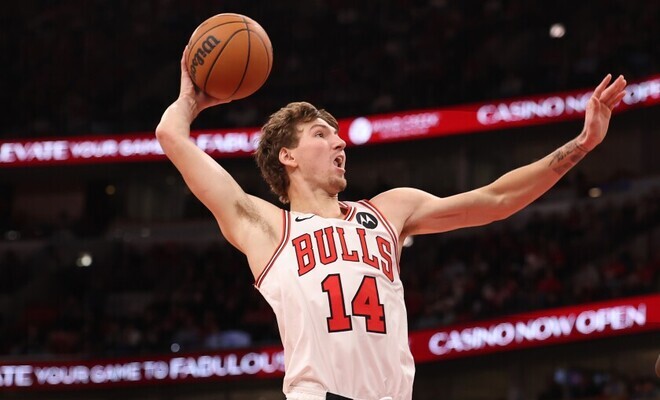
For the second season in a row, Buzelis found another level to his game after the All-Star break. Whereas his rookie season saw the Bulls comfortably in a Play-In spot despite not being very good, this time Chicago was more clearly committed to a rebuilding path that saw them plummet from the Play-In fringe. Fantasy GMs had big expectations for Buzelis after that strong finish to his rookie campaign and the ADP reflected as much. It wasn’t a good result for managers who bought at the absolute peak but we all saw Buzelis’ upside on display over his final 22 outings. Even at his most inconsistent, Buzelis provided value by virtue of regular contributions in blocks, points, 3-pointers and rebounds, but after the break he kicked it into high gear.
Want to see the full breakdown of Matas Buzelis and the rest of last year’s Second Half Sensations? You’ll need to have an Ethos 360, All-Sport or NBA FantasyPass membership. Click here to learn more and sign up! Premium Access Required
- About the Author
- Latest Posts

Mike graduated from Boston University’s Dual Degree Program with a BA in Economics and a BS in Business with Concentrations in Marketing and Operations Management. He is a faithful supporter of Toronto sports and the Detroit Lions and is always ready to be let down. Tweet to him @Mike_Pandador, but if you badmouth Jose Calderon you might get blocked.
