
 2024 Draft Guide Home
 Go To NBA FantasyPass
 Go To NFL FantasyPass
 Go To MLB FantasyPass
 Go To WagerPass
 Go To DFS Pass
 Bruski 150
SportsEthos 2026 Fantasy Basketball Draft Guide
Fantasy Basketball Draft Guide 2026: Best Ball & Weekly Trends
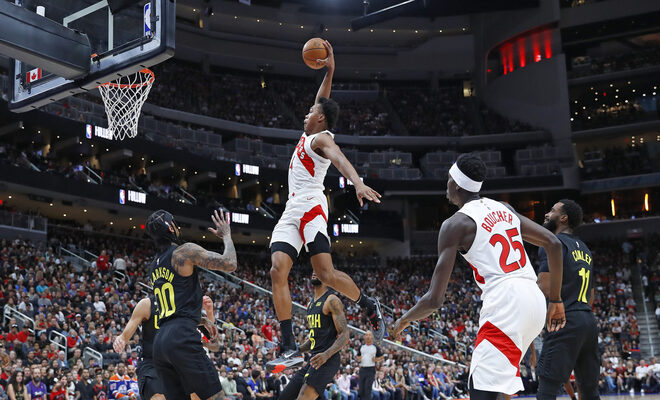
Despite the main target audience of this piece being anyone interested in Best Ball, the broader scope of “weekly variance” should still be interesting for the average fantasy manager. If you are trying to think about this through a 9-cat lens, you may have to take the precise valuations with a grain of salt since Best Ball is generally based off of a points-league scoring system, but again, the idea is to observe how performances varied on a week-to-week basis throughout the 2025-26 season.
For Best Ball (and other fantasy managers), this piece should allow you to observe the volatility or consistency of certain players or positional groups, with notes on how to approach the derived data and how things may change in 2026-27.
TABLE LAYOUT
All of the information discussed will be derived from a massive table of data, so before we dig in, I want to ensure that everything is easy to understand.
Player Name
As indicated, it is the name of each player (shocking!).
These may be adjusted slightly to match the source of the larger pool of statistical data, instead of the name on certain Best Ball platforms.
For example, Nate Williams, who formerly went by Jeenathan Williams Jr., may be the most stark example, as the source data still uses his old name.
In other cases, it might be a “Jr.” or an “II” or “III” that is included on the Best Ball platform, but isn’t included in the source data, or vice versa.
Best Ball Position
Underdog Best Ball uses the following positions:
Guard – Usually PGs + SGs, but some SG/SF players sneak in.
Wing – Usually SFs + PFs but some SG/SF players qualify and some PF/C players also qualify). This creates an incongruent blend of players under the same umbrella, since there are cases of “true” guards, power forwards and bigs all being labeled as wings.
Big – Almost always Cs, but there may be some PF/C exceptions.
Note: This is specifically taken from the Underdog Best Ball platform. Other platforms may label the positions of some players differently or have different positional groupings entirely.
Position Rank (Per Game)
The player’s rank combined from their overall per-game production throughout the season and their position (Guard, Wing, Big).
That is, the best-ranked player per game for each position.
Position Rank (Totals)
The player’s rank combined from their total production throughout the season and their position (Guard, Wing, Big).
That is, the best-ranked player for each position based on their total production.
Season Per-Game FPTs
Average Fantasy Points on a game-to-game basis.
Carefully note that this formula uses the default Yahoo Points League system, which is generally the standard points-scoring format for most platforms, including Underdog Best Ball. There may be variations, but this is meant to be a generalized study of week-to-week variance under the most common umbrella.
Formula: Points + (1.2 x Rebounds) + (1.5 x Assists) + (3 x Steals) + (3 x Blocks) – Turnovers.
Season Total FPTs
All Fantasy Points scored by a player.
Formula: Average FPTs per game x Games Played.
Total Games
The number of games the player appeared in throughout the entire season.
#1 Position Weeks
The number of weeks when a player was the top total points producer within their specific Best Ball Position (Guard, Wing, Big).
That is a combination of games played in a particular week and the fantasy points produced per game.
Best Ball Starter-Level Weeks
Typical Best Ball has 16-man rosters, which include 10 bench spots and starting spots of 2xGuard, 2xWing, 1xBig and 1xUTIL for six total spots across 12 teams.
This equates to 6 ×12 = 72 starting slots from a 192-player pool.
Note that there will be variations in terms of league size, overall player pool and starting spots, but this is meant to account for general trends.
If players are equally distributed across all teams, then the top-72 performers each would be the starters. This is unlikely, but it gives us more of a “guaranteed-to-be-a-starter picture” compared to trying to approximate which of the stragglers could sneak in.
Top-120 Weeks for H2H
This is a little throw-in for H2H managers.
Since a standard league is usually 12 teams with 10 starting spots, that equals 120 starters in a weekly setting.
This is useful insight for Weekly Lineup leagues, but also gives us a look into the general variance of weekly performances for H2H, even if you play in the more common Daily Lineups league type.
DNP Weeks (Did Not Play)
All the weeks when a player failed to appear in a single game for any reason.
That may be due to injuries or other circumstances.
Weekly Groupings
Week 1-25 Overall Rank: Individual rank among all players that week (via total fantasy points that week). If a player did not play, they are given a default rank of 600.
Week 1-25 FPTs: Total Fantasy Points scored that week.
Week 1-25 Position Rank: Individual rank in a particular week for specific Best Ball positions of Guard, Wing or Big, based off total fantasy points that week.
Schedule Note: Many fantasy basketball platforms combine both sides of the All-Star Break into one week, making the fantasy basketball season lasts 24 weeks. If any of the NBA Cup Knockout weeks are also combined, that might turn the 25-week NBA schedule into a 23-week fantasy season.
NAVIGATION TIPS
Use FILTER BY POSITION or FIND PLAYER by typing into the rectangular box alongside it. If you type Guard, then only players with the Guard position will be shown. If a player happens to have the same letter sequence as a position (Guard, Wing, Big) then they may inadvertently show up in the search as well.
If you type “Wembanyama” instead, only Victor Wembanyama’s data will be shown, allowing you to easily find any player you are looking for or performances you may be interested in.
SORT by using the little triangles/arrows on the header of the table, which are labeled the same as the table layout explored in the previous section.
PREVIEW NOTES
582 players appeared in a game last season, distributed between 257 Guards, 215 Wings and 110 Bigs based on the assigned Best Ball positions.
293 players had at least one Starter-Level Best Ball (Top-72) Week.
377 players had at least one Top-120 Week.
490 players had at least one DNP Week.
That means 92 players played at least once in every week of the regular season.
35 players had a #1 Position Week for Best Ball.
2025-26 Season
Weekly Best Ball Data
Want to get access to the 2026-27 SportsEthos Fantasy Basketball Draft Guide and continue reading this Best Ball & Weekly Trends Review? You’ll need to have an Ethos 360, All-Sport or NBA FantasyPass membership. Click here to learn more and sign up!(opens in new tab) Premium Access Required
- About the Author
- Latest Posts

Keston majored in Biology and minored in Literatures in English at the University of the West Indies (U.W.I.), St. Augustine. Hailing from Trinidad & Tobago, Kes grew up loving cricket, then football (soccer, not NFL) & never missed a Barça game in the 2010s. Later on, he grew obsessed with basketball/fantasy basketball & unfortunately claims to be a Sixers fan for some reason.