
-
 May 21, 2026, 3:06 pm
Last Updated on August 7, 2026 9:27 am by André Lemos | Published: May 21, 2026
The Celtics were prepared to take a temporary step back and spent the summer operating like a team trying to get its house in order. Their old championship core was basically cut in half and Boston looked in no rush to get Jayson Tatum back. It was a season for learning and experimentation… until it wasn’t.
How’d It Go?
Boston decided to pivot a bit with knowledge that Jayson Tatum would miss most, if not the entirety of the season after tearing his Achilles in the playoffs. In an effort to clean up the cap sheet, the Celtics waved goodbye to Kristaps Porzingis, Jrue Holiday and Al Horford, bringing back Anfernee Simons (and his expiring contract) and some light draft capital. The phrase “gap year” was a common refrain as the Celtics were destined for a temporary step back; this season was all about positioning themselves for another run when Tatum was healthy, gaining some financial flexibility while getting a real look at what the rest of the squad might be capable of in larger role.
Center was the weak spot on the depth chart as the Celtics lost their two veterans and were prepared to let Neemias Queta, Chris Boucher, Luka Garza, Xavier Tillman and Amari Williams battle it out. The power forward spot was a little better but still up for grabs with Sam Hauser, Josh Minott and Jordan Walsh competing for space, while Baylor Scheierman and rookie Hugo Gonzalez were presented with a legitimate opportunity to find time on the wing. Sorting out those battles to better assess the fit when the Celtics returned to full strength was the name of the game, and if Boston could gain some more assets along the way, even better.
That was the plan, but the Celtics kept winning. Tatum’s absence was supposed to make them a fringe playoff squad but they kept winning and winning and winning some more, eventually landing second in the Eastern Conference. Jaylen Brown thrived as the top dog — more on him shortly — and delivered a tremendous season that made him a down-ballot MVP candidate. Derrick White was predictably excellent despite a weak shooting season and Queta was a revelation as the team’s new starting center. Payton Pritchard was just as comfortable starting as he was coming off the bench, and he returned to his familiar sixth man role down the stretch when it was clear that the Celtics were good enough to ready themselves for Tatum’s return.
The deadline saw Boston flip Simons, who was a valuable shooter at times but a weak fit in general, to Chicago for the expiring contract of Nikola Vucevic. That added some real veteran mettle and scoring punch to a center group that was solid but a little one-dimensional, all at low cost.
The Celtics were riding high when Tatum returned to the floor in March. He had a month to shake off the rust and gear up for what suddenly looked like a deep playoff run. Boston avoided the gap year entirely and looked positioned to be a real threat to win the Eastern Conference, between their infallible system and Tatum’s fresh legs. Everything looked to be going according to plan as Boston took a 3-1 lead in their first-round series with the Sixers, but the 3-pointers stopped dropping and the Celtics had no answers for Joel Embiid, even at less than full strength. Vucevic ended up as a DNP-CD in Game 7, which Tatum sat out with knee soreness, and the Celtics’ all-vibes season went up in smoke in a week. While you can probably say a first-round exit is a strong showing for this group in the big picture given the initial expectations and the cast of characters, there is no way that any organization will be happy with a 3-1 playoff collapse.
It was a wild ride and a smashing success of a season… until it wasn’t.
Coaching
Joe Mazzulla could’ve changed the program to adapt to a depleted roster but him holding the entire team to the same standard resulted in a fantastic season, despite its conclusion. Mazzulla got more than expected out of this version of the team and was able to get career years out of players up and down the depth chart, notably Jaylen Brown — and the Celtics actually fared better statistically when Brown wasn’t on the floor. The team’s reliance on the 3-pointer is a feature, not a bug, and the roster has been built to play that way no matter who is or isn’t available.
Mazzulla tried a few different options up front to varying degrees of success and with the way things ended up heading into the playoffs, it looked a lot like the coach knew what he had in his back pocket and spent the first half of the season seeing if Josh Minott or Jordan Walsh could be a winning ingredient in crunch time. Keeping Pritchard as a starter over Simons, only to put Pritchard back on the bench down the stretch also felt pretty intentional in terms of prioritizing long-term intel for the Celtics. While the playoff collapse is a mark against him, getting this bunch to the second seed is a point in Mazzulla’s favor, and the degree to which the Celtics didn’t skip a beat despite all the turnover speaks to his qualities as a leader and tone-setter for the group.
If there is one point of contention it would be that first-round loss to Philly, as Mazzulla’s largest adjustments only came in Game 7 when Ron Harper Jr. and Hugo Gonzalez were introduced — and did not have the desired impact. While Mazzulla was quick to turn away from his new ideas when they weren’t working, testing out entirely new lineups in Game 7 is probably not where you want to find yourself as a head coach. That said, Mazzulla will surely get Coach of the Year votes and will continue to be treated as one of the best in the business, this year’s playoff failings aside.
The Players
 Jaylen BrownSG, Philadelphia Sixers
Season Team GP GS MPG FGM FGA FG% FTM FTA FT% 3PTM 3PTA 3PT% PTS REB AST STL BLK TO 26-27 PHI 1 1 35.0 7.0 14.0 50.0 3.0 4.0 75.0 2.0 4.0 50.0 19.0 8.0 6.0 1.0 1.0 2.0 25-26 BOS 71 71 34.4 10.4 21.7 47.7 6.0 7.5 79.5 2.0 5.7 34.7 28.7 6.9 5.1 1.0 0.4 3.6 24-25 BOS 63 63 34.3 8.2 17.7 46.3 3.9 5.1 76.4 1.8 5.7 32.4 22.2 5.8 4.5 1.2 0.3 2.6 ADP: 28.8 / 19.9 (Yahoo/ESPN) | Total Value: 20/50 (8/9-cat) | Per-Game Value: 29/62 (8/9-cat)
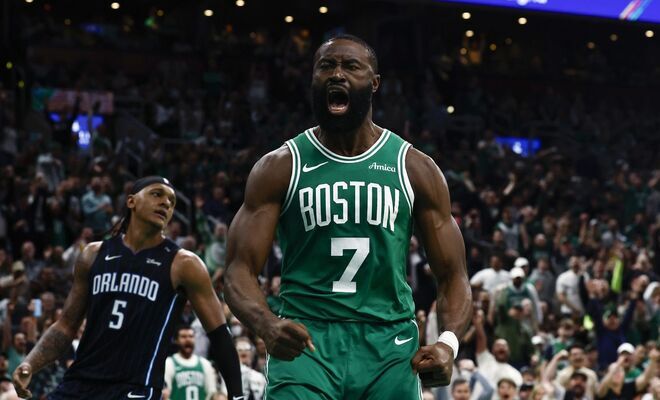
Never one to turn down extra motivation, Brown took it personally that people were counting the Celtics out in the absence of Jayson Tatum. He wore a huge chip on his shoulder (even after Boston’s elimination) all season long and put up a career year with new personal bests in points, assists and free throw percentage as the team’s primary offensive option. The concern coming into the season was the Brown getting tons of extra usage wouldn’t actually help him under the hood, as he only had so many more points to score given his previous levels while carrying major downside risk as an FG% drag. The efficiency was the key here and he ended up boosting his shooting percentage despite an additional four attempts per game. There was a month in the middle of the season when Brown’s shooting dipped and he was just a top-90 player, but that was well worth the trouble given everything else Brown provided. Now, Brown being less than a true booster of FG% meant that he fell short of his ADP, but this could’ve gone much, much worse. The big hesitation with Brown this year was that the expectation of additional counting stats would wipe out any room for profit at the draft table and that’s kind of what we got, though at the end of the day this was basically a best-case scenario.
The playoffs were a different beast as Brown struggled to meet the same standards as the regular season, having particular trouble shaking the cover of Paul George. Brown also drew attention for the wrong reasons after getting eliminated as he immediately went online to complain about Philadelphia’s flopping (in a major hypocritical move) and the officiating of the first round. He also had his words twisted a bit when he said that this was his favorite season to date — Brown enjoyed watching the young players step up and Tatum return from adversity while posting a big individual season, but saying that your best individual season that ended in a first-round exit was your favorite (when you have a Finals MVP at home) was never going to be read charitably. Speculation has started about Brown’s relationship with the organization so we could be in for an interesting summer.
 Derrick WhiteSG, Boston Celtics
Season Team GP GS MPG FGM FGA FG% FTM FTA FT% 3PTM 3PTA 3PT% PTS REB AST STL BLK TO 26-27 BOS 1 1 36.0 7.0 13.0 53.8 0.0 0.0 0.0 3.0 7.0 42.9 17.0 1.0 8.0 1.0 0.0 4.0 25-26 BOS 77 77 34.1 5.7 14.4 39.4 2.4 2.6 90.2 2.7 8.3 32.7 16.5 4.4 5.4 1.1 1.3 1.7 24-25 BOS 76 76 33.9 5.6 12.6 44.2 1.8 2.1 83.9 3.5 9.1 38.4 16.4 4.5 4.8 0.9 1.1 1.7 ADP: 33.5 / 43.6 (Yahoo/ESPN) | Total Value: 18/19 (8/9-cat) | Per-Game Value: 44/30 (8/9-cat)
One of the most well-rounded players in the league and perhaps its best role player, White took over the reins in the backcourt this year with Jrue Holiday traded away. Holiday wasn’t exactly blocking White from big usage, but it gave him more time on the ball and the absence of Jayson Tatum opened up more shots for everyone else. The result was a career year from White, who was a certified fantasy monster even despite a dreadful shooting performance. New career-highs in points, assists, steals, blocks and free throw percentage were enough to compensate for his brutal FG%, though you can’t help but wonder where White would’ve finished if he shot better from the field — or even just from beyond the arc (.327). One frightening aspect is that White was actually better before the All-Star break when he shot worse, as more volume led to a difference of about three points per game, not to mention White blocking an absurd 1.4 shots per contest prior to the break (“just” 1.0 after). The slowdown after resulted in top-50 value compared to top-30, so it wasn’t the end of the world, but managers were getting elite value for the first half of the season.
The rare PG who is actually better when you account for turnovers, White was money all season long. What looked like an early shooting slump proved to be the new normal but other than that, White was a force across the box score while shouldering a heavy burden in his new role. With his value supported by an elite foundation thanks to his defense, White’s gains in the offensive department fueled him to a great fantasy campaign.
Jayson TatumSF, Boston CelticsSeason Team GP GS MPG FGM FGA FG% FTM FTA FT% 3PTM 3PTA 3PT% PTS REB AST STL BLK TO 26-27 BOS 1 1 38.0 6.0 23.0 26.1 1.0 1.0 100.0 0.0 7.0 0.0 13.0 4.0 11.0 0.0 0.0 2.0 25-26 BOS 16 16 32.6 7.4 17.9 41.1 4.1 4.9 82.3 2.9 8.9 32.9 21.8 10.0 5.3 1.4 0.2 2.4 24-25 BOS 72 72 36.4 9.2 20.3 45.2 5.0 6.1 81.4 3.5 10.1 34.3 26.8 8.7 6.0 1.1 0.5 2.9 ADP: N/A / N/A (Yahoo/ESPN) | Total Value: 329/327 (8/9-cat) | Per-Game Value: 24/26 (8/9-cat)
After tearing his Achilles in the second round of last year’s playoffs, it felt like a sure thing that Tatum would miss the entire 2025-26 campaign. Watching Boston trade away Jrue Holiday and Kristaps Porzingis only hardened those feelings and common sense suggested that the Celtics would give Tatum the full season to recover and get ready for next year. The remaining Celtics continued to win, however, and when it became clear that the playoffs were not only attainable but a sure thing, you could start to wonder about a possible return. With the team in position for a legitimate playoff run, Tatum was able set sights on this year and get through his rehab without a ton of pressure. It wasn’t always smooth as there were conflicting reports about whether he planned to come back, but ultimately he got back on the floor in March and didn’t have any real restrictions. Tatum played a low of 26:46 in his 16 games and was up to 39:45 in his final appearance of the regular season.
There was rust to deal with and Tatum didn’t quite have his legs for a couple of weeks, resulting in a .411 mark from the field. He was under .500 from the floor in each of his first 10 games back, going .383 on 17.5 shots per game, but that still wasn’t enough to keep him from top-25 value. Unfortunately for him, Tatum missed Game 7 vs. the Sixers with left knee stiffness and was powerless to stop Boston’s embarrassing postseason collapse. Despite that sour end, Tatum looked far closer to his usual self than anticipated coming off a significant injury. We don’t see why fantasy managers would have any reservations about him going forward.
Neemias QuetaC, Boston CelticsSeason Team GP GS MPG FGM FGA FG% FTM FTA FT% 3PTM 3PTA 3PT% PTS REB AST STL BLK TO 26-27 BOS 1 0 22.0 1.0 3.0 33.3 1.0 2.0 50.0 0.0 0.0 0.0 3.0 4.0 2.0 1.0 2.0 1.0 25-26 BOS 76 75 25.3 4.3 6.6 65.3 1.6 2.3 70.3 0.0 0.1 12.5 10.2 8.4 1.7 0.8 1.3 1.0 24-25 BOS 62 6 13.9 2.1 3.3 65.0 0.7 1.0 75.4 0.0 0.0 0.0 5.0 3.8 0.7 0.3 0.7 0.6 ADP: 139.5 / 139.5 (Yahoo/ESPN) | Total Value: 50/33 (8/9-cat) | Per-Game Value: 96/68 (8/9-cat)
This is just a sneak peek of the Season Wrap. The entire roster is covered, as well as the Fantasy Star, Letdown, One to Watch and One Burning Question for this team. You’ll need to have an Ethos 360, All-Sport or NBA FantasyPass membership. Click here to learn more and sign up! Premium Access Required
📢 Want More? 📢
📡 Download the SportsEthos App to get real-time alerts and updates:
Get the SportsEthos App (iOS App Store) Get the SportsEthos App (Google Play)
 Follow us on Twitter: @EthosFantasyNBA
Follow us on Bluesky: @ethosfantasynba.bsky.social🏆 Join our premium community built on integrity, competition, and winning. Let’s crush this season together.
Get the NBA FantasyPass!Join the SportsEthos team! Fill out an application by clicking here!
- About the Author
- Latest Posts

Mike graduated from Boston University’s Dual Degree Program with a BA in Economics and a BS in Business with Concentrations in Marketing and Operations Management. He is a faithful supporter of Toronto sports and the Detroit Lions and is always ready to be let down. Tweet to him @Mike_Pandador, but if you badmouth Jose Calderon you might get blocked.
 NBA FantasyPass HomePage
 Go to 2025 NBA Draft Guide
 Go To NFL FantasyPass
 Go To MLB FantasyPass
 Go To WagerPass
 Go To DFS Pass
 In-season Bruski 150
Blurb Feed
Live Injury Report
Discord
ROS Projections/Rankings
The Layup Line
Pickups of the Night
Daily Projections
Working The Wire
The Week Ahead
Buy Low/Sell High
H2H Matchup Breakdown
Trade Analyzer
My Team Breakdown
Weekly Projections
Depth Charts
Streaming Schedule
Schedule Grid
Dynasty Rankings
Dynasty Check-In
In-season Bruski 150
Blurb Feed
Live Injury Report
Discord
ROS Projections/Rankings
The Layup Line
Pickups of the Night
Daily Projections
Working The Wire
The Week Ahead
Buy Low/Sell High
H2H Matchup Breakdown
Trade Analyzer
My Team Breakdown
Weekly Projections
Depth Charts
Streaming Schedule
Schedule Grid
Dynasty Rankings
Dynasty Check-In
