FIBA Women’s World Cup 2026 Semifinals Recap +…

One team has reached its first World Cup Final. Another survived the kind of semifinal that exposed exactly where it can be hurt.

France overwhelmed Germany with a defense that turned every possession into work. USA had to solve Spain deep into the fourth quarter before finally finding enough answers.

Now the tournament has one day left: Spain and Germany for bronze, then France and USA for the world title.

Game Report

France’s Defense Overwhelms Germany and Sends Les Bleues to a Historic World Cup Final

France 86, Germany 64

For the first time in their history, France are going to a World Cup Final.

Germany gave the hosts plenty to think about early. It found success with 45 cuts, used Nyara Sabally as a play initiator and repeatedly searched for creative ways to manipulate France’s aggressive defense. Through one quarter, only two points separated the teams.

From there, France made basketball increasingly difficult. Passes that normally feel routine became contested, post catches moved farther from the basket and pick-and-roll reads came under pressure from multiple directions. Germany remained close enough to threaten into the second half, but 25 turnovers eventually became impossible to survive.

France turned those mistakes into 29 points and pulled away for an 86-64 win, with Gabby Williams setting the tone for one of the most disruptive defensive performances of the tournament.

Germany finds answers early, Williams sets the standard

Williams needed only one possession to announce herself, opening the semifinal with a trademark steal and three.

France’s pressure was immediate. It picked Germany up aggressively and built an 8-2 lead in less than two minutes, but Germany responded with some of the offensive intelligence that had carried it this far.

The hosts attacked France’s positioning with 45 cuts and used Sabally as a creator rather than simply a finisher. Germany also went to inverted pick-and-rolls, searching for ways to force French defenders into uncomfortable assignments and get its bigger players involved in initiating offense.

There were openings. France’s pick-and-roll defense allowed Germany to reach the paint at times, and the Germans were moving the defense well enough to produce a 7-2 response.

What Germany did not always do was recognize the next advantage quickly enough. Mismatches appeared without being consistently punished, and France’s recovery speed meant those opportunities rarely remained available for long.

Williams was everywhere, finishing the opening quarter with seven points, three rebounds, two assists and two steals as France took a 25-23 lead. Germany was competing well, but had already committed five turnovers.

France starts making every possession expensive

The second quarter was where the pressure began accumulating.

Germany scored only three points across the opening three-plus minutes before a well-designed baseline out-of-bounds action freed Leonie Fiebich for three. Sabally continued giving Germany a useful alternative as an initiator, including an action built around a flat ball screen that allowed her to attack with her right hand.

But Germany was having to work exceptionally hard.

France pushed post touches farther from the basket and attacked Germany’s switching defense at the other end, deliberately hunting matchups involving Frieda Bühner and Emily Sontag. Williams repeatedly attacked Sontag in space, while Marine Johannès began finding her own scoring opportunities out of the pick-and-roll.

Germany’s turnover count reached 12 by halftime, already exceeding its tournament average of 9.8 per game. France converted those mistakes into 18 points.

That became the central tension of the semifinal. Germany was not without solutions, but too many possessions were ending before those solutions could fully develop.

Johannès pushed France’s advantage to nine midway through the quarter, and although Sabally answered with an and-one after the timeout, France continued to control where Germany was receiving the ball and how difficult the next decision became. The Germans also left points at the line, shooting 7-of-13 on free throws before halftime.

France led 45-38, in what had already become the second-highest scoring semifinal in World Cup history.

The French defense becomes a nightmare

France opened the third quarter with a 7-0 run to establish its first double-digit advantage.

Germany briefly changed the picture with a 2-3 zone and then generated a 7-0 response of its own behind Sabally, cutting back into the margin. France also helped with several offensive fouls and went more than four minutes without a field goal, but Germany could not fully exploit the opening.

France’s defense kept shrinking the available space. When Germany found a mismatch, France was willing to send help after the dribble rather than allow the isolation to develop cleanly. Off the ball, defenders sat in gaps and challenged passing lanes. Even when Germany generated good perimeter looks, the process required an enormous amount of work.

One possession captured the problem particularly well: Germany found Johannès matched onto Bühner and never managed to properly exploit it before the opportunity disappeared. France was making the Germans process everything faster than they wanted to.

A 5-0 French burst restored a 13-point lead late in the quarter, while Germany finished the period 4-of-15 from the field with eight turnovers. By then, the offensive difficulty had become the defining feature of the game.

Germany makes one last push

Germany still had a run left.

Bühner opened the fourth with a well-designed score, and the hosts started the quarter 5-0 to pull within nine. Carla Leite immediately answered with a three, but Germany kept coming.

Emily Bessoir’s three cut the deficit back to nine with 5:43 remaining. From that point, however, France closed the door.

Williams continued beating defenders off the dribble. Germany tried searching for high-low opportunities, but France’s length made entries difficult. When Bessoir was left on Johannès, France immediately attacked the matchup rather than allowing Germany to hide it.

Dominique Malonga, shaky during her first stint, then produced an excellent two-minute stretch with four points, an offensive rebound and a block. Johannès supplied the final blow with a three at 2:35 that pushed France ahead by 17, and Germany did not score again over the final 4:23.

France closed on a 17-4 run.

France makes history through defense

Germany finished with 25 turnovers, the most ever committed in a Women’s World Cup semifinal, and France turned them into 29 points. Eleven came directly from French steals.

Those numbers capture the night better than almost anything else.

Germany did find things that worked. Its cutting hurt France early, Sabally was effective initiating offense and the hosts repeatedly demonstrated why they had reached this stage for the first time. For much of the game, they were close enough that France could never simply relax.

But France made sustaining good offense almost impossible.

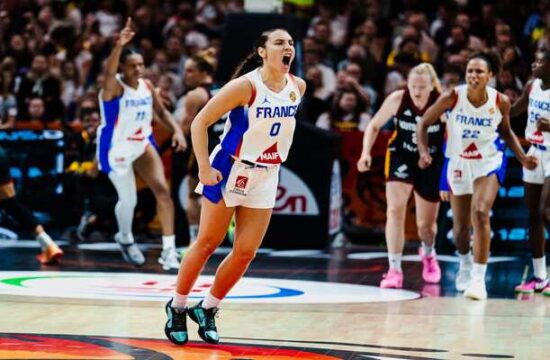
Williams was magnificent with 22 points, five rebounds, five assists and four steals, combining elite creation with the defensive activity that defined the game. Janelle Salaün added 14 points and 11 rebounds, while Johannès scored 13 points and supplied the shot that effectively ended Germany’s final resistance.

For Germany, Marie Gülich finished with 12 points and 10 rebounds, Sabally scored 12, and Fiebich added nine points, eight rebounds and four assists.

Germany’s historic run ends one game short of the Final, but it took the hosts deeper into this tournament than they had ever been before. France goes one step further.

One of these teams was always going to play in the first World Cup Final in its history. Germany had the home crowd, the tactical variety and enough stretches of quality to make the possibility feel real, but France had a defense that simply would not let go.

Now, for the first time, Les Bleues will play for a world championship.

Game Report

USA Survives Spain’s Half-Court Test and Advances 76-66

USA 76, Spain 66

Spain gave USA exactly the kind of game it wanted to avoid. It slowed the pace, made the Americans defend through multiple actions and repeatedly found ways to stress USA’s half-court defense. At the other end, Spain kept one of the tournament’s most talented offenses from consistently creating clean advantages.

After three quarters, the game was tied at 58. USA finally found the difference in the fourth, with Breanna Stewart raising her impact on both ends, the Americans attacking favorable matchups more deliberately and their defensive intensity forcing Spain into poorer decisions.

The 76-66 win sends USA through, but this was far from comfortable. Spain showed there are real ways to make the defending champions vulnerable.

Spain gets the game it wants

Spain started with Raquel Carrera and Awa Fam together, leaving Megan Gustafson on the bench, and immediately imposed its preferred tempo. A 5-0 opening became 9-1 before Chelsea Gray hit an important three to settle USA.

Spain’s offense was generating quality looks, particularly when the Americans lost track of actions away from the ball. Defensive breakdowns around screens repeatedly opened clean opportunities, while USA struggled to create similar advantages through its own structure. Aliyah Boston’s presence inside became especially important because she gave the Americans a direct source of offense when the perimeter actions stalled.

Spain controlled most of the quarter before three consecutive turnovers changed the game late. USA produced an 11-0 run, while Spain scored only two points over the final 4:20.

That stretch flipped the quarter completely. USA led 21-18 after one despite Spain shooting 6-of-10 on twos, with seven turnovers proving far too costly.

Spain keeps forcing USA to work

USA’s bench brought better defensive intensity in the second quarter and made fewer mistakes away from the ball, but Spain continued to keep the game under control.

Iyana Martín hit an important off-balance three to keep the deficit manageable, while empty-side pick-and-roll became one of Spain’s most useful actions, particularly when it flowed into it early before USA’s defense was fully organized. The action repeatedly created penetration and forced help.

Spain also mixed in a 2-3 zone, including on sideline out-of-bounds possessions, while USA experimented with Paige Bueckers at point guard for several minutes. Caitlin Clark played only 5:56 in the first half.

The biggest statistical difference came at the free-throw line. USA attempted 27 free throws before halftime, making 19, while Spain went just 3-of-4. That allowed the Americans to lead despite Spain shooting considerably better from the field, 15-of-34 compared with USA’s 9-of-26.

Spain cut the margin to two late before USA reached halftime ahead 39-36.

Spain finds the zone, USA finds Stewart

The third quarter became the most interesting tactical stretch of the game.

The teams initially traded threes, with Spain making three to USA’s one and briefly taking the lead. Napheesa Collier answered with a mid-range jumper that started a 7-0 American run and restored a six-point advantage.

USA then began deliberately involving Gustafson in pick-and-roll, testing her ability to defend in space. Spain responded by using more Horns alignments with Fam and Gustafson, while its guards continued finding success getting downhill.

Two missed Fam layups at the rim stood out as opportunities Spain may look back on, particularly in a game with so little separation. Yet Spain’s defense prevented those misses from turning into a larger American run, even while its own offense went more than four minutes without scoring.

The 2-3 zone then changed the quarter. Spain used it partly to protect Gustafson, but it also completely disrupted USA’s offense for a stretch. The Americans failed to score against the coverage, and Spain answered with a 7-0 run to tie the game at 58 with 1:32 remaining.

Spain won the quarter 22-19, leaving the semifinal completely open entering the fourth.

USA finally identifies the right advantages

Spain returned to man-to-man in the fourth, and USA immediately looked more decisive. The Americans opened 4-0 before Spain finally scored with 7:46 remaining, while Stewart became increasingly influential on both sides of the floor.

Martín picked up her fourth foul with 6:24 remaining, and USA began identifying mismatches earlier in possessions. Instead of allowing actions to drift, the Americans attacked Martín and Maite Cazorla on the block and became more deliberate about creating favorable matchups.

Spain still found some offense through María Conde, who scored four straight, but its decision-making began to deteriorate. Five fourth-quarter turnovers repeatedly stopped possessions before they could develop, while USA’s defensive intensity rose at the same time.

Jackie Young’s mid-range jumper pushed the lead back to 10 with 2:33 remaining and forced another Spanish timeout. Spain went to full-court pressure with 1:12 left, but by then the game had moved beyond reach.

USA won the fourth 18-8 and closed out the victory.

Spain exposed problems, USA found the finish

This was not USA at its most convincing, but it was enough.

The clearest statistical separation came at the free-throw line, where USA went 27-of-35 and Spain finished an efficient 10-of-11. The difference was not accuracy but access: USA attempted 24 more free throws, providing a major source of offense in a game where the teams otherwise produced relatively similar statistical profiles.

For Spain, Iyana Martín and María Conde scored 17 points each, combining for 34 of the team’s 66.

For USA, Breanna Stewart was the player who steadied the game when it mattered most. She finished with 16 points and six rebounds, while her defense and composure helped USA take control of the fourth quarter.

Spain pushed the defending champions deep into the game.

USA still found the finish.

Final + Bronze Preview

FIBA Women’s World Cup 2026 Final + Bronze Medal Preview

One game for history. One game for one last medal.

France will play for its first-ever world title, but standing in the way is the defending champion USA. Before that, Spain and Germany get another opportunity to leave the tournament with something tangible, meeting for bronze in a rematch of the opening game of the World Cup.

Spain dominated that first meeting. Germany has changed considerably since then.

France has arguably played the best basketball of the tournament. USA still has the deepest collection of talent in the field and arrives undefeated.

There is one day left.

Two medals still to decide.

Spain vs Germany

Last chance at a medal

Germany and Spain began their World Cups against one another.

Now they will end them the same way.

Spain won that opening matchup 83-53, but the score requires context. The Spaniards shot a remarkable 17-of-30 from three, while Germany was still trying to establish the version of itself that eventually reached the semifinals.

Germany has improved substantially since then.

Its offense has become increasingly comfortable using its bigs as initiators, not simply finishers. Nyara Sabally, Frieda Bühner and Germany’s other frontcourt pieces can facilitate actions, screen, handle and force defenses to make decisions away from the basket. That could put real pressure on Spain’s bigger lineups, particularly if Germany can make those defenders navigate repeated screens and defend in space.

Spain should want a very different game.

The Spaniards are at their best when they can control possessions, work through multiple actions and force the defense to guard for the full clock. Germany is dangerous when it can play faster and attack before the defense is fully established, so Spain’s transition defense will matter enormously.

The other tactical question is how Germany chooses to defend.

If it switches heavily, Spain has enough intelligence and size to search for favorable matchups rather than simply accepting the first shot available. We have already seen Spain punish teams when they overreact to its first action. The key will be whether it can identify the mismatch quickly enough and continue moving the defense rather than settling.

Turnovers could become another major swing factor.

Germany entered the semifinal as one of the best teams in the tournament at protecting the ball, then committed 25 turnovers against France. Spain ranks second in opponent turnover percentage and has enough length and activity across the perimeter to create similar discomfort.

That does not mean Germany suddenly has a turnover problem. France’s defense was exceptional. But Spain will certainly have noticed how much harder Germany’s offense became once passing windows narrowed and possessions started deeper in the clock.

The first meeting should not define this one.

Spain’s shooting that day was extraordinary. Germany is a better and more complete team now. Both are coming off semifinal losses and have to reset quickly for a game where the reward is still significant.

This should be much closer than the opener.

And after everything both teams have done to reach this point, one of them gets to leave with a World Cup medal.

USA vs France

Is it all in the head?

This is the game everyone wanted.

Two undefeated teams. The defending champions against the team trying to become world champions for the first time.

USA wants to retain the title.

France wants history.

Through much of this tournament, France has looked like the more complete basketball team. Its defense has been disruptive without becoming reckless, its half-court offense has produced clean looks through coordinated actions, and its shooting has punished almost every defensive choice opponents have made.

The question is whether France can play the same way when the opponent is USA.

That is where the title becomes more than tactical.

USA carries a different kind of weight in international basketball. Teams can know they have the talent, the game plan and the form to compete, yet still feel the pressure of what that jersey represents once the game starts to tighten.

France cannot play the reputation.

It has to play the team.

And if it does, there is very little in this tournament suggesting the French should approach the Final as anything other than a legitimate threat to win it.

Both sides are comfortable playing fast, which makes the possibility of a track meet very real. USA can overwhelm teams once possessions become open, especially with Caitlin Clark advancing the ball before defenses can match up. France is equally dangerous running, with athletes capable of turning steals, rebounds and deflections into immediate offense.

But the more interesting battle may come when the game slows down.

France has looked more synchronized in the half court. Its actions flow naturally into one another, the ball rarely stops without purpose, and it has consistently found ways to generate clean shots against different coverages.

USA has not always looked as connected in that environment.

The Americans possess elite individual creation, size and athleticism at every position, but their half-court offense has sometimes become slower and more dependent on individual solutions. Against France, that difference could matter.

The Americans, however, have the personnel to challenge everything France wants to do.

There is size on the perimeter, rim protection behind it and enough defensive versatility to switch, pressure and recover without giving up obvious mismatches. France has solved almost every defensive question placed in front of it so far.

USA can ask harder ones.

That brings us to the final possessions.

If this game is where it should be late, all the broader tactical ideas may eventually reduce to one question: who can create a good shot when everyone knows exactly what is coming?

France has Marine Johannès, Gabby Williams and multiple guards capable of creating something from nothing. USA can turn to Napheesa Collier, Caitlin Clark, Paige Bueckers, Breanna Stewart and an almost absurd amount of individual talent.

There may not be much between them.

France has played well enough to believe.

USA has spent years giving opponents reasons not to.

Now France gets 40 minutes to decide which one matters more.

This article was co-written by the European Hoops Podcast team, André Lemos and João Caeiro. Follow us at @EthosEuroLeague and subscribe to the European Hoops Podcast wherever you listen to your favorite podcasts.

Fantasy MLB Today: The National League Playoff Race…

Nathan Baker discusses the latest injury and prospect promotion news, and how the National League playoff race will shape up over the last two weeks of the MLB season, and its implications on fantasy value for the players involved.

Presented by FanDuel

SUBSCRIBE, Rate and Review on Apple and Spotify!

Follow us on Twitter: @EthosFantasyBB

Follow us on Bluesky: @ethosfantasymlb

Join our Fantasy Sports Discord Server: https://discord.gg/jSwGWSHqaV

Fantasy NBA Today: Sleepers, Busts & Our Guys…

Aaron Bruski and Dr. A continue the Sleepers, Busts & Our Guys series with the 76ers, Warriors and Celtics. They identify their favorite fantasy targets, biggest sleepers and potential busts from each roster while breaking down where the best and worst draft-day values could be hiding.

Presented by FanDuel

Download the SportsEthos App on the APP Store and Google Play!

FantasyPass now includes DAILY PROJECTIONS – perfect for DFS and head-to-head leagues.

Join the Discussion on DISCORD for real-time advice and community support.

Subscribe, Rate, and Review to Fantasy NBA Today on Apple and Spotify for expert updates and tips!

FIBA Women’s World Cup: Quarterfinal Recap + Semifinals…

André Lemos and João Caeiro recap all four FIBA Women’s World Cup quarterfinals before previewing France-Germany and USA-Spain. They break down Germany’s huge victory over Belgium, France’s dominant performance against China, USA’s rout of Hungary and Spain’s win over Australia before examining the matchups that will decide who reaches the World Cup Final.

This episode of the European Hoops Podcast is presented by FanDuel!

Follow the podcast for more EuroBasket previews and European basketball coverage!

Subscribe and rate on Apple and Spotify, and follow @EthosEuroleague on Twitter and Instagram for Euroleague men and Women, FIBA, and Olympics updates all season long!

Follow our team: André Lemos (@andmlemos), Tiago Cordeiro (@tiagoalex2000) and João Caeiro (@JCaeiro_6).

FIBA Women’s World Cup 2026 Semifinals Preview: USA…

Four teams remain, and every possession now carries the weight of a World Cup Final.

France and Germany bring physicality, structure and almost no tactical weaknesses into one semifinal. USA and Spain bring history, contrasting styles and a battle over pace that could decide everything.

Two games will separate contenders from finalists. Here is where each semifinal can be won.

Semifinals Preview

FIBA Women’s World Cup 2026 Semifinals Preview

And then there were four.

France took care of China. Germany, backed by its home crowd, produced the upset of the quarterfinals by sending Belgium home. USA rewrote the record book against Hungary, while Spain handled Australia to keep its medal hopes alive.

Now there is nowhere left to hide.

France and Germany meet in a matchup between two of the most physical and tactically disciplined teams in the tournament. USA and Spain renew one of international basketball’s classic rivalries in a game that could be decided by which team gets to dictate the pace.

Two games. Four medal contenders. Only two places in the World Cup Final.

France vs Germany

The best vs the hosts

France enters the semifinal looking every bit like one of the most complete teams in the competition, but Germany has already shown exactly why playing the hosts in front of their own crowd is such a difficult assignment.

These are two extremely physical teams, but reducing either one to physicality would miss what makes this matchup so interesting. Germany is one of the best-coached teams in the tournament. Its offense is constantly searching for the next advantage, moving from the first action into the next until the defense finally gives something away. It can hurt teams in the half court, but it is also comfortable running when the opportunity appears.

France has similar versatility. Its transition game can overwhelm opponents, yet this is not a team dependent on playing fast. Against China, France repeatedly showed it could execute against a set defense, attack different coverages and generate good shots when the game slowed down.

One of the biggest battles may come before either team even gets into its offense. France has been among the best teams in the competition at forcing turnovers, while Germany has been one of the most secure teams with the ball. If Germany can consistently survive France’s pressure and reach its half-court actions cleanly, the hosts will give themselves a real chance to control long stretches of the game. If France starts creating live-ball mistakes, the game can change very quickly.

Germany also has to find a solution for France’s shooting. The French are hitting 45.7 percent from three in the tournament, an extraordinary number that has made an already difficult offense even harder to defend. Germany has the size and versatility to contest across multiple positions, but France has repeatedly punished teams that collapse too aggressively.

At the other end, Germany’s balance may be its biggest weapon. The hosts can score through their frontcourt, attack mismatches, use their spacing to create driving lanes and move the ball until the defense is forced into a difficult rotation. France has the defensive personnel to challenge all of that, but Germany will test whether it can maintain its physicality without losing the movement and precision that carried it past Belgium.

This feels like a game where there may be very little separating the teams for long stretches. Both can defend, both can play at multiple speeds and both have enough size to survive physically.

France may enter with the slight edge, but Germany has already proven it can beat an elite opponent on this stage.

The details should decide it.

USA vs Spain

A classic international basketball rivalry

USA arrives after a quarterfinal in which almost everything went right. The Americans scored a World Cup-record 108 points against Hungary and turned the game into a track meet almost immediately. Spain’s route was less spectacular but equally convincing, handling Australia and earning another opportunity to test itself against the tournament favorite.

The first question is simple: who decides how this game is played?

USA wants speed. That becomes especially dangerous with Caitlin Clark on the floor, because the Americans do not need a traditional transition opportunity to attack early. Clark can hit a runner ahead of the defense, throw an entry pass before the matchup is established or spray the ball forward even after a made basket. Spain’s transition defense will have to be connected from the moment possession changes.

Spain’s best chance may be to drag the game in the opposite direction.

The more possessions become five-on-five, the more Spain can lean into its execution, ball movement and ability to force USA into longer defensive possessions. The Americans have looked much less comfortable at times when games become slower and their half-court offense has to repeatedly solve a set defense. Spain has enough experience and organization to test that part of USA’s game.

The glass could be just as important as pace.

These are the two best offensive-rebounding teams in the competition, while neither has been particularly dominant on the defensive glass. That creates the possibility of possessions being decided not by the first shot, but by who controls everything that happens afterward. If Spain can keep USA from generating repeated second chances, it removes one of the easiest ways for the Americans to turn athleticism into points. If USA dominates there, Spain may struggle to keep the game in the controlled environment it wants.

Spain also has to survive USA’s pressure without allowing the game to fracture. Against Hungary, the Americans showed how quickly a few mistakes can become a huge run. Spain is far better equipped to handle that pressure, but every live-ball turnover increases the chances of the game becoming exactly what USA wants.

USA should be favored.

But this is not a perfect American team, and Spain has enough experience, discipline and offensive execution to expose the areas where USA can still look vulnerable. If Spain controls the tempo, protects the ball and holds its own on the glass, this can become a real semifinal.

If USA turns it into a race, Spain may spend the night trying to catch up.

This article was co-written by the European Hoops Podcast team, André Lemos and João Caeiro. Follow us at @EthosEuroLeague and subscribe to the European Hoops Podcast wherever you listen to your favorite podcasts.

FIBA Women’s World Cup 2026 Diary: Day 7…

The FIBA Women’s World Cup is down to four teams after a quarterfinal round filled with history, dominant execution and one major upset.

USA rewrote the record book against Hungary, France solved China’s size, Germany knocked out Belgium and Spain overwhelmed a shorthanded Australia.

Now USA, France, Germany and Spain are one win away from the World Cup final.

Game Report

USA Buries Hungary in Transition and Writes More World Cup History

USA 108, Hungary 56

Hungary found decent early answers against USA’s hard-edge pick-and-roll coverage.

They barely mattered.

USA turned mistakes into immediate offense, overwhelmed Hungary before the defense could organize and got a major lift when the second unit raised the pressure and pace. Hungary committed eight first-quarter turnovers, USA shot 14-of-19 from the field, and the quarterfinal was already 36-12 after 10 minutes.

From there, the night became historic: 108 points, the highest total ever in a FIBA Women’s World Cup game, the largest margin in a quarterfinal, and 31 assists, making USA the first team to reach 30 in a World Cup quarterfinal.

Hungary sees the opening, USA takes it away

Hungary’s initial offense was more promising than the score eventually suggested. It attacked USA’s hard-edge pick-and-roll coverage well, forcing the defense to recover and creating shots that were often reasonable even when they did not fall. Hungary also mixed in a 2-3 zone defensively, trying to prevent USA from simply playing downhill possession after possession.

The fundamental problem was access. Hungary could not consistently get the ball to Dorka Juhász or Virág Takács-Kiss in advantageous positions, nor could its guards create enough penetration once USA’s pressure tightened. The Americans, meanwhile, were consistently generating cleaner opportunities.

Aliyah Boston’s back-to-back threes pushed the margin to 26-9, but the shooting was only part of the damage. The second unit changed the defensive intensity and created a much faster game. By the end of the quarter, USA was shooting 79 percent from the field and 3-of-3 from three, leaving Hungary with almost no way to slow the avalanche.

USA turns the game into something Hungary cannot match

Hungary increasingly resorted to perimeter shooting in the second quarter. Many of the looks were acceptable, but the offense had become far too one-dimensional for a team that does not want to live entirely from three. Repeated pick-and-rolls were producing diminishing returns, while USA’s length continued making access to the frontcourt difficult.

Caitlin Clark added another layer whenever the Americans could attack early. She did not need to dominate as a scorer to influence the game. Her ability to hit runners or deliver an entry pass before the defense was set repeatedly created immediate advantages.

There was also a noticeable difference in tempo depending on the American lineup. With the starters, particularly Chelsea Gray initiating, the offense could become slower and feature less movement. The bench groups played faster and with more activity on both ends.

Hungary briefly produced a 5-0 run that forced a USA timeout midway through the quarter, but by halftime the larger picture was brutal. Hungary was shooting 5-of-16 on twos and 6-of-16 from three, while USA had already created a 59-30 lead.

The quarterfinal becomes history

The second half offered little relief. After a relatively balanced opening to the third quarter, USA produced an 8-0 run, Hungary briefly stopped it with a basket from Kinga Józsa-Povits, and the Americans immediately scored four more. Takács-Kiss did not record her first points until 3:16 remained in the period, another reflection of how completely USA had taken away one of Hungary’s most important offensive pieces.

Sonia Citron briefly left after taking a blow to the head in the third quarter but returned in the fourth. With the result already beyond doubt, USA continued finding useful combinations. Clark’s shooting percentages have not been her strongest feature in this tournament, but the offense continues to look significantly better with her ability to advance the ball and connect possessions. Kiki Iriafen and Angel Reese were particularly effective sprinting into space and giving Clark simple, athletic finishing targets.

Hungary managed only nine points in the fourth quarter, including just four across the first six-plus minutes, and USA closed out the 108-56 win without ever allowing the game to regain competitive tension.

USA reaches the semifinals with a statement

USA finished with a 52-16 advantage in points in the paint and converted Hungary’s 27 turnovers into 44 points, while its 31 assists showed how willingly the ball moved once advantages appeared.

Five Americans finished in double figures, led by Napheesa Collier with 19 points and six rebounds. For Hungary, Réka Lelik led the scoring with 12.

Hungary’s run ends after earning its place among the final eight, but USA gave it almost no opportunity to turn the quarterfinal into the kind of physical half-court contest that might have created uncertainty.

The result was not merely another semifinal berth.

It was a World Cup record book rewritten in 40 minutes.

Game Report

France Solves China’s Size and Shoots Its Way Into the Semifinals

France 90, China 61

For 10 minutes, China looked capable of making France uncomfortable.

Shuyu Yang was getting into the paint, Han Xu was giving China an offensive anchor, and the introduction of Zhang Ziyu briefly changed what France could attempt around the basket. China answered an early French run with seven straight points of its own and, despite six first-quarter turnovers, produced perhaps its best stretch of basketball of the tournament.

France led only 25-20.

Then the game began to move away from China.

France’s defense progressively pushed the Chinese offense farther from the areas it wanted to occupy, while its own execution kept producing good shots against both man and zone. China often succeeded in making France shoot over the top rather than finish easily inside.

France simply made the shots.

By halftime the margin was 17. By the end of the third quarter it was 22, and France eventually advanced to the semifinals with a 90-61 win built as much on solving China’s defensive questions as imposing its own.

China gives France an early problem

France announced its defensive intentions immediately.

The full-court pressure produced an eight-second violation on China’s second possession, and Valériane Ayayi drew the initial assignment on Han Xu. A 7-0 French run soon followed, created largely through defensive pressure and poor Chinese possessions, forcing a timeout with 6:02 remaining.

China’s response was excellent.

Yang repeatedly found ways to penetrate the first line of the defense, and China came out of the timeout with seven unanswered points to tie the game. It was aggressive without abandoning its frontcourt, and for a period France was being forced to solve problems at both ends rather than simply dictate the terms.

Zhang entered with China ahead 20-18 and immediately made her size felt defensively, recording three blocks during her first stint. France adjusted quickly, using Dominique Malonga’s length against her and bringing additional help rather than allowing Zhang comfortable single coverage.

The bigger constant for France was Marine Johannès.

Johannès created advantages throughout the quarter and paired them with the kind of shot-making that changes what a defense can realistically take away. She scored nine points in the opening period, helping France turn a competitive first 10 minutes into a 25-20 lead.

China protects the paint, France accepts the invitation

China’s half-court defense did a lot right in the second quarter.

It protected the paint well, crowded France’s attempts to attack directly and increasingly forced the French offense toward jump shots. Given France’s athleticism and ability to finish inside, that was a reasonable trade.

The problem was the result rather than the process.

France made them.

Leïla Lacan was particularly efficient with her shot selection, and back-to-back French threes eventually pushed the margin to 13 with 2:41 remaining. China had succeeded in influencing where France was shooting from without actually lowering the efficiency of those possessions.

France was also winning around the margins. Nine offensive rebounds and seven steals by halftime created a stream of additional possessions, making it even harder for China to survive stretches in which its own offense struggled.

At the other end, France’s defense became increasingly disruptive. China was being forced to initiate farther from the three-point line, entries became more difficult and the second quarter produced only 11 Chinese points.

The double-big lineup offered no immediate escape. China paired Xu and Zhang while trailing by eight, but France handled those minutes comfortably and Malonga’s matchup with Zhang was particularly effective. Her length bothered Zhang’s catches and finishes without requiring France to completely distort its defense.

France reached halftime ahead 48-31.

France solves every coverage China shows

The third quarter removed most of the remaining uncertainty.

France opened with five straight points and looked equally comfortable playing quickly or operating in the half court. That balance mattered because China could no longer rely on simply getting France into a set defense and trusting its size to close space.

By the middle of the quarter, Xu and Yang had scored 29 of China’s 40 points, and no Chinese bench player had scored. China was still receiving strong production from its two most reliable creators, but there was very little beyond them.

France, meanwhile, kept finding solutions.

Against the zone, it overloaded one side of the floor to force China’s defenders into difficult choices, creating either open perimeter shots or lanes to attack once the defense shifted. Johannès punished that coverage with consecutive threes, pushing the lead to 24 with 2:36 remaining.

France also switched across the 3-through-5 positions defensively and continued managing Zhang without allowing her to become the center of the game. When she established position, France was willing to foul her before the shot and prevent the possession from developing into an easy finish. Zhang scored three points in the final 35 seconds of the quarter, but those were her first points of the game.

France led 70-48 entering the fourth.

France’s execution wins out

China made one final attempt to change the matchup by returning to Xu and Zhang together in the fourth quarter and involving both bigs in the same actions.

Again, France had an answer.

Its shooting stretched the larger Chinese lineup defensively, while Zhang’s mobility became something France could target at the other end. The quarter began slowly, with only four combined points across more than three minutes, but China never found the sustained run required to threaten the result.

France finished 14-of-37 from three and 21-of-42 on twos. Those numbers tell an important part of the story because China did not simply concede easy offense for 40 minutes. It regularly protected the most valuable areas of the floor and asked France to beat it with execution and shooting.

France did exactly that.

The possession battle made the challenge even larger. France collected 19 offensive rebounds to China’s two, while 11 French steals contributed to China’s 21 turnovers. Against a team already shooting this well, giving away that many additional opportunities left almost no margin for error.

Johannès finished with 15 points and seven assists, Janelle Salaün added 15 points and six rebounds, and Gabby Williams contributed 14 points and seven rebounds. Malonga’s nine rebounds, including six on the offensive glass, mattered enormously as well, but so did a defensive performance on Zhang that will not be captured completely by the box score.

For China, Xu finished with 21 points and nine rebounds, while Yang added 19 points and five assists. They were the two players most capable of consistently breaking through what France was doing, but France made the rest of the offense work too hard to sustain enough scoring around them.

China gave France a real basketball problem in the opening quarter and showed, for stretches, why its unusual frontcourt can change the geometry of a game.

France spent the next 30 minutes solving it.

Game Report

Germany Solves Belgium’s Offense and Earns a Place in the Semifinals

Germany 93, Belgium 74

We expected this to be one of the most difficult matchups Belgium could draw, and Germany showed exactly why. Its size and length gave it unusual flexibility against an offense that normally manipulates matchups until a clean advantage appears. Germany did not overwhelm Belgium with turnovers or completely erase its ball movement. Instead, it made those advantages harder to create, pushed Belgium toward more difficult shots and steadily found cleaner offense at the other end.

Emma Meesseman still produced 29 points, eight rebounds and three assists. Belgium finished with only five turnovers and 20 assists, and there were stretches when its defense kept the game within reach. Germany simply had more answers. Six players scored in double figures, Leonie Fiebich and Nyara Sabally impacted the game at both ends, and Germany pulled away for a deserved 93-74 win to reach the semifinals.

Belgium finds Meesseman early, Germany adjusts

Belgium immediately attacked Germany’s switching defense through Meesseman. She scored Belgium’s first five points by establishing herself against favorable matchups, and Belgium’s early offense looked familiar: identify the advantage, clear space and patiently work toward it. At the other end, Belgium also defended Germany’s frontcourt well enough to prevent the size advantage that had been so decisive against Korea from appearing immediately.

Germany consequently became perimeter-heavy. Eight of its first 13 shots came from three, with Fiebich providing the early release valve by making her first two attempts from deep. Belgium led 13-8 after an Allemand three and looked comfortable controlling the terms of the game.

Germany gradually changed that. Alexandra Wilke scored five straight to give Germany its first lead, and the offense began producing more attacks toward the basket rather than relying almost exclusively on jump shots. Fiebich found a finish inside, Frieda Bühner followed, and Sabally closed the quarter with another score as Germany turned a slow offensive start into a 22-19 lead.

That adjustment mattered. Belgium had done a good job of denying Germany’s initial plan, but once Germany stopped waiting for perimeter shots and began using its physicality in more varied ways, the matchup started to tilt.

Germany makes Belgium work for everything

The second quarter revealed the defensive challenge Belgium was facing. Germany pushed the margin to 29-19 while Belgium’s offense lost some of the fluidity of its opening possessions. The off-ball movement was still there, but the ball itself was no longer moving as easily from one advantage to the next, and Belgium increasingly reached shots without fully shifting the defense first.

Germany’s cross-matching played an important role. Fiebich took Meesseman, while Bühner could defend Antonia Delaere, helping Germany avoid repeatedly conceding the mismatch Belgium had exploited at the start. It did not remove Meesseman from the game, because very little does, but it made the path toward favorable situations more complicated.

Belgium responded intelligently. It cleared space for Meesseman to attack Bühner when that opportunity appeared and reduced a 13-point deficit to seven. Allemand then hit a pull-up three to make it 36-34 late in the half, but Germany answered immediately through threes from Sabally and Alexis Peterson to restore separation and go into halftime ahead 42-35.

The numbers supported what was happening without suggesting Belgium’s offense had completely broken down. Belgium had only two turnovers and 11 assists at halftime. The issue was efficiency. Germany was shooting 62 percent on twos, while Belgium was at 37 percent, and Fiebich had already scored 13 points. Germany was not winning by destroying Belgium’s decision-making; it was making good decisions produce less.

Germany begins finding the easier game

Belgium’s defensive work had kept the game manageable through the first half, but Germany started creating cleaner offense after the break. Sabally hit another three early in the third quarter, while Germany’s spacing increasingly opened driving lanes behind Belgium’s first line of defense. That produced an important contrast: Belgium was having to work deep into possessions to manufacture quality shots, while Germany began finding more direct routes to useful opportunities.

The shots were not consistently falling for Belgium either, which made the difficulty of the process even more costly. Germany opened the quarter strongly and eventually pushed the lead to 61-45. Belgium did find some late production through Kyara Linskens, and Julie Vanloo hit a three in the closing minute, but Bühner answered with seven late points and Germany reached the fourth ahead 74-59.

By then, the game was asking an enormous amount of Meesseman. Belgium still had enough quality to create stretches of resistance, but the offense increasingly depended on its best player manufacturing something against a defense specifically constructed to make that difficult.

Belgium pushes, Germany answers again

Belgium did not disappear. Meesseman continued carrying the offense, Lisowa-Mbaka added a basket, and Allemand turned a steal into a layup that cut the deficit to 83-71 with 5:35 remaining. Germany called timeout, and for a brief moment Belgium had injected some pressure back into the quarterfinal.

Meesseman already had 28 points, but the climb remained enormous, particularly as the foul situation became more complicated. Vanloo and Linskens both reached four fouls, and Linskens eventually fouled out with 3:41 remaining.

Germany then produced the response it had found every time Belgium threatened to get close. Peterson hit a pull-up three to make it 87-74 with 2:51 remaining, and Germany closed from there with control. The Peterson-Sabally two-woman game had also become another reliable source of offense during the fourth quarter, giving Belgium yet another action to solve after spending most of the night dealing with Germany’s size, spacing and versatility.

There would be no final run.

Germany deserved this one

The final numbers underline how unusual Germany’s defensive success was. Belgium finished with 20 assists and only five turnovers, while Germany had 19 assists and eight turnovers. This was not a game decided by Belgium suddenly losing its identity or becoming careless with the ball.

Germany simply made the offense less efficient. The Germans shot 48 percent from the field and 20-of-33 on twos, while Belgium finished at 42 percent overall. Germany also went 20-of-23 at the free-throw line, compared with Belgium’s 12-of-19, and won the rebounding battle 43-35.

Even the paint numbers tell an interesting story. Belgium actually outscored Germany there, 42-32. Germany’s advantage came from creating good shots across more areas of the floor, spacing Belgium out and consistently converting the opportunities that emerged.

Sabally finished with 16 points and 12 rebounds, including two threes after making only two across Germany’s first four games. Fiebich added 17 points, 10 rebounds and two blocks, while Peterson and Bühner scored 13 each, Gülich had 12 and Wilke added 10. Six Germans reached double figures.

Meesseman was magnificent for Belgium with 29 points, eight rebounds and three assists on 12-of-21 shooting. Linskens added 10 points, 10 rebounds and four assists before fouling out, Allemand finished with 10 points and seven assists, and Lisowa-Mbaka contributed 11.

Belgium will understandably leave disappointed. This is a team capable of playing some of the most beautiful basketball in the tournament, and there were still glimpses of it here, but this matchup always looked capable of asking unusually difficult questions of that style. Germany had the personnel to switch, cross-match and contest Belgium’s usual sources of advantage without sacrificing much elsewhere, then had the execution to make that defensive work count.

Belgium kept searching for solutions, and Germany kept finding the next one.

Game Report

Spain’s Complete Performance Sends Australia Home and Books a Semifinal With USA

Spain 89, Australia 66

Spain’s shooting caught the eye first.

Its execution was even better.

The Spaniards made eight threes in the first half, shot 56 percent from the field and built a 21-point lead before Australia had much chance to settle into the quarterfinal. But this was never simply a case of one team getting hot. Spain consistently created clean advantages, moved the ball into favorable shots, attacked mismatches and received production from almost every part of the rotation.

Australia, already without Alanna Smith and Ezi Magbegor and bringing Jade Melbourne off the bench, kept competing. It cut into the deficit early in the second quarter, won the third and refused to allow the game to completely unravel.

Spain always had another answer.

The result was a convincing 89-66 win and a semifinal date with USA.

Spain’s execution sets the tone

Spain opened with Awa Fam and Megan Gustafson together, immediately giving Australia a different kind of problem with its size.

Australia punished Spain’s opening possession of zone with a Stephanie Reid three, prompting Spain to return quickly to man-to-man. At the other end, Spain went straight toward Fam. She collected her own miss and kicked the ball out to Iyana Martín for three, establishing one of the themes of the opening quarter: Spain could threaten Australia from inside and then turn that attention into quality perimeter looks.

Reid was magnificent early, making three of her first four threes and accounting for Australia’s first nine points. Spain simply kept producing.

Martín hit her second three to make it 10-6, continuing an impressive tournament from a young guard already contributing at this level with plenty of room still to grow. From there, Spain’s offense expanded. Alicia Flórez immediately changed the game off the bench with finishing, creation and defensive activity. Raquel Carrera scored inside, Alba Torrens hit consecutive threes, and Spain repeatedly found the next open player rather than allowing possessions to stagnate.

By the time Australia called timeout at 24-15, the concern was not merely Spain’s shooting percentage. A normally difficult Australian defense was being moved far too comfortably.

Spain closed the quarter ahead 31-17.

Australia pushes back, Spain finds another gear

Australia began the second quarter with the aggression it needed.

Isobel Borlase attacked downhill and kicked to Steph Talbot for three, helping reduce the margin to eight and forcing a Spanish timeout with 8:20 remaining. Australia briefly showed a 2-3 zone out of the stoppage, but Paula Ginzo found space immediately and knocked down a jumper.

Then Spain’s perimeter shooting became absurd.

Maite Cazorla’s three at 6:42 made Spain 7-of-9 from deep, but those numbers still reflected the quality of the offense more than a series of desperate makes. Spain was consistently moving Australia into rotation before taking the shot.

Australia’s initial surge disappeared quickly. Helena Pueyo and Ginzo generated steals, Cazorla hit another three, Gustafson scored after an offensive rebound and the lead climbed to 48-30.

Spain was also increasingly comfortable attacking closer to the basket. Fam finished off a Pueyo assist, while María Conde repeatedly penetrated and created additional possessions on the offensive glass. Australia kept trying to manufacture something through Borlase, Reid and Talbot, but Spain was making those drives difficult enough that the Opals could not generate the run they needed.

At halftime Spain led 58-37.

The numbers were spectacular: 8-of-13 from three, 56 percent overall and 15 assists. But perhaps more revealing was how many players were contributing. Martín and Flórez had nine points each, Gustafson had eight, while Cazorla, Torrens and Conde had six apiece.

Australia was not trying to stop one player.

It was trying to stop an entire offense.

Australia competes, but cannot reopen the game

The third quarter was Spain’s least convincing offensive stretch.

Australia opened poorly with the ball, committing five turnovers in a little more than two minutes, but Spain did not fully capitalize. Its perimeter shooting cooled dramatically and the offense became considerably less productive than it had been before halftime.

Australia took advantage enough to win the quarter 14-12.

Talbot, Miela Sowah, Chloe Bibby and Alex Wilson all provided scoring, with Wilson beating the buzzer from three. It was an important response from a shorthanded team that could easily have allowed a 21-point halftime deficit to become much larger.

The problem was that winning the quarter barely changed the situation.

Spain still led 70-51, and Australia had spent too many possessions simply trying to complete its offense cleanly to make a meaningful run at the lead.

That remained the challenge entering the fourth. The Opals were competing. They just were not getting close enough.

Spain closes without needing the threes

Australia continued pushing early in the fourth.

Wilson hit another three, Sowah scored in transition and the deficit came down to 74-58 with 7:56 remaining. Spain, however, did not need the shooting that had powered its first half to settle the game.

Carrera returned and helped steady the offense, and Spain increasingly attacked the basket and free-throw line rather than searching for another barrage from deep.

Around the four-minute mark, the last real opening disappeared. Martín attacked the rim, Carrera followed with a driving and-one, and Martín then turned a steal into another basket to move the lead back beyond 20.

Australia continued fighting through Bibby, Talbot and Borlase, but Spain remained composed enough to prevent any sustained pressure.

The final score was 89-66.

Much more than a shooting night

Spain finished 8-of-20 from three after making eight in the first half alone.

That decline did not matter because everything else remained.

Spain shot 48 percent from the field, recorded 26 assists on 31 made baskets and controlled the rebounding battle 38-32. It also finished with a 42-18 advantage in points in the paint, showing how completely the offense evolved once the early perimeter explosion cooled.

Australia’s 23 turnovers made an already difficult assignment even harder, but Spain’s performance should not be reduced to defensive disruption either. It consistently created quality offense from different players and different areas of the floor.

Gustafson led Spain with 16 points on 7-of-11 shooting. Martín added 13 points, four assists and three steals, while Conde and Flórez scored 10 each. Fam finished with nine points, eight rebounds and four assists, Carrera added nine and five, and Cazorla contributed eight points and five assists.

That balance was the defining feature.

For Australia, Talbot produced an excellent all-around performance with 11 points, 11 rebounds and seven assists. Reid finished with 11 after her brilliant opening stretch, while Wilson and Bibby scored 13 each.

Borlase, so extraordinary against Italy, endured a much more difficult night with eight points on 2-of-12 shooting and five turnovers. After everything she had been asked to carry in the previous round, Spain rarely allowed her to find the same downhill opportunities or finishing rhythm.

Australia leaves after competing through an increasingly difficult injury situation and refusing to fold even when Spain threatened to end the game early.

Spain simply gave it too much to solve.

The early threes created the separation. The execution, balance and adaptability made sure Australia never got it back.

This article was co-written by the European Hoops Podcast team, André Lemos and João Caeiro. Follow us at @EthosEuroLeague and subscribe to the European Hoops Podcast wherever you listen to your favorite podcasts.

FIBA Women’s World Cup: Quarterfinals Set After Dramatic…

André Lemos and João Caeiro recap the four Qualification to Quarter-Finals games before turning their attention to the quarterfinal bracket. They break down Australia’s dramatic win over Italy and its matchup with Spain, Germany’s dominant performance before a huge test against Belgium, China surviving Puerto Rico before facing France, and Hungary’s impressive win over Japan ahead of a daunting matchup with USA.

This episode of the European Hoops Podcast is presented by FanDuel!

Follow the podcast for more EuroBasket previews and European basketball coverage!

Subscribe and rate on Apple and Spotify, and follow @EthosEuroleague on Twitter and Instagram for Euroleague men and Women, FIBA, and Olympics updates all season long!

Follow our team: André Lemos (@andmlemos), Tiago Cordeiro (@tiagoalex2000) and João Caeiro (@JCaeiro_6).

FIBA Women’s World Cup 2026 Diary: Day 6…

The FIBA Women’s World Cup quarterfinal field is set after two dramatic final qualification games.

China survived Puerto Rico behind a huge fourth quarter from Han Xu, while Australia escaped Italy after one of the most remarkable comebacks of the tournament.

Now only eight teams remain, and every possession carries medal implications.

Game Report

Han Xu Takes Over Late as China Survives Puerto Rico 75-72

China 75, Puerto Rico 72

Puerto Rico pushed China to the final possessions, but Han Xu decided the fourth quarter.

She scored 14 points in the period and repeatedly answered Puerto Rico’s pressure before Xinyu Luo’s corner three created the separation China needed to survive and advance to face France.

Puerto Rico stretches China from the start

Puerto Rico’s offensive idea was clear immediately.

It opened in five-out spacing, trying to pull Xu away from the basket and create driving lanes behind her. San Antonio took advantage first, scoring Puerto Rico’s opening six points and consistently looking to turn the corner before China could establish its preferred defensive shape.

China answered with shooting. It opened 4-of-4 from three and used that early perimeter efficiency to stay ahead despite Puerto Rico’s pressure after made baskets.

The complexion changed when Zhang entered for the final four minutes of the quarter. China shifted into its zone, and Puerto Rico initially struggled to solve it, committing three turnovers during that stretch. All seven of Puerto Rico’s late points came either in transition or from baseline out-of-bounds situations rather than sustained half-court offense.

China led 24-21 after one, having made four threes while also holding a 12-6 advantage in points in the paint.

Puerto Rico starts making the zone move

Puerto Rico spent the second quarter searching for ways to change the geometry at both ends.

Defensively, it mixed coverages. In man-to-man, Puerto Rico switched away from the ball to preserve size closer to the basket, while also showing a hybrid 1-3-1/3-2 zone. Offensively, the adjustment against Zhang was even more important.

When she returned with 4:17 remaining, Puerto Rico immediately doubled her on catches inside. Zhang passed well out of the pressure, but Puerto Rico was also beginning to understand how to attack China’s zone more effectively. Instead of driving directly into its length, the ball moved through the high post and short corner, forcing Zhang to cover more ground and make decisions away from the basket.

Back-to-back Puerto Rico threes briefly produced a one-point lead, and the perimeter contrast had shifted dramatically from the opening minutes. China went without a three after the 9:32 mark of the quarter, while Puerto Rico reached halftime 4-of-9 from deep.

The game itself became increasingly messy, with 10 combined turnovers in the second quarter, but San Antonio remained the most consistent Puerto Rican creator. She had 14 points and two steals at halftime, while Shuyu Yang was driving China with 12 points and six assists.

China led only 41-40.

Neither team can solve the half court

The third quarter became a grind.

Puerto Rico turned the ball over on its first two possessions, while McGee-Stafford settled for difficult jumpers against Xu rather than consistently forcing the defense to move. More than four minutes produced only a 3-2 Puerto Rico edge, and neither side generated sustained quality offense.

China used Zhang selectively, even checking her in specifically for baseline out-of-bounds possessions. She scored four points directly from those situations, offering China an efficient way to use her physical advantage without leaving her exposed for long defensive stretches.

Puerto Rico answered by going to a 2-3 zone when Zhang returned late in the quarter. She scored three points in just over a minute before checking back out, continuing a fascinating game of tactical substitutions and counter-adjustments.

San Antonio buried a three late to send Puerto Rico into the fourth ahead 53-52.

Han Xu decides the fourth

Xu’s three at 7:54 was China’s first since early in the second quarter and started a 5-0 run. McGee-Stafford answered with an and-one, but Xu scored again as the roller to restore a four-point lead with 4:17 remaining.

Coming out of a timeout, San Antonio’s defensive activity helped force consecutive Chinese turnovers and fuel a 4-0 response that tied the game. Xu broke the tie herself with another three at 2:50.

From there, Puerto Rico’s execution began to unravel. Guirantes committed back-to-back turnovers and followed them with a difficult shot, allowing China to finally open some space. Luo then hit the corner three with 1:40 remaining that pushed the margin to six.

San Antonio found McGee-Stafford to cut it to four, and a loose Xu turnover gave Guirantes the chance to make it a two-point game with 25.7 seconds remaining. Yang calmly made both free throws at the other end, and Puerto Rico used too much time on its final possession to create another realistic comeback opportunity.

China survives

Xu finished with 21 points and 11 rebounds, including 14 in the fourth quarter, while Yang added 15 points and 11 assists and Zhang produced 13 points in only nine minutes.

China advances to face France in the quarterfinals.

Puerto Rico’s run also deserves to be remembered for what Trinity San Antonio produced in its final game. She finished with 24 points, nine rebounds, seven assists and five steals, becoming the first player in Women’s World Cup history to record that combination in a single game. The numbers were extraordinary, but they only begin to capture her impact.

San Antonio was Puerto Rico’s creator, disruptor and emotional engine, repeatedly dragging them back into a game that could easily have slipped away. Puerto Rico leaves the tournament just three points short of the quarterfinals, but San Antonio leaves having written her name into World Cup history.

Game Report

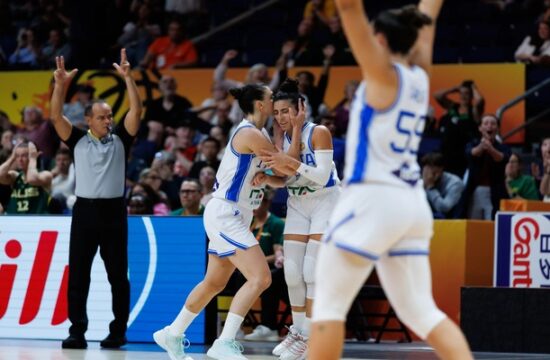
Australia Survives Italy’s Furious Comeback, but Italy Leaves Us Believing

Australia 82, Italy 80

There are nights when basketball seems to resist you.

You know what you want to do. You know the reads, the actions, the places you are supposed to reach. You care desperately about doing it well. Yet for reasons both tactical and human, the game keeps pulling everything away from you. The pass arrives a fraction late. The lane closes. The frustration grows. The basket seems smaller.

For three quarters, Italy lived inside that feeling.

Australia was better. Clearly better. The Opals attacked Italy’s defense through the pick-and-roll, consistently touched the paint, moved the ball beautifully and turned those advantages into trips to the free-throw line. Isobel Borlase produced a magnificent performance, and even after Ezi Magbegor left the game in the first quarter and did not return, Australia kept finding solutions and built a lead that reached 26.

Italy looked frustrated, disconnected and, at times, almost trapped inside the game it desperately wanted to play.

Then Italy scored 31 points in the fourth quarter.

And with 4.2 seconds remaining, Francesca Pasa ran almost the entire length of the floor, put a layup off the glass to tie the game, and watched the ball roll around the rim before falling out.

Australia survived, 82-80, and deservedly moves into the quarterfinals.

Italy goes home.

Basketball can be cruel enough for both of those things to be true at once.

Australia finds the game Italy cannot stop

With Alanna Smith already ruled out for the rest of the tournament, Australia entered another elimination game without one of its most important half-court pieces. The opening possession nevertheless established exactly what the Opals wanted, using a well-designed set to create a low-post touch for Magbegor and an immediate basket.

Italy picked up full court from the beginning and searched for Lorela Cubaj inside, while both teams attacked quickly enough to produce a 7-6 Italian lead in less than two minutes. That early success did not last. Australia began getting into the paint far too comfortably, with its pick-and-roll offense creating problems possession after possession and its empty-side actions proving particularly difficult for Italy to contain.

Magbegor left the game with 5:51 remaining in the first quarter and did not return. Losing another major frontcourt player could easily have disrupted Australia, but instead the Opals produced an 8-0 run that forced an Italian timeout.

Italy’s own problems were growing. Matilde Villa was barely involved early, the half-court offense struggled to create clean advantages, and Italy went almost five minutes without scoring. Even when it shifted into a 2-3 zone late in the quarter, unnecessary fouls kept giving Australia another route to points.

Six of Italy’s 13 first-quarter points came after turnovers. In the settled half court, very little was working. Australia went 7-of-10 on twos and 12-of-15 at the line, while Italy managed only 3-of-12 inside the arc.

The Opals led 26-13.

Borlase punishes every opening

Italy finally found something in the second quarter.

Pasa hit an early three that helped trigger a 7-0 run, cutting the deficit to eight and forcing Australia to stop the game. Italy leaned increasingly on its 2-3 zone, trying to change the rhythm of an Australian offense that had been finding the paint too easily.

Australia kept finding the next answer.

Alex Fowler stopped the run with a basket, and the Opals continued sharing the ball well enough to create closeout after closeout. When Italy committed extra attention inside, Australia moved the defense and attacked the next rotation before it could recover.

The middle of the quarter became a duel of individual bursts. Costanza Verona scored six straight to pull Italy within seven, only for Borlase to respond with six consecutive points of her own and restore a 13-point margin.

Borlase was spectacular.

She reached halftime with 23 points, attacking every opening Italy gave her and becoming the scoring engine of an Australian offense that rarely allowed the defense to settle. Australia had also attempted 22 free throws by the break, converting 18, compared with Italy’s 8-of-10.

That disparity was partly the product of Italy’s growing frustration. The Italians were a step late defensively too often, and Australia kept turning those small delays into contact, rotations and high-value opportunities.

The halftime score was 48-33.

Australia had complete command.

Italy reaches the point where basketball feels impossibly hard

The third quarter looked as though it might end the game completely.

Australia opened with five straight points while Italy immediately added more turnovers. Zitina Aokuso gave the Opals another imposing presence around the basket, and Australian guards continued reaching the rim without enough resistance.

Australia went to its own 2-3 zone defensively, and Italy struggled badly to make it move. The ball was not shifting defenders enough, good looks were difficult to generate and the margin eventually reached 26.

This was the part of the night that felt heavier than a tactical problem.

Italy had spent the tournament showing exactly who it was: physical, stubborn, intelligent and absolutely willing to drag more talented opponents into uncomfortable basketball. It had pushed USA to the final possessions. It had found ways to survive games without beautiful offense. It had made people believe.

Now nothing seemed to work.

Yet Italy closed the quarter on a 7-2 run.

The score was still 69-49. Twenty points remained between the teams. There was no sensible reason to believe one final quarter could undo everything that had happened during the first three.

Italy apparently did not care about sensible reasons.

Thirty-one points of refusal

The fourth quarter began with Italy playing as though the previous 30 minutes had never happened.

Vittoria Blasigh hit a three during a 9-2 opening run that cut the margin to 13. The defensive intensity rose sharply, Australia began turning the ball over and possessions that had once ended with comfortable Opals attacks suddenly became difficult.

Italy kept coming.

The threes started falling. Drives reached the basket. Cubaj and Olbis Futo André supplied important scores from the frontcourt. The pressure that had looked ineffective earlier in the evening now produced hesitation.

Most importantly, Italy stopped looking like a team burdened by everything that had gone wrong.

It looked free.

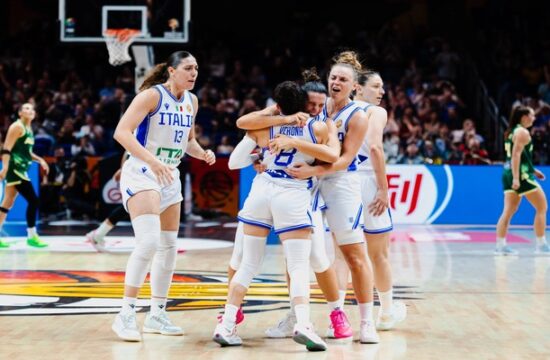
Verona eventually buried a three with 1:09 remaining to tie the game at 77-77.

A team that had trailed by 26 had erased every point of it.

Australia deserves enormous credit for what happened next because surviving a comeback like that requires its own kind of composure. Borlase found Aokuso on the roll to restore the lead, and after an Italian miss, Australia successfully challenged a call before Sami Whitcomb Wilson went to the line and made both free throws.

With 8.3 seconds left, Australia led by four.

And then came the moment that may stay with me longer than anything else in this game.

Vittoria Blasigh and the reason we love this game

Blasigh is 22 years old.

She gives Italy an extraordinary 13 points in only 15 minutes, making all three of her attempts from beyond the arc. With Italy down four and its World Cup almost over, she received the ball after the timeout and launched from well behind the three-point line.

It went in.

Of course it went in.

For a fraction of a second, she celebrated so naturally that she almost lost track of the defensive assignment waiting at the other end. Not because she did not understand the situation. Not because she did not care.

Because she is 22 years old, had just made an outrageous shot in an elimination game at the World Cup, and joy arrived before thought could catch it.

That smile was basketball.

There is something beautiful about the imperfection of that moment. Elite sport often asks us to talk about players as if they are machines built to execute. Every rotation must be perfect, every emotional response controlled, every possession processed instantly.

But the whole reason any of this matters is because people care.

They dream about these shots. They spend years trying to become good enough to take them. They feel fear, pressure, frustration and joy, sometimes within seconds of one another.

Blasigh made the shot because she was good enough to take it.

She smiled because she loved what she had just done.

Basketball should always have room for both.

Millimeters

Borlase split the free throws at the other end, leaving Italy down two with 4.2 seconds remaining.

Pasa took the ball and ran.

There was no time for an elaborate final set or a sequence of counters. She went the length of the floor, reached the basket and put the ball softly off the backboard.

For a moment, it was going in.

The ball reached the rim, rolled toward the basket and seemed ready to drop. Five more minutes were sitting there. A 26-point comeback, overtime, one more chance for Italy to continue this impossible night.

Then the ball came out.

And the pain of that moment did not belong only to Italy.

Borlase, the 21-year-old hero of the night, raised her arms because Australia had won. She had scored 30 points, carried the Opals through enormous adversity and earned every bit of that celebration. But look around her and the reaction is almost extraordinary. Australian players seem momentarily perplexed themselves, happy to have survived but still absorbing what they had just seen. For a second, winner and loser appeared caught inside the same disbelief.

On the sideline, Sandy Brondello had her hands on her head.

It was the reaction of almost everyone watching.

How did that not go in?

That is part of the strange beauty of sport. Australia had done its job. It deserved to celebrate. Italy had done almost everything required to create one of the great comebacks of the tournament. Pasa had reached the basket and given the ball every opportunity to fall.

And still, the basketball gods offered no overtime.

Only the rim.

Only the ball rolling out.

Only two teams standing there trying to process what had just happened.

There are misses where the process is poor, where the defense forces the wrong decision or a possession falls apart. This was not one of them. Pasa attacked the moment and gave Italy exactly the chance it needed. The difference between another five minutes and elimination was measured in millimeters.

Only the best players in the world ever earn the right to take a shot carrying that much weight.

And sometimes, as spectators, we are lucky simply to be there for it.

To watch a game like this, to feel the hope build, to experience the disbelief of the comeback and then share that final second with players on both sides is one of the privileges of loving basketball. It does not matter whether it happens at a World Cup, in a local gym or on an empty court somewhere nobody is watching.

Sometimes we are lucky enough to be part of something.

Basketball gives us those moments.

Australia earned this

None of Italy’s fourth-quarter magic should obscure how well Australia played.

The Opals were the superior team for three quarters and created their advantage through excellent basketball. Their pick-and-roll offense repeatedly broke down Italy’s defense, the ball moved well enough to create favorable closeouts and their aggression generated 37 free-throw attempts, of which they made 27.

Australia finished with 25 assists, another reflection of how well the offense operated for most of the night.

Borlase was exceptional with 30 points, carrying an enormous offensive load after Magbegor left the game. Aokuso added 15 points and six rebounds, while Steph Talbot produced 14 points, nine rebounds and five assists.

Australia also deserves credit for surviving the psychological force of that fourth quarter. Once a 26-point advantage disappears and the opponent ties the game, the previous three quarters no longer protect you. Australia still found the roll for Aokuso, defended the next possession, won the challenge and made enough free throws to escape.

The Opals earned their quarterfinal place.

Italy made us believe

Verona finished with 23 points. Blasigh produced 13 in those remarkable 15 minutes. Italy somehow scored 80 even with Cecilia Zandalasini and Villa, its two leading scorers, combining for only 14.

But numbers cannot really explain why this one hurts.

Italy’s World Cup ended on a missed layup after it had spent an entire quarter refusing the obvious ending.

For three quarters, the game seemed to be taking something away from them. The offense would not cooperate. Australia was better. Frustration was visible. The margin kept growing.

That feeling exists at every level of basketball. Sometimes you love the game desperately and it does not seem to love you back.

The special teams keep playing anyway.

Italy did more than keep playing. It punched back against that feeling until an impossible game was tied with 69 seconds remaining. A 22-year-old buried a shot from another postcode and smiled like a child who had just discovered basketball for the first time. Pasa ran the floor with the season in her hands and came within the width of a rim of giving them five more minutes.

I am sure none of this will mean much to the Italian players tonight.

They wanted to win.

They came close enough to touch it.

And then it disappeared.

But there will be another tournament. Blasigh will be older. Villa will have another season behind her. This young group will have lived through what happened here and carry it with them.

And when Italy takes the floor again, there will be people waiting to watch.

Because this team made its country proud.

Because it made the rest of us believe.

And because after a game like this, how could you not want to see what they do next?

Quarterfinals Preview

FIBA Women’s World Cup – Quarterfinals Preview

And then there were eight.

Belgium, France, Germany, Hungary, Spain, USA, (China/Puerto Rico and Italy/Australia) have already booked their places in the FIBA Women’s World Cup quarterfinals.

From here, the tournament changes again. There is no next round guaranteed, no opportunity to recover from one poor stretch and no room for an opponent to expose the same weakness twice. Four games will decide which four teams remain in the medal hunt.

Here is what to expect from every possible quarterfinal matchup.

USA vs Hungary

Hungary meets size again

Hungary produced an excellent team performance against Japan to reach the quarterfinals. Réka Lelik carried the offense early, Virág Takács-Kiss took over after halftime and the Hungarians found enough answers even without needing a dominant game from Dorka Juhász.

Their reward is USA.

The matchup presents a very different physical challenge from the ones Hungary faced against Korea and Japan. USA has tremendous size and length across the floor, with no player under 180 cm, and can combine that physical profile with aggressive ball pressure. That is particularly concerning for a Hungarian team averaging 21.5 turnovers per game, the highest mark in the tournament.

The turnover battle could decide whether this remains competitive. USA should have opportunities to pressure Hungary’s guards and make the first pass into the offense difficult. Hungary needs to avoid allowing those mistakes to become transition chances because USA has looked considerably less comfortable when forced to generate everything against a set half-court defense. Italy already showed how dramatically the American offense can change when easy points disappear and possessions become more physical.

For Hungary, the challenge is not simply having Juhász and Takács-Kiss available inside. It is finding them in advantageous situations. USA has the bodies to defend both without compromising the rest of the floor, so Hungary’s guards must handle the pressure, create clean passing angles and get the offense far enough into its actions for that frontcourt pairing to matter.

If Hungary can protect the ball and force USA to spend most of the afternoon attacking five defenders, there is at least a route toward making the game uncomfortable. If the turnovers start piling up and USA gets into transition, that route becomes extremely narrow.

USA has the clear edge.

China vs France

Will China be a mountain too high?

China beats Puerto Rico, and it will once again find itself among the final eight of women’s basketball.

Waiting there would be a French team that has yet to face a sustained challenge in this tournament.

China possesses something no other team can quite replicate: a frontcourt featuring Han Xu and Zhang Ziyu, two players over 205 cm who can fundamentally alter how opponents defend. Han combines height with mobility and skill, while Zhang changes the geography of possessions simply by establishing position near the basket.

The question is whether China can consistently access those weapons against one of the tournament’s most disruptive defenses.

France owns the second-best defensive rating in the competition, while China sits second-to-last in turnover percentage. That is a dangerous combination. France pressures the ball, closes passing lanes and can turn one loose entry into points at the other end before China has any chance to establish its preferred defense.

Zhang’s minutes create another fascinating tactical question. China regularly uses a 2-3 zone when she is on the floor, but France has shot an extraordinary 48.5 percent from three and is lethal in transition. France will want to attack before the zone can establish its shape, and if the threes continue falling once China gets set, Zhang’s impact can be pulled farther away from the areas where she is most valuable.

China nevertheless has tools that make this matchup different from anything France has faced so far. If Han and Zhang can force France to alter its normal defensive rules and China can keep the turnover count manageable, there are ways to create genuine problems.

France would still enter as the clear favorite, but China has a physical variable that cannot simply be ignored.

Belgium vs Germany

That seems familiar

Germany made history against Korea, reaching the FIBA Women’s World Cup quarterfinals for the first time in program history.

Now comes Belgium.

There are interesting similarities between these teams. Both are comfortable running when transition is available but do not depend on it. Both can operate deep into the half court, use constant ball and player movement and search patiently for the next advantage rather than treating the first action as the final one.

That should make execution especially important. The game may come down less to which team creates the first advantage and more to which one recognizes what comes next. Belgium has been exceptional at making the next pass, moving defenders twice and turning small openings into high-value shots. Germany showed against Korea that it can do something similar, particularly once its high-low game and frontcourt passing became central to the offense.

The individual battle between Emma Meesseman and Nyara Sabally should carry significant weight. Sabally gives Germany the mobility and physicality to challenge Meesseman in different areas of the floor, but defending Belgium’s star is never simply a one-on-one assignment. Meesseman’s ability to facilitate, screen, relocate and punish help means Germany has to defend everything happening around her as well.

Belgium’s guard play gives it another important advantage. Julie Allemand and Julie Vanloo can control possessions in different ways, and Belgium’s ability to create from the perimeter could become decisive if Germany succeeds in matching the frontcourt battle.

Still, Germany will have its home crowd, a physical profile capable of making Belgium work and the confidence of knowing it has beaten this core before, winning 83-69 in the Olympic group stage.

Belgium should be favored, but this could be one of the trickier quarterfinals on the board.

Australia vs Spain

Transition vs half court

Australia survives Italy, and the quarterfinal against Spain becomes another battle over who decides where the game is played.

Australia wants to run. The Opals are at their best when rebounds and turnovers become immediate attacks, allowing their athleticism to create advantages before the defense can organize. Their half-court offense has been less reliable, and the absence of Alanna Smith makes those possessions even more challenging.

Spain can play fast when the opportunity is there, but it does not need to. It is perfectly comfortable getting into five-on-five offense and using well-designed actions to manipulate a set defense. That makes pace control central to the matchup. Australia needs enough transition opportunities to avoid spending the entire afternoon solving Spain possession by possession.

Spain’s set offense could also test Australia’s concentration. It has repeatedly used screening combinations, off-ball movement and counters to create good shots when the first action is covered. Australia will need to remain physical without losing connectivity, because one missed switch or late rotation can allow Spain to turn a defended first option into an easy second one.

At the other end, Australia has often generated its best half-court offense by punishing teams physically with wings and bigs in the post. Spain has the size to match those actions, which could force Australia’s guards to create more than usual if the transition game is limited.

That is another area where Spain may hold an advantage.

Iyana Martín has played like one of the best guards in the tournament and gives Spain a reliable creator when possessions deteriorate. In a quarterfinal that could come down to a handful of late-clock decisions, that matters enormously.

Australia has the athleticism to change the game in transition. Spain has the half-court tools to slow it back down.

This one has every chance to be decided in the dying moments.

This article was co-written by the European Hoops Podcast team, André Lemos and João Caeiro. Follow us at @EthosEuroLeague and subscribe to the European Hoops Podcast wherever you listen to your favorite podcasts.

Fantasy NBA Today: Sleepers, Busts & Our Guys…

Tim Woodson and Dr. A continue the Sleepers, Busts & Our Guys series with the Lakers, Raptors and Clippers. They reveal their favorite fantasy targets, overlooked sleepers and potential busts from each roster while examining how the Clippers could look if the expected Kawhi Leonard trade is completed.

Presented by FanDuel

Download the SportsEthos App on the APP Store and Google Play!

FantasyPass now includes DAILY PROJECTIONS – perfect for DFS and head-to-head leagues.

Join the Discussion on DISCORD for real-time advice and community support.

Subscribe, Rate, and Review to Fantasy NBA Today on Apple and Spotify for expert updates and tips!

Fantasy MLB Today: The American League Playoff Race…

Paul Williamson breaks down each of the contending teams’ upcoming schedules and highlights which games are the key ones that will shape their destiny while pointing out streaming opportunities (Cristian Javier) and risky fantasy starts (Foster Griffin). Also, find out which long shot contender has the best rout to shocking everyone. It isn’t likely but crazier things have happened.

Presented by FanDuel

SUBSCRIBE, Rate and Review on Apple and Spotify!

Follow us on Twitter: @EthosFantasyBB

Follow us on Bluesky: @ethosfantasymlb

Join our Fantasy Sports Discord Server: https://discord.gg/jSwGWSHqaV

FIBA Women’s World Cup 2026 Diary: Day 5…

The FIBA Women’s World Cup field is down to 10 teams, with Hungary and Germany claiming two more quarterfinal places on Day 5.

Hungary found scoring beyond Dorka Juhász to end Japan’s run, while Germany leaned into its size and interior advantage to make history on home soil.

Now only two spots remain. Italy faces Australia in a matchup between medal contenders, while Puerto Rico looks to continue its surprise run against China as Day 6 decides the final quarterfinal field.

Game Report

Hungary Finds More Than Juhász and Ends Japan’s World Cup Run

Hungary 84, Japan 63

Hungary knew exactly what Japan was going to try to take away.

These teams had met during the World Cup qualifiers, when Dorka Juhász overwhelmed Japan with 35 points and nine rebounds in a 77-65 Hungarian win. This time, Japan built much of its defense around denying the same kind of influence.

Hungary simply found other answers. Réka Lelik carried the offense early, Virág Takács-Kiss took over the third quarter and Hungary’s perimeter shooting punished Japan whenever its defense committed too much attention elsewhere.

The reward is a place in the quarterfinals against USA.

Japan takes away the first option, Hungary keeps moving

Hungary opened the game 7-0 and quickly showed it had no interest in forcing the obvious matchup. Japan doubled inside and attacked Hungary’s frontcourt in space, but Hungary kept the ball moving. Lelik became the early beneficiary, scoring eight first-quarter points on 4-of-5 shooting.

At the other end, Hungary had a thoughtful plan for Japan’s pick-and-roll game. It used late switches, with the guard veering back toward the popping big while Hungary’s big took the ball-handler, helping deny one of the spacing advantages Japan was trying to create. The scrambling behind those coverages was strong as well, preventing many of the easy looks Japan normally generates once the defense has been shifted.

Japan still found some clever solutions. It attacked Juhász on closeouts, drove aggressively toward the rim and used the gravity of its shooters to open slips in off-ball actions. The process was often good, but the finishing was not. Japan shot just 22 percent in the opening quarter, while Hungary made 53 percent of its attempts and led 20-12 despite Japan holding a 4-1 advantage on the offensive glass.

Japan’s pressure finally creates a game

Japan continued changing the picture defensively in the second quarter. Side pick-and-rolls were blitzed, full-court pressure appeared after dead balls and Japan briefly went bigger with Maki Takada and Ramu Tokashiki together.

For much of the half, Hungary handled those adjustments well. The ball moved quickly, Japan was repeatedly forced into extra rotations and Hungary consistently found perimeter looks when the defense overcommitted. Across the full first half, Hungary went 8-of-17 from three, a major reason it was able to stay in front even as Japan increased the pressure.

Then a Hungarian technical foul helped open the door for Japan. Hungary committed four turnovers during the stretch that followed, and Japan finally found the transition opportunities it had been searching for. Stephanie Mawuli hit a three on the break, while Japan’s pressure began creating the faster, less controlled possessions it needed.

The most difficult moment of the half had nothing to do with the score. Saki Hayashi left the game after suffering what appeared to be a serious arm injury and did not return. It was a painful way for her World Cup to end after one of the tournament’s most memorable individual performances, when she made nine threes against Mali to set the Women’s World Cup record. Whatever comes next, she leaves this tournament having put her name in its history, and hopefully her recovery is a smooth one.

Japan continued pushing after her departure. A sequence of missed free throws still produced second chances, and the deficit fell to just three before Ágnes Studer hit a three at the halftime buzzer.

Hungary led 37-34 despite Japan shooting only 10-of-33 from the field for the half. Japan had compensated by getting to the line, making 10 of 14 free throws compared with Hungary’s 3-of-6, while Hungary’s 8-of-17 shooting from three provided the scoring efficiency that kept it ahead.

Takács-Kiss changes the second half

Hungary started the third quarter the same way it had started the first, with a 7-0 run.

This time, the separation came through Takács-Kiss. She had gone scoreless in the first half, but Hungary began actively searching for her after the break and she responded with 10 points in the quarter.

Japan could not generate enough offense to match her production. It scored only four points over the first seven-plus minutes of the period, and although Norika Konno eventually provided six points during a late response, Hungary had already rebuilt a comfortable advantage.

The foul line widened it further. Japan committed several avoidable fouls, and Hungary punished them by going 11-of-12 at the stripe in the quarter. What had been a three-point game at halftime became a 58-45 Hungarian lead entering the fourth.

Takács-Kiss had given Hungary exactly what it needed.

Hungary keeps Japan from finding another run

Japan’s best route back remained speed, and Hungary did an excellent job preventing transition possessions from developing throughout the game. When necessary, it used fouls to stop breaks before Japan could exploit an unsettled defense.

Japan still searched for solutions in the half court, including a 1-4 alignment into central pick-and-roll with smart cutting around the action. But its scoring never became consistent enough. Hungary’s defense kept forcing difficult stretches, and its bench was also quick to use timeouts whenever Japan appeared capable of putting consecutive possessions together.

Takács-Kiss hit a three to stretch the lead to 17 with 5:26 remaining. Konno answered from deep, prompting another Hungarian timeout, before Juhász contributed six important fourth-quarter points. Dóra Kányási then buried the three with 2:54 left that effectively ended Japan’s hopes.

Hungary had enough answers

Lelik finished with 23 points and eight rebounds, setting the tone when Hungary needed someone else to lead the offense. Takács-Kiss scored all 17 of her points in the second half and added eight rebounds, becoming the decisive scorer after halftime.

Hungary’s shooting was another major separator. It finished 11-of-25 from three, while Japan went just 7-of-33. Kokoro Tanaka was Japan’s only double-digit scorer, while Rui Machida turned back the clock as a creator with 12 assists.

Japan had stretches of excellent basketball. Its pressure changed the second quarter, its movement created intelligent openings and it continued searching for ways to attack Hungary’s defensive coverages. The shots simply did not fall often enough to sustain those stretches.

Hungary moves on to face USA in the quarterfinals.

For Japan, the World Cup ends here, with Hayashi’s record-setting performance against Mali remaining one of the unforgettable moments of its run. Hopefully, the next news about her is good news.

Game Report

Germany Overpowers Korea and Makes World Cup History on Home Soil

Germany 94, Korea 56

Germany spent part of the first half playing away from its clearest advantage, then corrected course decisively.

Korea’s pressure created some early discomfort, and Germany briefly helped by settling for too many perimeter shots. Once the hosts started consistently getting the ball closer to the basket, using cuts, high-low actions and their frontcourt mobility to attack Korea’s coverages, the game changed completely.

Germany went just 5-of-25 from three but shot 63 percent on twos, a contrast that captured where the game was won and sent the hosts into the first Women’s World Cup quarterfinal in program history.

Korea creates an early problem

Germany opened 5-0, but Haeran Lee quickly gave Korea a foothold by scoring its first eight points and helping tie the game at 8-8. Korea’s pressure also began disrupting Germany’s initiation, pushing the hosts away from the areas where their physical advantage mattered most.

Frieda Bühner steadied Germany with a three, free throws and attacks to the basket, helping build a 23-14 lead after one. Korea responded again early in the second through Leeseul Kang, whose eight straight points, including back-to-back threes, cut the margin to 27-22.

That was the point where Germany’s shot selection became the issue. It was taking too many perimeter attempts and allowing Korea to stay close despite owning a much clearer advantage elsewhere.

The high-low game breaks Korea open

Germany began attacking much more directly. The ball started going inside, cuts came behind Korea’s double teams and the connection between Bühner and Marie Gülich became the centerpiece.

Back-to-back high-low actions produced four straight Gülich points, and Germany later returned to the same concept with Gülich cutting down from the elbow for another finish. Korea tried to crowd those catches, but once the second defender committed, Germany consistently found the next pass before the defense could recover.

The lead grew to 46-29 by halftime, with Gülich scoring 14 points on 7-of-8 shooting and Germany holding a 28-12 advantage in points in the paint.

The important part was not simply that Germany was bigger. It had started using that advantage with precision.

Korea changes the coverage, not the problem

Korea spent the second half cycling through answers. It opened with an active zone that collapsed hard toward Germany’s frontcourt, then returned to man-to-man, mixed in doubles and kept changing the defensive picture.

Germany continued moving the defense, making the next pass and reaching productive scoring areas without relying on the three-ball. The margin reached 61-36 midway through the third, while Lina Sontag and Clara Bielefeld added steals that turned stops into easier offense.

By the end of the period, Germany led 68-40. The fourth became about finishing professionally rather than solving anything new, with Luisa Geiselsöder remaining efficient, Nyara Sabally, Sontag and Bühner continuing to contribute around the basket, and Alexandra Wilke adding a three and an and-one.

Germany closed out a 94-56 win without allowing the game to regain any tension.

Germany’s balance tells the story

Gülich led the way with 19 points on 7-of-9 shooting, adding five rebounds and three assists. Bühner scored 17, Geiselsöder added 12 on 6-of-9 shooting, and Sabally produced 10 points, five rebounds and six assists. Leonie Fiebich affected the game everywhere despite scoring only eight, finishing with 11 rebounds, four assists and three blocks.

Lee was excellent for Korea with 21 points on 10-of-13 shooting, while Kang added 17, but there was too little offense beyond them to keep pace.

Germany also finished with 30 assists against only seven turnovers, another reflection of how cleanly it played once the offense began consistently reaching the right areas.

The defending European champions now wait in the quarterfinals. Belgium will enter as favorites, but Germany has legitimate ways to make the matchup difficult through its physicality, versatility and ability to create from multiple positions. There is also recent history between the teams, with Germany beating Belgium 83-69 during the Olympic group stage.

That result guarantees nothing, but Germany has already shown it can hurt this Belgian core and now gets the chance to do it again with a semifinal place on the line.

Day 6 Preview

FIBA Women’s World Cup – Day 6 Preview

Only two quarterfinal places remain, and Italy, Australia, Puerto Rico and China have all reached the point where there is nothing left to protect and nowhere left to recover. Win, and the World Cup continues. Lose, and the tournament is over.

The two games could hardly present more different tactical questions. Italy vs Australia is a battle over pace, with Italy wanting to drag the game into the half court and Australia looking to run before the defense is set. Puerto Rico vs China is about whether disruption can neutralize China’s physical advantage.

Two games, two quarterfinal places, and very little separating the teams.

Italy vs Australia

Winner faces Spain in the quarterfinals
Two medal contenders, one place left

Australia entered the final day of the group stage playing Belgium for first place and, one loss later, now finds itself here. Waiting for the Opals is an Italy team that has already shown it can make life extremely uncomfortable for anyone, including USA.

The first battle is pace. Italy wants a slower, physical half-court game where its defense can stay connected, switching can remove first options and every Australian possession has to work deeper into the clock. Australia is much more dangerous when it can attack early and let its athleticism create advantages before the defense is organized.

That puts a premium on Italy’s transition defense. Australia also loves quick-hitting actions designed to create immediate openings, and if Italy can anticipate those and force the Opals deeper into possessions, the game begins to look much more favorable for the Italians.

Then there is the wing matchup between Steph Talbot and Cecilia Zandalasini, which could become one of the most important individual battles of the day. Both influence far more than the scoring column, and whichever one is able to impose herself more consistently could tilt a game where the margins should be extremely small.

Italy has already shown it can survive ugly possessions, defend through contact and keep games where it wants them, which gives the Italians a very slight edge.

Puerto Rico vs China

Winner advances to the quarterfinals and faces France
Can Puerto Rico shock the world again?

Puerto Rico was not supposed to be here, but it beat Türkiye in the decisive group-stage game and earned another night with its World Cup alive. Now comes China, which produced its best performance of the tournament against Italy behind Han Xu, Zhang Ziyu and a defense that made the floor feel increasingly crowded.

Puerto Rico’s problem is clear because so much of its offense has come from attacking inside. Against China, it may need to create more before the defense is fully established, using early attacks and movement to avoid letting possessions become static.

At the other end, China has to take care of the ball. Puerto Rico ranks fourth in the competition in steals and has repeatedly used defensive pressure to create easier offense. If China becomes loose with its entries or initiation, Puerto Rico has the tools to turn those mistakes into exactly the kind of game it wants.

That is where this one could swing. If China protects the ball, Han and Zhang should become increasingly difficult to handle. If Puerto Rico can disrupt the guards and create transition chances, another surprise is very much in play.

This article was co-written by the European Hoops Podcast team, André Lemos and João Caeiro. Follow us at @EthosEuroLeague and subscribe to the European Hoops Podcast wherever you listen to your favorite podcasts.

FIBA Women’s World Cup: Group Stage Recap, Power…

André Lemos and João Caeiro recap the FIBA Women’s World Cup group stage, explain the updated Power Rankings and preview all four Qualification to Quarter-Finals games. They break down Italy-Australia, Hungary-Japan, Puerto Rico-China and Germany-Korea before projecting the eventual quarterfinal bracket.

This episode of the European Hoops Podcast is presented by FanDuel!

Follow the podcast for more EuroBasket previews and European basketball coverage!

Subscribe and rate on Apple and Spotify, and follow @EthosEuroleague on Twitter and Instagram for Euroleague men and Women, FIBA, and Olympics updates all season long!

Follow our team: André Lemos (@andmlemos), Tiago Cordeiro (@tiagoalex2000) and João Caeiro (@JCaeiro_6).

Punt Intended: What Stats Matter for Dynasty

Mark C breaks down what stats matter for dynasty evaluations. Are points and assists truly the most important stats for dynasty rankings? Should you de-value blocks and steals? Do rebounds hold more weight than we think? Mark C details what stats dynasty managers should care about in this must-listen episode!

The Punt Intended podcast is also now available on YouTube(opens in new tab)!

Follow Mark on Twitter(opens in new tab) and on BlueSky(opens in new tab)!

Grab a FantasyPass subscription(opens in new tab) so you don’t miss out on any dynasty content, among all the other great analysis from the SportsEthos team!

Check out my Dynasty Rankings(opens in new tab) and my 2026 Dynasty Rookie Rankings(opens in new tab) (Gain access to the full Ranks with any SportsEthos subscriptions that gives you access to the NBAPass)!

SUBSCRIBE, Rate and Review on iTunes!(opens in new tab)

FIBA Women’s World Cup 2026 Diary: Day 4…

The FIBA Women’s World Cup group stage closed with records, statement wins and the knockout picture finally taking shape.

Belgium claimed first place behind a historic Julie Allemand performance, France rewrote the record book from three, USA and Spain rolled into the next phase, while Puerto Rico kept its tournament alive.

We break down all eight games and look ahead to the first elimination matchups of Day 5.

Game Report

Belgium Makes Australia Chase Shadows as Allemand Makes History and Meesseman Shines

Belgium 80, Australia 68

Belgium came into the afternoon playing for first place in the group and a place on the opposite side of the bracket from USA.

Then Julie Allemand made history, Emma Meesseman nearly produced a triple-double, and Australia spent most of the game chasing a team that always seemed one decision ahead.

Belgium won 80-68 with perhaps its most complete performance of the World Cup so far. The Cats moved the ball beautifully, defended with real collective sharpness and never allowed one of the tournament’s most physical teams to dictate the game.

Allemand entered five assists away from becoming the Women’s World Cup’s all-time leader. She reached the record before halftime. Meesseman finished with 22 points, 10 rebounds and eight assists.

Together, they gave the game its shape.

Belgium’s first pass was rarely the point, and neither was the first screen. One action bent the defense, another forced a new decision, and by the time the shot came, Australia had often been asked to solve two or three problems in the space of a few seconds.

That is what made the afternoon feel special.

Belgium did not simply beat Australia.

It made the game look unmistakably Belgian.

Australia starts chasing almost immediately

Julie Allemand hit a three early and smiled, usually a dangerous sign for whoever is standing across from Belgium.

The Cats had arrived ready to play fast, but speed was only part of the problem Australia faced. The real difficulty was how much happened within each Belgian half-court trip. The ball changed sides, players cut through the defense and one action flowed directly into the next. Belgium could run something, see Australia handle the first part correctly and simply continue until another opening appeared. Even the misses often came from strong process.

Australia’s offense looked more individual by comparison. The Opals searched for Stephanie Talbot on the wing and in the post, tried to establish Zitina Aokuso on the block and used their physical advantages where they could, but many attacks became static and dependent on somebody winning a matchup. Belgium rarely made those wins comfortable.

The Cats were connected defensively from the opening quarter, forcing Australia to work in the half court while also attacking the offensive glass themselves. Belgium grabbed two offensive rebounds almost immediately and had six by halftime, an important detail against an Australian team built to punish opponents physically.

Australia did find opportunities when Belgian turnovers allowed it to run, but once the game settled, the contrast became increasingly clear. Belgium was creating advantages collectively, while Australia was being asked to solve more of its offense individually.

The Cats closed the first quarter on an 8-4 run to lead 23-17, having made eight of their 12 two-point attempts while Australia was just 6-of-15.

And Allemand was only getting started.

Julie Allemand makes history exactly as Julie Allemand should

There are records that tell you how long somebody has played.

This one tells you who Julie Allemand is.

Her pick-and-roll passing was on full display in the second quarter. She waited for defenders to commit, changed the timing of actions, found rollers the instant the window appeared and kept manipulating Australia until the defense finally gave something away.

Allemand entered this World Cup with 87 career assists, then handed out 17 more over Belgium’s first two games. That left her at 104 entering the matchup with Australia, five short of the record. Before the first half was over, she had reached the top of the Women’s World Cup assist list.

Think about the names she passed: Laia Palau, Sue Bird, Dawn Staley. Three of the great guards international basketball has known. Allemand has reached this point in only her third World Cup, with this tournament itself still in the group stage, while Bird and Palau each played five.

But the number alone is not what made the moment beautiful.

Watch Belgium play and the record makes perfect sense.

Allemand does not pass simply because she prefers to create for others. She passes because she sees where the advantage is going to appear. She understands what the defense has already conceded, sometimes before the defense fully recognizes it itself.

Against Australia, that intelligence was everywhere.

Belgium’s defense helped fuel a 7-0 run and a 10-point lead, with all five players moving together and the rotations arriving sharply enough to hold Australia scoreless through several stretches. Ezi Magbegor eventually broke one drought inside, and Australia answered with a 6-0 run to climb back within six.

Belgium needed a response, and Meesseman supplied it without needing the ball for long. A sharp off-ball defensive play became a steal, then smart movement at the other end drew contact and sent her to the line for two free throws.

That is Meesseman in miniature: changing a game without needing every possession to run through her.

Australia had begun doing a better job staying with Belgium deeper into the shot clock, but Billie Massey’s three at the halftime buzzer restored a seven-point advantage.

Belgium 40, Australia 33.

And somewhere inside those first 20 minutes, Julie Allemand had become No. 1.

Julie and Emma start playing basketball in their own language

Australia came out of halftime with adjustments.

Belgium kept finding answers.

One of the Cats’ most effective actions was an empty-side pick-and-roll with Meesseman operating as the short roller. It put Australia in a brutal sequence of decisions: contain Allemand, account for Emma receiving the ball in the middle of the floor, then recover quickly enough to deal with whatever came next.

Because Meesseman catching in space is rarely the end of the action.

More often, it is where the defense’s real problem begins.

She can score. She can find the cutter. She can fire the ball to the perimeter. She can hold it for half a beat and let the defense rotate itself out of position.

Australia also tried to involve Magbegor through the pitch handoff that had worked so well against Türkiye, looking to release her toward her right hand, but Belgium was ready for it. The Cats opened the third quarter 7-3 and pushed the advantage to 11 before Australia answered after a timeout with six straight points.

Julie Vanloo responded immediately with a three out of Belgium’s timeout, another reminder of why this offense can be so difficult to contain. Take away one solution and another appears. Commit more attention to Meesseman and Allemand sees the next read. Collapse on their two-woman game and Vanloo is waiting beyond it.

And when Julie and Emma began working directly together, there were stretches when basketball looked almost impossibly simple. A screen created a read, the read became a pass, the pass led to movement, and the next opening appeared before Australia had fully recovered from the first one.

Two players understanding not only where the other is, but where she is going to be.

Australia did find more success getting its guards downhill during the quarter, and its rebounding improved significantly after halftime. Belgium did not collect a single offensive rebound in the third, while back-to-back turnovers to close the period gave the Opals enough life to remain close.

After three quarters, it was only 60-55.

Australia was still there.

But it had spent almost the entire game solving problems.

Belgium was about to give it several more.

The Cats find another gear

Allemand opened the fourth-quarter separation with the kind of shot that changes the feeling inside an arena: an off-the-bounce three that pushed Belgium back ahead by 10.

The Cats opened the quarter 5-0 and eventually stretched the run to 11-2 as Australia’s execution began to unravel. Four turnovers came during that stretch, each one another sign that Belgium had tightened the game at exactly the right moment. Australia had committed only four turnovers through the first three quarters. It committed seven in the fourth.

That was where the game finally broke.

The Opals responded to a timeout with four quick points, but Antonia Delaere buried a corner three before the momentum could grow. Vanloo followed with four straight points, and Belgium had pushed the margin to 15 with 2:21 remaining.

Australia still tried to summon one last push. Chloe Bibby hit a three and Magbegor finished a layup, leaving just enough time to imagine one final run if Belgium opened the door.

Emma closed it.

Her mid-range jumper with 40 seconds remaining was soft, certain and final, a fitting dagger from a player who had spent the entire game doing almost everything else first.

She scored when Belgium needed scoring, rebounded against one of the tournament’s strongest frontcourts, created for teammates, defended away from the ball and became the decision-maker in the short roll whenever Australia committed two defenders to the initial action.

Twenty-two points. Ten rebounds. Eight assists.

A near triple-double in a game for first place against Australia, and somehow even that line does not fully capture how much of the game she touched.

This is what Belgium can be

Belgium finished with 28 assists to Australia’s 18, and that number is not decoration.

It is the clearest expression of what separated the teams.

The Cats made Australia defend decisions rather than players. They linked actions together, kept cutting after the first advantage disappeared and trusted that one more pass would eventually reveal the opening. At the other end, they were just as collective, allowing only six offensive rebounds against an Australian team capable of overwhelming opponents with size and physicality.

Meesseman was magnificent with 22 points, 10 rebounds and eight assists. Kyara Linskens added a double-double with 12 points and 10 rebounds. Vanloo contributed 12 points and five assists.

And Allemand?

Eleven points. Seven assists. Another afternoon spent deciding where the basketball needed to go, except this one will live forever in the record book.

She reached the World Cup assist record doing what she has always done: seeing beyond herself.

There is something perfect about that. Basketball celebrates scoring because scoring is loud. The crowd rises when the shot falls, and highlights remember the player who finishes the play. Allemand has built a career seeing everything that has to happen before that moment: the defender leaning half a step too far, the roller arriving behind the help, the teammate waiting in the corner, the pass that turns movement into advantage.

And beside her is Meesseman, another superstar whose greatness has never required the game to stop around her. She screens, passes, cuts, rebounds, steals, scores and thinks her way through possessions while making everyone around her better.

That is why watching Belgium at its best can feel different.

It is not simply beautiful because the ball moves.

It is beautiful because the players understand why it should move.

Australia came to Berlin playing for first place in the group.

Belgium made them chase shadows.

The Cats are group winners. Julie Allemand is the Women’s World Cup’s all-time assist leader. Emma Meesseman came within two assists of a triple-double.

And when these two see the game like this, and the rest of Belgium sees it with them, basketball can become something truly special.

Game Report

Puerto Rico Finds Its Way Inside and Outlasts Türkiye 75-71

Puerto Rico 75, Türkiye 71

Türkiye kept winning extra chances. Puerto Rico kept creating the better shots.

That contrast defined a wonderful back-and-forth game. Türkiye collected 20 offensive rebounds and repeatedly survived poor shooting by winning the ball back around the rim. Puerto Rico answered by attacking inside, where it shot 63 percent on twos and found its most reliable offense.

Then the fourth quarter changed everything.

Pamela Rosado hit the threes that erased Türkiye’s lead, Trinity San Antonio took over the game’s energy, and Arella Guirantes supplied the composure at the finish. Puerto Rico came from seven down after three quarters and won 75-71 in a game with 10 lead changes and six ties.

Türkiye is eliminated.

Puerto Rico gets to keep playing for a place in the quarterfinals.

Türkiye keeps finding another chance

Puerto Rico looked sharper first.

It opened with more activity, attacked Türkiye before the defense could settle and built a 14-10 advantage through the opening five minutes. An early attempt to show zone lasted only briefly after Türkiye immediately punished it from the perimeter, sending Puerto Rico back to man-to-man.

Then Sevgi Uzun began taking over the Turkish offense.

Türkiye’s defense started making Puerto Rico’s creation more difficult, and Uzun supplied the points required to turn that resistance into something tangible. She hit a three to give Türkiye a 15-14 lead, added two free throws moments later and had scored 10 of her team’s first 17 points.

Puerto Rico responded to move back ahead, but Türkiye had already found the other element that would sustain it throughout the afternoon: the offensive glass.

Even while shooting only 32 percent in the first quarter compared with Puerto Rico’s 47 percent, Türkiye collected five offensive rebounds. That work kept it attached to a game Puerto Rico had largely played better.

Then came a final swing with one second remaining.

Derin Erdoğan drew a three-shot foul and converted all three free throws.

Türkiye led 20-19 after one.

Puerto Rico’s best offense is waiting inside

Puerto Rico did not need to search very far for its advantage.

When it attacked the paint, Türkiye struggled to contain it.

The problem was that Puerto Rico did not always stay there.

At halftime, the contrast was almost absurd: Puerto Rico had made 14 of 21 two-point attempts and just 2 of 13 threes. When the ball went downhill, the offense produced. When it drifted toward the perimeter, Türkiye was being given a reprieve.

Trinity San Antonio understood where the opportunities were. She reached halftime with 10 points on 5-of-8 shooting, consistently bringing force to the spaces Türkiye was having difficulty protecting.

Still, Türkiye led 40-37 because the offensive glass kept bailing out poor shooting.

Ten offensive rebounds had already produced a 13-2 advantage in second-chance points. Elif Bayram became increasingly important in that battle, finding the ball around the rim, extending trips and making Puerto Rico defend for longer than it wanted.

Uzun remained the organizer around all of it. Türkiye’s offense became noticeably more difficult when she went to the bench in the second quarter, with Puerto Rico moving ahead 29-28. Once she returned, Türkiye immediately looked more comfortable, turning that deficit into a 35-29 lead.

Puerto Rico fought back by forcing turnovers and running, tying the game at 37.

Uzun answered one more time.

Her third three of the half dropped with 16 seconds remaining, sending Türkiye into halftime ahead 40-37 with 13 points.

Bayram owns the glass, but Puerto Rico stays close enough

Türkiye came out of halftime with its best sustained stretch of offense.

Tilbe Şenyürek Arslan and Uzun hit early threes. Olcay Çakır added another. For the first time, the work Türkiye had been doing on the glass was being paired with enough perimeter shot-making to create real separation.

Bayram remained at the center of everything physical.

By the end of the third quarter, Türkiye had an astonishing 18 offensive rebounds. Bayram accounted for seven of them herself and had already assembled 13 points and 12 rebounds, repeatedly winning loose balls and finishing around the basket.

Türkiye led 58-51 after three.

Yet even then, Puerto Rico’s path remained obvious. Thirty of its points had already come in the paint, while its perimeter shooting sat at just 2-of-15. Guirantes could create, McGee-Stafford gave them a target inside and San Antonio kept bringing the kind of force the game demanded.

Seven points still did not feel safe.

San Antonio changes the fourth quarter

Rosado changed the game first.

Back-to-back threes erased Türkiye’s lead and put Puerto Rico ahead 59-58 with 8:23 remaining. Almost immediately, Bayram went down injured, a brutal interruption to a performance built on relentless work around the rim.

Then San Antonio took over the energy of the game.

Her impact was bigger than the box score. She pressured the ball, disrupted Türkiye’s execution and kept attacking, giving Puerto Rico exactly the lift it needed while Türkiye struggled to reset. When she scored again with 3:28 remaining, Puerto Rico led 67-60.

The final minutes tightened quickly.

Türkiye tried to rescue a broken trip with its final timeout and just 0.4 seconds left on the shot clock, but the restart ended in an offensive foul on Uzun for moving on the back screen. Puerto Rico punished the mistake immediately, with Guirantes finishing a reverse layup to make it 69-65.

Another Uzun turnover released San Antonio in transition, stretching the margin to 71-65 with 39 seconds left.

Even then, Türkiye found one last answer.

Çakır buried a pull-up three to cut the margin to three. McGee-Stafford answered with two free throws, but Şenyürek Arslan drew a three-shot foul on the next trip and made all three, dragging Türkiye back to 73-71 with five seconds remaining.

After nearly 40 minutes of swings, missed chances and second efforts, everything came down to one inbound.

Puerto Rico found Guirantes.

She drew the foul, made both free throws and restored the four-point lead. Erdoğan’s final pull-up three missed with one second left, and Puerto Rico finally had the 75-71 win.

Puerto Rico earns another game

Türkiye finished with 20 offensive rebounds. Puerto Rico finished shooting 51 percent from the field and 63 percent on twos.

That was the game in miniature.

Türkiye created more chances. Puerto Rico made more of the ones it had.

Guirantes finished with 21 points and supplied the composure Puerto Rico needed at the end. San Antonio scored 18 on 9-of-13 shooting, her fourth-quarter energy becoming one of the defining forces of the comeback. McGee-Stafford added 16 points and 14 rebounds.

Uzun finished with 18 points and eight assists after carrying Türkiye through enormous stretches of the game. Bayram had 13 points and 12 rebounds, including seven offensive boards, before her afternoon ended painfully early.

Puerto Rico moves on with a chance to reach the quarterfinals.

Türkiye’s World Cup is over.

Game Report

Hungary Survives Korea’s Pressure as Juhász Delivers a Second-Place Finish

Hungary 82, Korea 73

Hungary knew where its advantage was.

Korea spent almost the entire afternoon trying to stop them from reaching it.

The size was obvious. So was the damage Hungary could do around the basket. Early in the game, Dorka Juhász and the Hungarian frontcourt were getting exactly where they wanted, while Korea struggled to handle the physical disparity and found itself staring at a 17-9 deficit.

Then Korea changed the game.

Its guards pushed higher, the pressure became more aggressive, Hungary’s entries became harder to make and the high-low game became more difficult to access. By the second half, a game Hungary had looked completely comfortable controlling had become a fight for every possession.

Korea erased the gap, took the lead and stayed within one shot deep into the fourth quarter. Hungary still found a way, leaning on Juhász, the offensive glass and one huge late three to finally create separation.

The reward is second place in the group.

Hungary starts by playing exactly the game it wants

This may have been the most composed Hungary had looked all tournament.

Against a Korean team constantly searching for speed, Hungary refused to be dragged into an open game. It got back defensively, kept Korea out of transition and patiently searched for the size advantages waiting at the other end.

Those advantages were not difficult to find.

Hungary went inside early and often, while defensively switching 1-through-5 with impressive discipline. Korea’s movement normally forces defenders through multiple decisions, but the switches prevented the first action from immediately creating separation. Without transition opportunities to accelerate the game, Korea was being asked to manufacture offense against a bigger defense already in position.

Hungary led 13-6, then 17-9.

Isaem Choi provided Korea’s first meaningful response, scoring five straight points late in the opening quarter and helping reduce the deficit to 19-16. Hungary still carried a 20-16 lead into the second, but Korea had found enough offense to stay connected.

Then its pressure began changing the matchup.

Hungary continued getting production around the basket, with Juhász scoring inside and reaching the line, but Korea started extending its defense farther from the paint. The Hungarian guards suddenly had less time to initiate, passing angles became more difficult and getting the ball to the frontcourt stopped being automatic.

Hungary still had the size advantage.

Korea was beginning to deny access to it.

A brief injury concern added another complication. Juhász came down awkwardly on her left hand and went to the bench to have it checked, while Virág Takács-Kiss also appeared to be dealing with a hand issue. Juhász soon returned, but Korea had already begun changing the terms of the game.

By the final two minutes of the half, Hungary had seven turnovers and Korea’s pressure was making every initiation more uncomfortable. The lead fell to 38-36 before Hungary steadied itself, with Takács-Kiss producing a steal and Réka Lelik converting two free throws.

Hungary led 40-36 at halftime.

The size advantage was still there. The question had become whether Hungary could consistently reach it.

Korea turns pressure into belief

The answer became increasingly complicated in the third quarter.

Hungary briefly pushed the lead to 45-39, then committed four turnovers in less than two minutes. Korea was no longer merely making the offense uncomfortable. It was turning disruption directly into points.

Heji An stole the ball and Haeran Lee finished in transition. Later, Sohee Lee turned two more Hungarian mistakes into five points, first hitting a three and then stealing the ball and scoring in the open floor.

What had been a composed half-court matchup was now being played on Korea’s terms more frequently. Hungary could not get comfortably into its actions, and each mistake created another opportunity for Korea to speed everything up.

Yeeun Heo tied the game at 51 with a three. Turner briefly put Hungary back ahead after an offensive rebound, only for Sohee Lee to answer immediately from deep and give Korea a 54-53 lead.

Hungary recovered before the end of the quarter, carrying a 58-56 advantage into the fourth despite 15 turnovers and 10 Korean steals.

What kept Hungary upright was the glass.

The rebounding margin stood at 31-19 after three quarters, and Juhász had 17 points and nine rebounds. Even while Korea was disrupting the route to Hungary’s preferred offense, the Hungarians were still imposing size in other ways.

That would matter enormously late.

The glass gives Hungary its way out

Jihyun Park tied the game at 62 early in the fourth, and from there neither side could create meaningful separation. Korea continued pressuring Hungary’s guards while Hungary searched for ways to get its size back into the game.

Eventually, the offensive glass provided them.

With Hungary protecting a narrow lead, Ágnes Studer missed two free throws, but Kinga Józsa-Povits collected the miss and scored to make it 68-64. It was her second important offensive rebound in a short span, both producing baskets at a moment when clean half-court offense had become difficult to find.

Korea kept answering. Park scored to cut the margin to two, and after Hungary rebuilt it to five from the line, Choi buried a three to make it 72-70 with just over a minute remaining.

Then the game finally gave Hungary a chance to breathe.

A defensive stop was followed by a Korean five-second inbound violation. With 55 seconds left, Juhász stepped beyond the arc and buried the shot of the afternoon.

77-70.

Heo answered with another three, but Hungary handled the final seconds from the line and on the glass. Appropriately, the last decisive play came when Takács-Kiss grabbed a missed Turner free throw and finished the putback that stretched the margin beyond Korea’s reach.

Hungary survives by reaching its advantage often enough

Hungary finished with 21 turnovers.

Korea generated 10 steals and scored 22 points off those mistakes.

But the other side of the box score explains why Hungary survived.

43-21 on the glass.

Twelve offensive rebounds.

A 17-8 advantage in second-chance points.

Juhász finished with an excellent 22 points and 11 rebounds, including four offensive boards, and made both of her three-point attempts. Takács-Kiss added 14 points, eight rebounds and four assists, while Turner scored 12.

For Korea, Park finished with 21 points, while 42 percent shooting from three kept the game close deep into the fourth.

Hungary takes second place in the group. Korea takes third. Both move into the crossover round with a quarterfinal place still available.

And when Hungary finally needed one shot to breathe, Dorka Juhász stepped outside and made it.

Game Report

France Buries Nigeria Under Length, Pressure and a World Cup Record

France 111, Nigeria 56

France had already secured first place, while Nigeria was playing only for its first win of the World Cup. The difference in stakes did nothing to soften the mismatch.

Nigeria brought energy and physicality, but France’s length erased space around the basket, its pressure turned mistakes into points, and its shooting quickly made the game impossible to contain. By halftime, France led 65-26.

There was never much doubt about the result. The interest came from seeing just how complete France could make the performance.

Nigeria brings the fight, France removes the space

Nigeria opened with tremendous activity on both ends.

The physicality was immediate, and France did not simply walk into clean offense. Nigeria challenged catches, fought through actions and tried to make every trip demanding.

The problem was what happened at the other end.

France’s length began shrinking Nigeria’s options almost immediately. Drives that might normally reach the rim ran into bodies and arms. Possessions stretched deeper into the shot clock. Even when Nigeria succeeded in creating an opening, finishing through the size waiting inside became another problem entirely.

Nigeria went just 1-of-8 on two-point attempts in the first quarter, a brutal illustration of how little was available near the basket.

France, meanwhile, kept finding solutions.

Marine Johannès supplied the early shot-making, knocking down a three to push the lead to 16-7 before continuing an excellent opening quarter. France moved the ball well, punished the attention Nigeria had to commit elsewhere and finished the period with eight assists and seven made threes.

Johannès already had 11 points on 4-of-5 shooting.

France led 31-13.

There was one uncomfortable moment late in the quarter when Dominique Malonga went down after taking contact around the leg or knee area. She left briefly, creating understandable concern, but returned during the second quarter and was able to continue.

That was about the only moment all afternoon when France looked genuinely unsettled.

The game breaks open from everywhere at once

By the middle of the second quarter, the question was no longer whether France would win.

It was how far the performance might go.

The defensive pressure intensified. Nigeria’s possessions continued to become more difficult, and mistakes increasingly became French offense before Nigeria could even organize defensively. By halftime, France had forced 15 turnovers and scored 22 points off them.

Then there was the shooting.

France reached 11 made threes through roughly 15 minutes. By halftime, it was 14-of-25 from deep.

The shooting was spectacular, but it was not disconnected from everything else France was doing. The ball was moving, the defense was creating transition chances and Nigeria was constantly being forced to cover multiple threats. France had 17 assists by halftime, and the open shots were often the result of the advantage created one action earlier.

Gabby Williams was at the center of the destruction with 19 first-half points. Johannès had 14 on 5-of-7 shooting, including four threes.

Nigeria kept competing.

France kept expanding the problem.

65-26 at halftime.

The game was over as a contest.

France still had basketball to play.

The record arrives

By the end of the third quarter, France led 95-39 and had moved within one three of the mark Japan had set only three days earlier.

There was no need to force it. The same offense that had carried France there kept producing good looks, and with 5:45 remaining, Migna Touré rose and knocked down another three.

Twenty-one.

That was the record.

France kept playing and eventually finished with 22 made threes on 40 attempts, with Malonga adding one of the final makes after returning from her first-quarter scare.

More than a shooting exhibition

The shooting will own the headline, but the performance was broader than that.

Nigeria finished at just 28 percent from the field and committed 23 turnovers. France collected 14 steals, scored 35 points off those mistakes and finished with 29 assists, combining defensive pressure with relentless ball movement at the other end.

France also used portions of the fourth quarter to work in a zone defense. How much that means for the knockout rounds is impossible to know. It may simply have been a useful coverage in a game long decided, or it may be another changeup France wants available later.

Williams finished with 25 points on 8-of-12 shooting and six made threes. Janelle Salaün added 19, Johannès scored 17 and Touré finished with 16. France also received 54 points from its bench, while Malonga returned after the first-quarter scare and was able to finish the game.

The final was 111-56.

France spent the afternoon showing just how much more it still had to offer.

Game Report

Spain Solves Japan’s Pressure and Pulls Away to Win Group A

Spain 79, Japan 59

For three quarters, Japan kept making Spain earn everything.

It brought the physicality, the pressure and the speed that have defined so much of its World Cup. It forced mistakes, made bodies hit the floor and repeatedly found ways to pull itself back into a game Spain seemed ready to control. Even after falling behind by 11 in the first half, Japan closed to within three at halftime. Even after Spain opened the third quarter with another surge, Japan found another answer.

What Japan could never quite do was turn all of that disruption into enough offense.

Spain could.

The difference became clearer as the game wore on. Spain dominated the offensive glass, punished turnovers, found cutters when Japan overcommitted and, when the traps became most aggressive in the fourth quarter, consistently identified the player Japan had left behind. A competitive game finally broke open because Spain could survive pressure without losing sight of the advantage it had created.

The 79-59 win sends Spain to the top of Group A. Japan finishes second and will face Hungary for the right to meet USA in the quarterfinals.

Spain creates more chances than Japan can afford to give away

Spain announced one of its intentions immediately, repeatedly going to a stagger cross-screen action in the opening minutes and using it for different players. Japan responded with the expected aggression, making catches difficult and trying to speed the game whenever possible, while Spain hunted mismatches and leaned toward its size.

The early problem for Japan was not its defense. Spain had to work. Japan simply could not produce enough at the other end.

France had already shown how difficult it can be to create clean interior offense against length and size, and Spain presented Japan with a different version of the same problem. The first quarter became increasingly difficult as turnovers accumulated, while Spain began finding just enough shot-making to separate. Iyana Martín hit two threes, Spain started targeting Rui Machida defensively after she entered, and an 8-0 run opened the first meaningful gap.

Japan briefly cut the margin to 18-15 through Saki Hayashi, but Spain closed the quarter with five straight points, including Megan Gustafson’s and-one, to lead 23-15.

The game became more physical in the second quarter, and Spain started finding another source of control: the offensive glass.

Awa Fam was particularly active there, while Spain used double-big lineups with Fam and Gustafson together. Japan could force the initial miss and still find itself defending again. By halftime, Spain had 12 offensive rebounds to Japan’s five and had produced 15 second-chance points.

That was essential because Spain was not actually shooting well.

Japan reached halftime shooting 40 percent from the field compared with Spain’s 31 percent and had a significant efficiency advantage on twos. Spain’s lead was being built elsewhere: on the glass, through defensive activity and by creating far more opportunities to score.

Japan, however, refused to let the first half end quietly.

Spain had stretched the margin to 37-26 and looked ready to create serious separation when Kokoro Tanaka changed the final 90 seconds. She scored seven points during the closing stretch, including a step-back three, as Japan finished the half on a 10-2 run.

Suddenly, it was 39-36.

For all the damage Spain had done through offensive rebounds and turnovers, Japan was one shot away.

Awa Fam gives Spain another way to attack

The third quarter belonged to Fam.

Her impact went well beyond scoring. When Japan shifted extra attention toward her in the post, Fam began finding cutters moving behind the defense, turning Spain’s size advantage into a playmaking hub rather than simply a place to throw the ball and wait for a shot.

That distinction mattered against Japan’s aggression.

Japan wants pressure to make an opponent rush. Spain increasingly used that aggression against it.

Cuts came when defenders gambled. Players moved into the space vacated by overhelp. The ball left Fam’s hands before Japan could complete its rotations. Spain was not merely resisting the pressure anymore; it was beginning to manipulate it.

The result was an 11-3 start to the half and a 50-39 lead.

Fam was everywhere during the stretch, scoring, defending, rebounding and creating from the post. By the end of the third quarter, she had 12 points and nine rebounds, five of them offensive, and had become the most important player in Spain’s effort to keep the game under control.

Japan’s path back remained speed.

Whenever it could make the game move before Spain was set, the offense looked more dangerous. Tanaka and Norika Konno hit important threes, and Japan repeatedly cut into margins that could easily have become decisive.

But every comeback demanded enormous energy.

Spain still led 57-48 after three quarters, still held the advantage on the glass and still had more ways to generate offense when the first action failed.

Japan had stayed alive.

The question was how much longer it could keep doing it.

Spain finally turns pressure into punishment

Japan made one more push at the start of the fourth quarter.

Tanaka cut the deficit to 57-50, and the familiar ingredients were still there: physicality, pressure and the sense that another Spanish mistake could pull Japan right back into the game.

Spain answered immediately.

María Conde hit a three. Martín continued attacking. The lead moved back into double figures, and from there the nature of Japan’s pressure began to change.

Earlier in the game, it had disrupted Spain.

Now Spain was reading it.

The traps arrived, but the ball escaped them. Japan committed a second defender, and Spain found the space that defender had abandoned. The more aggressively Japan gambled, the more clearly the next pass appeared.

With 1:54 remaining, Spain led 74-57.

That was the real separation between the teams.

Japan could still force difficult moments. It could still create turnovers and produce good looks around the rim. But it was not converting enough of those chances, while Spain had become increasingly precise whenever Japan tried to speed the game up.

There were bodies on the floor throughout the fourth quarter. Neither team backed away from the contact. Spain simply matched Japan’s intensity without allowing the physicality to dictate its decisions.

The fourth quarter ended 22-11.

The game was finally gone.

Spain earns first place by solving every version of Japan

The final numbers tell the story without needing much decoration.

Spain won the rebounding battle 47-31, including an 18-8 advantage on the offensive glass. It forced 18 turnovers, collected 13 steals and finished with 19 assists to Japan’s nine.

Those were not separate advantages. They connected.

The offensive rebounds protected Spain when its shooting was poor. The steals created easier offense. The ball movement punished Japan whenever its pressure overextended. By the time Spain began shooting and executing more cleanly, Japan was being asked to survive too many different problems at once.

Martín finished with 20 points on 7-of-12 shooting, adding four rebounds, two steals and a block. Fam produced a superb 16 points and 10 rebounds, including six offensive boards, while also giving Spain playmaking and defensive impact from the post.

Tanaka led Japan with 15 points, and Konno added 12, but Japan finished just 7-of-30 from three and never found enough efficiency to match the number of problems it was creating defensively.

Japan made Spain uncomfortable.

Spain never stopped thinking.

And by the fourth quarter, every aggressive rotation, every trap and every gamble Japan threw at them seemed to reveal the next answer.

Spain leaves Group A in first place.

Japan finishes second, with Hungary waiting next.

One game now stands between Japan and a quarterfinal against USA.

Game Report

Germany Keeps Finding Its Structure and Ends Mali’s World Cup Run 83-58

Germany 83, Mali 58

Germany did not play a perfect game against Mali, but every time the game threatened to become uncomfortable, it knew how to find itself again.

The offense was crowded early. Alexis Peterson had a couple of loose turnovers. Mali found brief openings against the zone, hit enough threes to stay attached and came out of halftime with five straight points that briefly suggested there might still be a game to chase. Germany never panicked. The ball kept finding the right places, its size controlled the glass and the threes eventually opened the floor.

By the end, 26 assists on 30 made field goals told the story better than almost anything else.

Germany won 83-58, secured second place in the group and moved on to face Korea for the right to play Belgium in the quarterfinals. Mali’s tournament ends here, but not without leaving something behind.

Mali finds the spaces Germany is willing to give

Germany’s defensive idea was clear almost immediately: protect the paint first.

Germany collapsed bodies toward the interior and asked Mali to create through traffic, making the areas where Mali can be most physically imposing difficult to reach cleanly. When Germany shifted into a 2-3 zone, Mali initially found a useful answer by attacking closer to the basket, scoring four straight points inside to cut the early margin to 9-6.

Then Mali drifted away from it.

More possessions began ending from three, exactly the kind of trade Germany seemed more willing to accept. Rokia Doumbia hit twice from deep and helped keep Mali attached, but the offense never found enough sustained efficiency to punish Germany for conceding those shots.

Germany was hardly smooth itself. The spacing looked congested in the opening quarter, Peterson committed a couple of clumsy turnovers and there were stretches when Germany had nine assists without the offense actually feeling particularly free. Nyara Sabally and Frieda Bühner gave them useful interior production, while Leonie Fiebich kept contributing across the game without needing to dominate the scoring.

That was enough for a 23-18 lead after one. Mali had made Germany work, but Germany had not yet started shooting.

Bühner opens the floor

That changed in the second quarter as the threes began falling and the entire geometry of the game shifted.

Peterson started settling Germany down, and the offense that had looked cramped began creating more space between actions. Mali was still hanging around at 34-29, close enough to keep the game competitive.

Instead, Bühner detonated the margin.

She hit three threes over the final five minutes of the half, while Alexandra Wilke and Marie Gülich also connected from deep. A five-point game became 17, and Germany closed the half on a 15-3 run to go into the break ahead 49-32.

The improvement was not simply about hot shooting. The important part was what the makes unlocked. The floor stretched, passing lanes widened and the ball began arriving earlier and cleaner. By halftime, Germany had 16 assists and was 7-of-15 from three.

Bühner had 13 points, while Luisa Geiselsöder was perfect from the field at 4-of-4 for 10. Mali had stayed alive through perimeter makes of its own, but it was shooting only 30 percent overall and had gone 4-of-17 from deep. Once Germany began converting consistently, Mali no longer had enough offense to keep the margin where it had been.

Germany refuses to let the gap close

Mali came out of halftime exactly as it needed to, scoring five straight points to cut the margin to 49-37.

Germany responded almost immediately.

Peterson got the offense moving again, Geiselsöder scored five straight herself, including a three, and the lead was suddenly 56-37. Mali later cut it to 56-42, only for Germany to score the next eight.

That became the defining pattern of the second half. Mali could reduce the margin, but Germany never allowed those stretches to alter the direction of the game.

There was a maturity to that response. Germany did not need a spectacular individual bailout or a frantic timeout to settle itself. It simply returned to what had been working: better spacing, quicker decisions and the willingness to trust the next pass.

By the end of the third quarter, the lead was 64-44, and the fourth did not become a victory lap. Germany stayed purposeful.

Peterson found Geiselsöder inside, then came up with a steal and hit Bühner in transition for another three that pushed the margin beyond 20. It was a fitting sequence because it captured so much of what Germany had done well: defensive activity, balance and the instinct to keep the ball moving rather than force the first option.

Germany moves on, Mali leaves with something real

Germany finished with 26 assists on 30 made field goals, the clearest expression of why the game steadily moved away from Mali.

It also won the rebounding battle 50-35, shot 45 percent from the field and made 14 of its 16 free throws. Bühner finished with 21 points and went 4-of-6 from three, Geiselsöder added 17 on 7-of-11 shooting, Fiebich contributed seven points, nine rebounds and six assists, and Peterson finished with nine points, five assists and two steals.

Mali shot 33 percent overall and 6-of-28 from three. The fight never disappeared, but the efficiency required to threaten Germany never arrived.

Germany advances in second place and will meet Korea, with Belgium waiting for the winner in the quarterfinals.

For Mali, this is the end of the road, but this World Cup should not be reduced to the final score of its last game. Mali beat Spain, played with physicality, courage and real competitive quality across the group stage, and kept fighting even as Germany steadily pulled away.

The tournament moves on without them, but Mali leaves it with its head high.

Game Report

USA Overwhelms Czechia Inside and Rolls Into the Knockout Stage 105-64

USA 105, Czechia 64

USA shot just 7-of-25 from three and still scored 105 points. The Americans dominated inside, controlled the glass and moved the ball with precision, steadily turning those advantages into a 41-point win over a Czechia team that competed confidently despite already being eliminated.

Stewart sets the standard early

Czechia did not begin like a team simply waiting for its World Cup to end. It attacked with confidence, absorbed USA’s early physicality and stayed within 16-10 midway through the opening quarter. The problem was that Breanna Stewart was already influencing almost everything. She scored around the basket, created for teammates and protected the rim, producing 11 first-quarter points while helping establish the standard at both ends.

The defensive activity around her made Czechia’s task increasingly difficult. Napheesa Collier and Rhyne Howard generated steals, Stewart and Paige Bueckers recorded blocks, and USA gradually began turning defensive disruption into cleaner offense. Caitlin Clark helped create for others, while Stewart repeatedly found opportunities near the basket as the Americans pulled away late in the quarter. Czechia had not looked intimidated, but USA’s combination of shot-making and defensive activity stretched the lead to 29-15 after one.

USA finds its advantage inside

Czechia briefly cut the margin to 30-19 early in the second quarter, but USA rebuilt it through interior efficiency and ball movement. Collier scored seven points during one stretch before Jackie Young added five straight as the lead reached 44-24. Bueckers provided late scoring, Angel Reese created extra opportunities around the basket and Stewart continued to move comfortably between scorer and facilitator.

By halftime, USA led 57-33 despite making only five of its 16 three-point attempts. The Americans were shooting 62 percent on twos and had already scored 28 points in the paint. Czechia was actually finishing well inside itself at 10-of-17 on two-point attempts, but the perimeter shooting was a major problem at 1-of-14 from three.

USA’s decision-making created an even sharper contrast. The Americans had 19 assists against only two turnovers, consistently reaching quality shots without giving Czechia the kind of mistakes that might have opened transition opportunities at the other end. Stewart reached halftime with 13 points, six rebounds and six assists, Collier had 12 points and five rebounds, Young had 10, and both Bueckers and Clark had four assists.

Defensive pressure widens the gap

Czechia opened the third quarter with another competitive stretch, finding offense through Eliška Joklová, Julie Pospíšilová and Gabriela Andělová. USA never allowed it to seriously reduce the margin. Howard generated multiple steals, Bueckers added another block and Czechia began losing possessions under the increasing defensive pressure.

Young and Kiki Iriafen contributed through the middle of the quarter before Clark, Bueckers, Aliyah Boston and Sonia Citron helped close it. USA won the period 25-14 and entered the fourth ahead 82-47.

With the result settled, Citron was particularly active in transition and around the basket, while Iriafen and Reese continued creating extra opportunities inside. Bueckers added another jumper and Clark knocked down a pull-up three late in the quarter. Czechia still competed and put together a small run that reduced the margin from 94-51 to 94-57, but the game had long since moved beyond reach.

A 105-point performance built from the inside out

USA shot 35-of-55 on twos, won the rebounding battle 55-35 and turned 19 offensive rebounds into a 22-4 advantage in second-chance points. The ball movement remained just as impressive, with 31 assists on 42 made field goals.

Stewart was outstanding in only 16:47, finishing with 19 points, seven rebounds and six assists on 8-of-11 shooting. Joklová led Czechia with 19 points, but a 3-of-30 night from three left too much ground to recover.

USA had first place secured before tip-off and did not need anything extraordinary to close the group stage. It simply imposed its advantages inside, on the glass and through the quality of its passing until the difference between the teams became impossible to hide.

Game Report

China’s Size Overwhelms Italy and Secures Second Place

China 71, Italy 51

China imposed the game from the inside out.

Han Xu’s mobility, Zhang Ziyu’s presence and China’s zone crowded Italy’s offense from the start, while the attention they demanded also opened driving lanes for the guards. Italy produced one strong third-quarter response by increasing its defensive pressure, but it never found enough scoring to seriously threaten the result.

The 71-51 win sends China through in second place and into a quarterfinal qualifier against Puerto Rico. Italy finishes third and now faces Australia.

China takes away Italy’s clean looks

China opened 5-0, Cecilia Zandalasini answered with a three, and then the game quickly began tilting toward China.

Han was causing problems with her mobility, while Italy was largely trying to handle her one-on-one. Zhang added another difficult cover, and China kept finding productive scoring areas. By the time Italy called timeout trailing 14-5 with 4:54 remaining, the offensive problems were just as concerning.

Almost every Italian look felt forced. China was 10-of-16 from the field while Italy had started 3-of-14, and the contrast in shot quality was even sharper. China held a 14-0 advantage in points in the paint, consistently creating cleaner opportunities while Italy struggled to generate comparable looks.

The problem extended beyond China’s man-to-man possessions. Its zone also worked well and remained effective even when Zhang went to the bench, with enough length still on the floor to alter attempts and make Italy hesitate. Italy did not score its first points of the second quarter until 7:16.

China changes Italy’s help rules

The influence of Han and Zhang extended beyond their own scoring.

Chinese guards were able to attack with surprising ease, particularly Wang Siyu, because the threats behind those drives complicated Italy’s help decisions. Leaving Han or Zhang carried obvious consequences, and that hesitation created cleaner lanes for China’s perimeter players.

Italy never found the same freedom offensively. The zone kept shrinking available space and affecting attempts even when the initial action appeared to work. Matilde Villa and Zandalasini supplied most of Italy’s useful offense, but the team reached halftime just 1-of-10 from three and 8-of-18 on twos.

The rebounding numbers added another layer. China had already collected eight offensive rebounds, while Italy had only seven defensive boards. A small 4-0 Italian run before halftime softened the margin slightly, but China still took a commanding 40-21 lead into the break.

Italy finally changes the game defensively

Italy’s best basketball arrived after halftime.

China continued looking for Han as the roller, but Italy raised its defensive intensity considerably. Catches became more difficult, the ball was pressured earlier and Lorela Cubaj began making an impact on both ends of the floor.

That produced a 10-0 Italian run and, for the first time, made China genuinely uncomfortable. Italy was disrupting the initial actions rather than simply trying to survive them once China had already reached its preferred spots.

Zhang eventually stopped the run, and Yang Shuyu later hit an important midrange jumper to restore a 15-point advantage.

Italy won the quarter 21-15, but China still led 55-42.

China closes the door

Any possibility that the third quarter might develop into something more disappeared quickly in the fourth.

China opened with an excellent set, using a middle elevator action to create a three, and after the teams traded baskets, back-to-back Chinese threes pushed the lead back to 20 with 7:30 remaining. Italy never cut meaningfully into it again, and China closed out the win without needing the final quarter to become especially productive offensively.

Han was the standout, finishing with 19 points and 10 rebounds as her mobility and overall influence shaped the game at both ends. Yang added 15 points and supplied several important baskets whenever Italy threatened to make things more competitive.

For Italy, Villa scored 15 and Zandalasini added 12. Together they accounted for 27 of Italy’s 51 points, more than half of the team’s offense, which captured how difficult it was for Italy to find reliable scoring elsewhere.

China moves on in second place with Puerto Rico next. Italy now faces Australia, with a quarterfinal place on the line.

Day 5 Preview

FIBA Women’s World Cup – Day 5 Preview

The group stage is over. From here, the World Cup starts taking teams away.

Four nations are already on their way home. Spain, France, Belgium and USA have secured quarterfinal places. Day 5 now brings two elimination games that may be decided by the same type of matchup, but in very different ways.

In Germany vs Korea, the key battle is whether Germany’s guards can survive Korea’s pressure long enough to bring its size and physicality into the game. In Hungary vs Japan, the question is even more direct: can Hungary consistently get the ball to Dorka Juhász and Virág Takács-Kiss before Japan’s ball pressure disrupts the possession?

That is where both games may turn.

Germany and Hungary both have clear physical advantages. Korea and Japan both have the tools to attack the route toward those advantages rather than the advantages themselves.

Germany and Korea are playing for the right to face Belgium. Hungary and Japan are playing for the right to face USA.

Two games, two quarterfinal places, and two matchups that could be decided before the ball ever reaches the players the bigger teams most want to use.

Germany vs Korea

Winner faces Belgium in the quarterfinals
Can Korea take down the hosts?

Korea came close against Hungary but could not finish the job. Now it faces Germany, the second-place team from Group A, with an even smaller margin for error.

For Korea, the formula remains familiar. The ball has to move, bodies have to keep moving with it and the threes need to go up without hesitation. When Korea’s offense reaches that level of speed and connectivity, it can make bigger teams defend continuously and force uncomfortable decisions.

Germany has already seen a similar challenge.

Against Japan, it did an excellent job taking away transition opportunities, using its size and switching to make a fast offense work deeper into possessions. Korea brings many of the same ideas, but with different creators and another level of confidence after pushing Hungary so hard.

The defensive choices will be fascinating. Germany has used zone at this tournament, but deploying it against a team so willing to shoot carries obvious risk. Switching could keep Korea from generating the initial separation it wants, but Germany will also have to deal with constant movement and guards capable of attacking off the bounce.

At the other end, Germany can play fast too, but its version comes with far more physicality. Korea will have to survive the glass, deal with Germany’s frontcourt and still find enough energy to create quality offense.

Korea may need an exceptional shooting night to win this one.

Even that might not be enough.

Hungary vs Japan

Winner faces USA in the quarterfinals
Dorka and Co. face Japan’s speed

Dorka Juhász led Hungary to second place in Group B. The reward is a meeting with Japan, one of the most distinctive teams in the tournament.

These teams already know each other.

They met during the March qualifiers, when Juhász was dominant and helped carry Hungary to the win. The question now is whether Japan can make it much harder for Hungary to consistently reach her.

Hungary just faced a Korean team with some stylistic similarities to Japan and responded by switching across actions. Japan presents an even more difficult creation problem off the bounce, with greater ability to attack those switches and keep the defense moving after the first action.

For Hungary, the frontcourt remains the clearest advantage. Juhász and Virág Takács-Kiss can punish Japan inside and on the glass, but that advantage only matters if Hungary’s guards can deliver the ball cleanly.

That is where Japan will try to change the game.

Its pressure can make every entry difficult, harass ball-handlers well beyond the three-point line and turn comfortable possessions into rushed ones. Hungary dealt with exactly that problem against Korea, committing 21 turnovers even while dominating the glass.

Japan will try to push that weakness much further.

Hungary has the best individual player in the matchup.

Japan may have the more difficult system to prepare for.

One of them will be playing USA next. The other will be going home.

This article was co-written by the European Hoops Podcast team, André Lemos and João Caeiro. Follow us at @EthosEuroLeague and subscribe to the European Hoops Podcast wherever you listen to your favorite podcasts.

Fantasy MLB Today: Fantasy Baseball Weekend Update &…

Paul Williamson breaks down key news and notes from around MLB this weekend, including the latest on Shohei Ohtani’s trio of injuries. He then dives into names to know this week that have extremely favorable matchups, including Henry Bolte and Jeff McNeil.

Presented by FanDuel

SUBSCRIBE, Rate and Review on Apple and Spotify!

Follow us on Twitter: @EthosFantasyBB

Follow us on Bluesky: @ethosfantasymlb

Join our Fantasy Sports Discord Server: https://discord.gg/jSwGWSHqaV