
Last Updated on October 20, 2026 9:09 am by André Lemos | Published: October 20, 2026
EuroLeague Women Week 1: What Happened, What Comes Next and Coach’s Corner
The qualifier teams arrived loudly, the contenders made early statements, and one tactical action kept showing up across the opening week.
One week is never enough to define a EuroLeague Women season. It is enough to start separating a result from a trend.
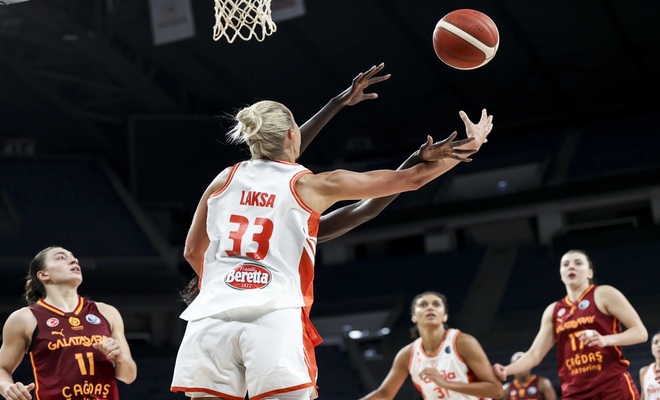
Gameday One gave us plenty of both. The four teams that fought through the Qualifiers went 4-0 and won by an average of 31.8 points. Fenerbahçe Tarfin and Beretta Famila Schio opened with convincing road wins in contender matchups. Casademont Zaragoza and Basket Landes produced the first overtime game of the season. ZVVZ USK Praha turned a tied halftime game into a second-half defensive clinic.
There was also a tactical theme that appeared again and again: teams using a Double Iverson alignment to flow into an empty-side pick-and-roll, then keeping the possession alive if the first advantage was taken away.
So this weekly piece will work in three parts: what happened, what comes next and Coach’s Corner. The goal is not to recap every possession. It is to identify what from the week actually matters going forward.
What Happened
The qualifier teams are for real
The cleanest headline from Week 1 is almost absurd: all four teams that came through the Qualifiers won, all four won by at least 24 points, and all four currently sit first in their respective groups on point differential.
Kibirkstis-TOKS beat Athinaikos Qualco 103-65. KKZ Crvena Zvezda handled Kangoeroes Basket Mechelen 89-56. Emlak Konut opened its first-ever EuroLeague Women Regular Season with an 85-61 win over Lotto AZS UMCS Lublin. Flammes Carolo Basket beat CS Rapid Bucuresti 98-66. The combined margin was 127 points.
That does not mean all four are suddenly Final Six teams. It does mean the qualification route was not a separate tier of competition. Those games prepared teams that already had real structure, and Week 1 showed that structure translated immediately.
Kibirkstis was the loudest statement. The Lithuanian side shot 57 percent from the field and 54.6 percent from three, but the most encouraging part was the process behind the percentages. Vilius Stanišauskas kept generating advantages through smart cutting, off-ball screening, pick-and-roll and transition rather than simply waiting for difficult shots to fall. Nausia Woolfolk supplied the downhill pressure, Niyah Becker gave them an inside-out connector, and Zoe Wadoux turned the attention she commands as a shooter into opportunities for everyone else. Wadoux finished only one rebound and one assist short of a triple-double, a useful illustration of why her value cannot be reduced to made threes.
There will be shooting regression. Nobody should build a projection around 54.6 percent from deep. The question is whether the spacing and decision-making that produced those shots are sustainable. Through the two qualifier rounds and the opener, the answer has been yes.
Crvena Zvezda’s identity was even clearer. Marina Maljković’s team held Mechelen to 29 percent shooting and only 18.4 percent from three. The pressure started full court, sometimes became a trap as soon as the ball crossed half court, and remained physical once Mechelen finally entered its offense. The damage was not limited to steals. Deflections, denied passing lanes and catches several feet farther from the basket repeatedly forced Mechelen to start possessions in bad positions.
The Serbian offense still has room to grow. Artemis Spanou can initiate from the frontcourt and Destanni Henderson can create downhill, but there were stretches without the same order seen on the defensive end. That is actually a useful early-season distinction: Zvezda already has something it knows can travel every week, while the offense still has a clear runway for improvement.
Emlak Konut may have shown the highest two-way ceiling of the qualifier group. The Turkish side beat Lublin 85-61 behind another connected pick-and-roll performance and a massive night from Stephanie Mavunga, who finished with 29 points, 11 rebounds and two blocks for a Gameday-best efficiency rating of 37. Pallas Kunaiyi added a 13-point, 13-rebound double-double.
Lublin did find one useful counter with a 3-2 zone, especially in the first half. The more important detail was Emlak’s response. Rather than continuing to attack the same spaces, they were better prepared when the zone returned after halftime. Defensively, they mixed man-to-man with zone possessions, rotated sharply and stayed connected through long Lublin actions. The qualifier offense was already impressive. A defense capable of changing shape by opponent is what makes the ceiling more interesting.
Flammes Carolo completed the 4-0 sweep with a 98-66 win over Rapid Bucuresti. Coline Franchelin controlled the game with 12 points, 13 assists and three steals, and the team shot 59 percent from the field. The same variety we saw in qualifying was present again: pick-and-roll, off-ball movement, post touches and quick continuation after the first advantage. Rapid was overmatched, so the level of opponent matters, but scoring 98 while making the game look collective rather than individual is still a statement.
Fenerbahçe and Schio looked like contenders
The opening week also gave us two games between teams with legitimate Final Six ambitions, and both road teams left with convincing wins.
Fenerbahçe began its title defense by beating Valencia 88-69. The game was effectively tilted in the first quarter, when the champions won the period 27-12 and immediately forced Valencia to chase. Javier Torralba’s team showed some of the ideas that should define its season, especially a faster five-out attack built around pick-and-roll, but the execution was not ready for Fenerbahçe’s activity and collective awareness.
Ahmet Çakı changed the picture of ball-screen possessions without changing the personnel every time. Fenerbahçe could sit in drop, show higher at the level or bring more aggressive help depending on who was involved. On offense, the ball moved through high-IQ actions rather than stopping with one star. One sequence that stood out was Emma Meesseman flowing from a dribble handoff into a flare action, the kind of layered possession that forces a defense to guard more than the first threat. Leila Lacan was the leading scorer with 19 points.
There is still something for the champions to clean up. The turnover count was too high, with too many mistakes that were not directly forced by Valencia. Against a better executing opponent, those lost possessions become much more expensive. The larger takeaway, though, was how coherent a heavily changed roster already looked.
Schio’s 84-66 win at Galatasaray may have been even more revealing. Galatasaray was heavily depleted, opening without Dorka Juhász, Natasha Howard and Marine Fauthoux, while Janelle Salaün remained with Golden State ahead of the WNBA Finals. Schio was also without Cecilia Zandalasini, but the Italians showed a clear offensive identity without their best closer.
They ran when the advantage was obvious and were perfectly comfortable playing longer half-court possessions when it was not. Those possessions were long in time, not slow in thought. The ball kept moving through multiple actions, and Schio repeatedly found value against Galatasaray’s pick-and-roll coverage by hitting the big on the short roll in central actions and then playing from the next decision.
Galatasaray tried several answers, including targeting Mariam Coulibaly in ball-screen defense and using bigger lineups to hunt deep seals. Nothing consistently produced clean offense. The absences matter and make it too early to draw a definitive conclusion about Galatasaray, but Schio did exactly what a contender should do against a short-handed opponent: remove the suspense.
Seventy-six was the magic number, but the games could not have looked more different
Every winner in Week 1 scored at least 76 points. Two teams landed exactly on that number, and they got there in completely different ways.
USK Praha was tied 34-34 with Tango Bourges at halftime before turning the second half into a defensive problem Bourges never solved. USK won the final 20 minutes 42-21 and allowed only six points in the fourth quarter. Brianna Fraser led the way with 21 points on 9-of-11 shooting, adding four rebounds, three assists and two blocks. The score finished 76-55, but the important split was before and after halftime: once Praha raised the defensive pressure, Bourges never found a second offensive answer.
Zaragoza needed overtime to reach 76 against Basket Landes, and the game already has an early claim as one of the best of the season. Zaragoza led 25-14 after the first quarter, Landes spent the next 30 minutes pulling the game back and then moved ahead 68-61 with 57 seconds left. Zaragoza responded with a 7-0 finish to regulation, with Merritt Hempe’s free throws in the final seconds sending the game to overtime before the home side survived 76-75.
Mariona Ortiz was the control center throughout. Her 15 assists tied the third-highest single-game total of the modern EuroLeague Women era and made her only the fourth player in that era to reach 15. Trinity San Antonio was excellent in defeat for Landes, finishing her competition debut with 23 points, five rebounds, three steals and two assists.
The result matters for Zaragoza. The way it happened may matter even more for Landes. They lost in the same arena and to the same opponent that ended their 2025-26 season, but San Antonio immediately looked capable of absorbing major backcourt responsibility. That is a useful positive to take from a painful loss.
Standings notes and one piece of news
After one round, the standings contain a perfect little symmetry. The four qualifier teams lead all four groups on point differential: Kibirkstis in Group A, Crvena Zvezda in Group B, Flammes in Group C and Emlak Konut in Group D. Zaragoza, Schio, Fenerbahçe and USK are the other 1-0 teams.
It is one game, so nobody should pretend those tables are predictive yet. They do matter in one respect: the First Round only lasts six games, and results against teams that advance are carried into the Second Round. A strong October result can still be sitting in the standings months later.
Away from the court, Galatasaray head coach Frédéric Dusart added another job this week after being named head coach of the Türkiye national team for the next stage of the FIBA Women’s EuroBasket 2027 Qualifiers. The national-team windows come later, but it is another layer of responsibility for a coach already integrating a new Galatasaray roster.
What Comes Next
Gameday Two brings six games on Wednesday and two more on Thursday. It is too early for anything to be mathematically decisive, but a 2-0 start in a six-game group creates real leverage, while 0-2 immediately shrinks the margin for error.
Basket Landes vs. Kibirkstis-TOKS: is the Lithuanian offense this real?
This is the game that should tell us the most about Kibirkstis. Athinaikos never found a way to disrupt their rhythm in Vilnius. Landes should be much more physical, much more experienced and backed by one of the strongest home environments in the competition.
The test is not whether Kibirkstis can make half its threes again. It is whether the same advantages survive when the shooting cools. Woolfolk has to create against more ball pressure, Wadoux has to continue producing value even when she is denied clean catches, and Becker’s ability to connect the interior and perimeter game becomes more important against Murjanatu Musa and the Landes frontcourt.
Landes also has its own pressure point. San Antonio looked immediately comfortable in her EuroLeague debut, and her ability to turn defensive activity into pace could keep Kibirkstis from controlling the offensive environment the way it did against Athinaikos. This is the clearest “prove it again” game of the week.
Valencia vs. Flammes Carolo: an early pressure game for the favorite
Valencia entered the season with Final Six ambitions and now comes home at 0-1 to face a Flammes team that has won three straight EuroLeague games including the qualifiers.
The matchup should revolve around whether Valencia can keep its pick-and-roll attack organized against Flammes’ ball pressure. Carolo wants to make handlers uncomfortable, force the offense away from its preferred entry points and turn mistakes into transition. Valencia needs Alexis Peterson-Smalls and the secondary creators to move the defense before Carolo can dictate where the possession begins.
At the other end, Flammes has to prove its Week 1 rebounding improvement can travel. Defensive rebounding was an issue last season, and Valencia has enough size to make every failed box-out hurt. A Carolo road win would put the qualifier at 2-0 and give it a major head start in the fight to advance. For Valencia, avoiding 0-2 matters just as much.
Beretta Famila Schio vs. KKZ Crvena Zvezda: unbeaten, but built in opposite directions
This is the best pure style clash of Gameday Two.
Schio wants to move through layers of offense until the defense gives up the right shot. Crvena Zvezda wants to prevent those layers from ever developing by applying pressure before the offense reaches its preferred spots.
Watch the first pass after Schio’s ball screens. Galatasaray struggled when the Italians found the short roll and played from there. Zvezda’s activity can make that pass difficult, but overcommitting to the ball also creates the exact four-on-three situations Schio wants.
Cecilia Zandalasini remains with Golden State during the WNBA Finals, with Game 3 scheduled for October 21, so Schio is expected to remain without its star wing for Thursday’s game. That reduces some of the late-clock advantage. It does not remove the depth Schio showed in Istanbul.
Tango Bourges vs. Emlak Konut: the next road test for the team nobody should call a surprise anymore
Emlak already won away at Panathinaikos and Girona in the Qualifiers. Bourges is another road game against a historic club, but the Turkish side has earned the right to enter it with confidence.
The key remains the way Emlak connects actions. Lindsay Allen can create the first shift, and Réka Lelik has been excellent attacking the second side after the defense has already changed responsibilities. Bourges needs its switching and ball pressure to prevent that first advantage rather than hoping to recover after it.
At the other end, Emlak’s defensive versatility is the part worth testing. Lublin had stretches of success with patience and with a 3-2 zone defensively, but Emlak adjusted. Bourges has more experience and should present more varied half-court problems. If Emlak wins this one as well, the conversation changes from “dangerous newcomer” to legitimate Group D favorite.
Athinaikos needs a response, and Galatasaray needs bodies
Athinaikos returns home to face Zaragoza after losing by 38 in Vilnius. One bad night does not erase the talent on that roster, but the first response matters. Julie Vanloo needs more support in creating advantages, and the Fasoula-Macaulay frontcourt combinations have to produce enough interior pressure to prevent Zaragoza from dictating every matchup. Falling to 0-2 in Group A would not end the season, but it would make the remaining four games significantly less forgiving.
Galatasaray travels to Mechelen after its own difficult opening. Availability is the first thing to monitor. Janelle Salaün remains with Golden State for the WNBA Finals, while Dorka Juhász, Natasha Howard and Marine Fauthoux all missed the Schio game. Their status should be watched rather than assumed. Mechelen is the opponent Galatasaray would choose for a bounce-back on paper, but another short-handed rotation would make the game more interesting than the names suggest.
The favorites still have to travel
The other two games are Lotto AZS UMCS Lublin hosting USK Praha and CS Rapid Bucuresti hosting Fenerbahçe. USK and Fenerbahçe are clear favorites, but both games are useful measuring sticks.
For USK, the question is whether the second-half defense from the Bourges win appears from the opening possession. For Fenerbahçe, it is whether the champions can reduce the unforced mistakes from Valencia while maintaining the same defensive activity and collective offensive flow.
The outcomes may be predictable. The quality of the performances still tells us something.
Coach’s Corner: Why “Double Iverson into Empty-Side Pick-and-Roll” was everywhere
One action kept appearing across Gameday One: a Double Iverson alignment flowing into an empty-side pick-and-roll. Emlak Konut has been hurting defenses with it since the Qualifiers, while Kangoeroes Basket Mechelen, USK Praha and Lublin all showed variations in Week 1. Valencia added its own wrinkle by setting the action higher on the floor to stretch the available space.
The roots are familiar. The Iverson cut was popularized as a way to get Allen Iverson a catch on the wing after running across a pair of screens near the elbows. Modern teams are using the same initial picture less as an endpoint and more as a disguise for what comes next.


The empty corner is the first reason the action is so difficult to guard. In a normal side pick-and-roll, the low defender can often tag the roller from the corner and then recover to the shooter. Remove that player and the defense has to find the tag from farther away, switch the action or bring help from a place the offense can immediately punish.
The second problem is the ram screen. Before the big even arrives to set the ball screen, another offensive player can screen the screener. That can create separation from the big defender, delay the coverage call and make a clean switch harder to execute. A slip becomes more dangerous, the guard has more room to reject the screen toward the baseline, and the roller or popper can arrive with momentum rather than standing still.


The third problem is what happens if the defense survives all of that. The spacing naturally leaves the offense ready to flow into another ball screen on the second side instead of resetting. This has been particularly valuable for Emlak. Allen can organize the first action, the defense shifts, and Lelik attacks the next side against players who have already changed responsibilities once.
There are answers. A defense can switch the Iverson cut early, top-lock the cutter, jam the ram screen or pre-rotate a weak-side defender before the ball screen develops. None is free. Switching can create a mismatch, top-locking opens back cuts, jamming requires excellent communication and early help risks giving up a skip pass or a clean second-side attack.
That is why the action is showing up so often. It is not one play designed to create one shot. It is a way to force the defense through several decisions before the real pick-and-roll has even started.
One week down
Week 1 gave us enough to be curious without giving us enough to be certain.
The qualifier teams were not overmatched. Fenerbahçe still looked like the champion. Schio looked like a team capable of reaching the deciding stages even without its closer. Zaragoza and Landes reminded us how little can separate two strong teams. Emlak and Kibirkstis showed offensive ideas that already look more sustainable than a one-night shooting streak.
Now the league gets its first chance to answer itself.
Can Kibirkstis create the same advantages in Landes? Can Flammes turn a dominant home opener into a road win at Valencia? Can Crvena Zvezda’s defense disrupt Schio the way it disrupted Mechelen? Can Emlak keep winning away from home? And which teams that opened badly can make Week 1 look like noise rather than signal?
That is what Gameday Two gets to tell us.
This article was co-written by the European Hoops Podcast team, André Lemos and João Caeiro. Follow us at @EthosEuroLeague and subscribe to the European Hoops Podcast wherever you listen to your favorite podcasts.
- About the Author
- Latest Posts

From the cliffs of Porto Moniz to the forests of Latvia. With a degree in business and a background in finance, I traded balance sheets for projection models, following a lifelong love of the game. I’ve played it, I’ve lived it and I’ve had the privilege of working inside team front offices at both the club and national level.
For over 20 years, I’ve also been immersed in the world of Fantasy Basketball, studying trends, finding edges and living the grind season after season. That passion has brought me here, to SportsEthos, where I’m honored to be part of our management team alongside the great Aaron Bruski. My mission is simple: help SportsEthos thrive as the premier home for Fantasy Sports and sports coverage. A place where users get real value and where every member of the team can sharpen their craft, find joy in the work and build something special that feels like home.