
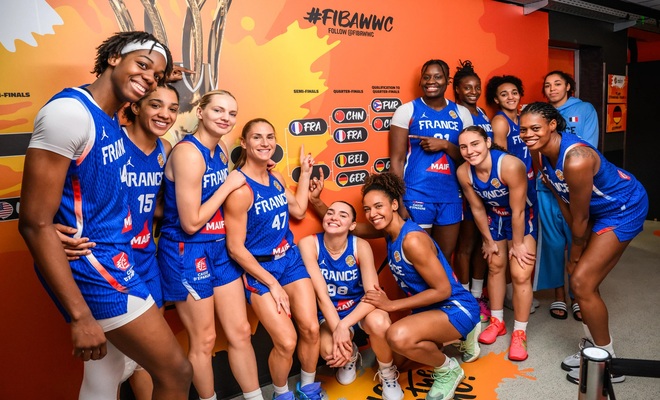
The FIBA Women’s World Cup is down to four teams after a quarterfinal round filled with history, dominant execution and one major upset.
USA rewrote the record book against Hungary, France solved China’s size, Germany knocked out Belgium and Spain overwhelmed a shorthanded Australia.
Now USA, France, Germany and Spain are one win away from the World Cup final.
USA Buries Hungary in Transition and Writes More World Cup History
Hungary found decent early answers against USA’s hard-edge pick-and-roll coverage.
They barely mattered.
USA turned mistakes into immediate offense, overwhelmed Hungary before the defense could organize and got a major lift when the second unit raised the pressure and pace. Hungary committed eight first-quarter turnovers, USA shot 14-of-19 from the field, and the quarterfinal was already 36-12 after 10 minutes.
From there, the night became historic: 108 points, the highest total ever in a FIBA Women’s World Cup game, the largest margin in a quarterfinal, and 31 assists, making USA the first team to reach 30 in a World Cup quarterfinal.
Hungary sees the opening, USA takes it away
Hungary’s initial offense was more promising than the score eventually suggested. It attacked USA’s hard-edge pick-and-roll coverage well, forcing the defense to recover and creating shots that were often reasonable even when they did not fall. Hungary also mixed in a 2-3 zone defensively, trying to prevent USA from simply playing downhill possession after possession.
The fundamental problem was access. Hungary could not consistently get the ball to Dorka Juhász or Virág Takács-Kiss in advantageous positions, nor could its guards create enough penetration once USA’s pressure tightened. The Americans, meanwhile, were consistently generating cleaner opportunities.
Aliyah Boston’s back-to-back threes pushed the margin to 26-9, but the shooting was only part of the damage. The second unit changed the defensive intensity and created a much faster game. By the end of the quarter, USA was shooting 79 percent from the field and 3-of-3 from three, leaving Hungary with almost no way to slow the avalanche.
USA turns the game into something Hungary cannot match
Hungary increasingly resorted to perimeter shooting in the second quarter. Many of the looks were acceptable, but the offense had become far too one-dimensional for a team that does not want to live entirely from three. Repeated pick-and-rolls were producing diminishing returns, while USA’s length continued making access to the frontcourt difficult.
Caitlin Clark added another layer whenever the Americans could attack early. She did not need to dominate as a scorer to influence the game. Her ability to hit runners or deliver an entry pass before the defense was set repeatedly created immediate advantages.
There was also a noticeable difference in tempo depending on the American lineup. With the starters, particularly Chelsea Gray initiating, the offense could become slower and feature less movement. The bench groups played faster and with more activity on both ends.
Hungary briefly produced a 5-0 run that forced a USA timeout midway through the quarter, but by halftime the larger picture was brutal. Hungary was shooting 5-of-16 on twos and 6-of-16 from three, while USA had already created a 59-30 lead.
The quarterfinal becomes history
The second half offered little relief. After a relatively balanced opening to the third quarter, USA produced an 8-0 run, Hungary briefly stopped it with a basket from Kinga Józsa-Povits, and the Americans immediately scored four more. Takács-Kiss did not record her first points until 3:16 remained in the period, another reflection of how completely USA had taken away one of Hungary’s most important offensive pieces.
Sonia Citron briefly left after taking a blow to the head in the third quarter but returned in the fourth. With the result already beyond doubt, USA continued finding useful combinations. Clark’s shooting percentages have not been her strongest feature in this tournament, but the offense continues to look significantly better with her ability to advance the ball and connect possessions. Kiki Iriafen and Angel Reese were particularly effective sprinting into space and giving Clark simple, athletic finishing targets.
Hungary managed only nine points in the fourth quarter, including just four across the first six-plus minutes, and USA closed out the 108-56 win without ever allowing the game to regain competitive tension.
USA reaches the semifinals with a statement
USA finished with a 52-16 advantage in points in the paint and converted Hungary’s 27 turnovers into 44 points, while its 31 assists showed how willingly the ball moved once advantages appeared.
Five Americans finished in double figures, led by Napheesa Collier with 19 points and six rebounds. For Hungary, Réka Lelik led the scoring with 12.
Hungary’s run ends after earning its place among the final eight, but USA gave it almost no opportunity to turn the quarterfinal into the kind of physical half-court contest that might have created uncertainty.
The result was not merely another semifinal berth.
It was a World Cup record book rewritten in 40 minutes.
France Solves China’s Size and Shoots Its Way Into the Semifinals
For 10 minutes, China looked capable of making France uncomfortable.
Shuyu Yang was getting into the paint, Han Xu was giving China an offensive anchor, and the introduction of Zhang Ziyu briefly changed what France could attempt around the basket. China answered an early French run with seven straight points of its own and, despite six first-quarter turnovers, produced perhaps its best stretch of basketball of the tournament.
France led only 25-20.
Then the game began to move away from China.
France’s defense progressively pushed the Chinese offense farther from the areas it wanted to occupy, while its own execution kept producing good shots against both man and zone. China often succeeded in making France shoot over the top rather than finish easily inside.
France simply made the shots.
By halftime the margin was 17. By the end of the third quarter it was 22, and France eventually advanced to the semifinals with a 90-61 win built as much on solving China’s defensive questions as imposing its own.
China gives France an early problem
France announced its defensive intentions immediately.
The full-court pressure produced an eight-second violation on China’s second possession, and Valériane Ayayi drew the initial assignment on Han Xu. A 7-0 French run soon followed, created largely through defensive pressure and poor Chinese possessions, forcing a timeout with 6:02 remaining.
China’s response was excellent.
Yang repeatedly found ways to penetrate the first line of the defense, and China came out of the timeout with seven unanswered points to tie the game. It was aggressive without abandoning its frontcourt, and for a period France was being forced to solve problems at both ends rather than simply dictate the terms.
Zhang entered with China ahead 20-18 and immediately made her size felt defensively, recording three blocks during her first stint. France adjusted quickly, using Dominique Malonga’s length against her and bringing additional help rather than allowing Zhang comfortable single coverage.
The bigger constant for France was Marine Johannès.
Johannès created advantages throughout the quarter and paired them with the kind of shot-making that changes what a defense can realistically take away. She scored nine points in the opening period, helping France turn a competitive first 10 minutes into a 25-20 lead.
China protects the paint, France accepts the invitation
China’s half-court defense did a lot right in the second quarter.
It protected the paint well, crowded France’s attempts to attack directly and increasingly forced the French offense toward jump shots. Given France’s athleticism and ability to finish inside, that was a reasonable trade.
The problem was the result rather than the process.
France made them.
Leïla Lacan was particularly efficient with her shot selection, and back-to-back French threes eventually pushed the margin to 13 with 2:41 remaining. China had succeeded in influencing where France was shooting from without actually lowering the efficiency of those possessions.
France was also winning around the margins. Nine offensive rebounds and seven steals by halftime created a stream of additional possessions, making it even harder for China to survive stretches in which its own offense struggled.
At the other end, France’s defense became increasingly disruptive. China was being forced to initiate farther from the three-point line, entries became more difficult and the second quarter produced only 11 Chinese points.
The double-big lineup offered no immediate escape. China paired Xu and Zhang while trailing by eight, but France handled those minutes comfortably and Malonga’s matchup with Zhang was particularly effective. Her length bothered Zhang’s catches and finishes without requiring France to completely distort its defense.
France reached halftime ahead 48-31.
France solves every coverage China shows
The third quarter removed most of the remaining uncertainty.
France opened with five straight points and looked equally comfortable playing quickly or operating in the half court. That balance mattered because China could no longer rely on simply getting France into a set defense and trusting its size to close space.
By the middle of the quarter, Xu and Yang had scored 29 of China’s 40 points, and no Chinese bench player had scored. China was still receiving strong production from its two most reliable creators, but there was very little beyond them.
France, meanwhile, kept finding solutions.
Against the zone, it overloaded one side of the floor to force China’s defenders into difficult choices, creating either open perimeter shots or lanes to attack once the defense shifted. Johannès punished that coverage with consecutive threes, pushing the lead to 24 with 2:36 remaining.
France also switched across the 3-through-5 positions defensively and continued managing Zhang without allowing her to become the center of the game. When she established position, France was willing to foul her before the shot and prevent the possession from developing into an easy finish. Zhang scored three points in the final 35 seconds of the quarter, but those were her first points of the game.
France led 70-48 entering the fourth.
France’s execution wins out
China made one final attempt to change the matchup by returning to Xu and Zhang together in the fourth quarter and involving both bigs in the same actions.
Again, France had an answer.
Its shooting stretched the larger Chinese lineup defensively, while Zhang’s mobility became something France could target at the other end. The quarter began slowly, with only four combined points across more than three minutes, but China never found the sustained run required to threaten the result.
France finished 14-of-37 from three and 21-of-42 on twos. Those numbers tell an important part of the story because China did not simply concede easy offense for 40 minutes. It regularly protected the most valuable areas of the floor and asked France to beat it with execution and shooting.
France did exactly that.
The possession battle made the challenge even larger. France collected 19 offensive rebounds to China’s two, while 11 French steals contributed to China’s 21 turnovers. Against a team already shooting this well, giving away that many additional opportunities left almost no margin for error.
Johannès finished with 15 points and seven assists, Janelle Salaün added 15 points and six rebounds, and Gabby Williams contributed 14 points and seven rebounds. Malonga’s nine rebounds, including six on the offensive glass, mattered enormously as well, but so did a defensive performance on Zhang that will not be captured completely by the box score.
For China, Xu finished with 21 points and nine rebounds, while Yang added 19 points and five assists. They were the two players most capable of consistently breaking through what France was doing, but France made the rest of the offense work too hard to sustain enough scoring around them.
China gave France a real basketball problem in the opening quarter and showed, for stretches, why its unusual frontcourt can change the geometry of a game.
France spent the next 30 minutes solving it.
Germany Solves Belgium’s Offense and Earns a Place in the Semifinals
We expected this to be one of the most difficult matchups Belgium could draw, and Germany showed exactly why. Its size and length gave it unusual flexibility against an offense that normally manipulates matchups until a clean advantage appears. Germany did not overwhelm Belgium with turnovers or completely erase its ball movement. Instead, it made those advantages harder to create, pushed Belgium toward more difficult shots and steadily found cleaner offense at the other end.
Emma Meesseman still produced 29 points, eight rebounds and three assists. Belgium finished with only five turnovers and 20 assists, and there were stretches when its defense kept the game within reach. Germany simply had more answers. Six players scored in double figures, Leonie Fiebich and Nyara Sabally impacted the game at both ends, and Germany pulled away for a deserved 93-74 win to reach the semifinals.
Belgium finds Meesseman early, Germany adjusts
Belgium immediately attacked Germany’s switching defense through Meesseman. She scored Belgium’s first five points by establishing herself against favorable matchups, and Belgium’s early offense looked familiar: identify the advantage, clear space and patiently work toward it. At the other end, Belgium also defended Germany’s frontcourt well enough to prevent the size advantage that had been so decisive against Korea from appearing immediately.
Germany consequently became perimeter-heavy. Eight of its first 13 shots came from three, with Fiebich providing the early release valve by making her first two attempts from deep. Belgium led 13-8 after an Allemand three and looked comfortable controlling the terms of the game.
Germany gradually changed that. Alexandra Wilke scored five straight to give Germany its first lead, and the offense began producing more attacks toward the basket rather than relying almost exclusively on jump shots. Fiebich found a finish inside, Frieda Bühner followed, and Sabally closed the quarter with another score as Germany turned a slow offensive start into a 22-19 lead.
That adjustment mattered. Belgium had done a good job of denying Germany’s initial plan, but once Germany stopped waiting for perimeter shots and began using its physicality in more varied ways, the matchup started to tilt.
Germany makes Belgium work for everything
The second quarter revealed the defensive challenge Belgium was facing. Germany pushed the margin to 29-19 while Belgium’s offense lost some of the fluidity of its opening possessions. The off-ball movement was still there, but the ball itself was no longer moving as easily from one advantage to the next, and Belgium increasingly reached shots without fully shifting the defense first.
Germany’s cross-matching played an important role. Fiebich took Meesseman, while Bühner could defend Antonia Delaere, helping Germany avoid repeatedly conceding the mismatch Belgium had exploited at the start. It did not remove Meesseman from the game, because very little does, but it made the path toward favorable situations more complicated.
Belgium responded intelligently. It cleared space for Meesseman to attack Bühner when that opportunity appeared and reduced a 13-point deficit to seven. Allemand then hit a pull-up three to make it 36-34 late in the half, but Germany answered immediately through threes from Sabally and Alexis Peterson to restore separation and go into halftime ahead 42-35.
The numbers supported what was happening without suggesting Belgium’s offense had completely broken down. Belgium had only two turnovers and 11 assists at halftime. The issue was efficiency. Germany was shooting 62 percent on twos, while Belgium was at 37 percent, and Fiebich had already scored 13 points. Germany was not winning by destroying Belgium’s decision-making; it was making good decisions produce less.
Germany begins finding the easier game
Belgium’s defensive work had kept the game manageable through the first half, but Germany started creating cleaner offense after the break. Sabally hit another three early in the third quarter, while Germany’s spacing increasingly opened driving lanes behind Belgium’s first line of defense. That produced an important contrast: Belgium was having to work deep into possessions to manufacture quality shots, while Germany began finding more direct routes to useful opportunities.
The shots were not consistently falling for Belgium either, which made the difficulty of the process even more costly. Germany opened the quarter strongly and eventually pushed the lead to 61-45. Belgium did find some late production through Kyara Linskens, and Julie Vanloo hit a three in the closing minute, but Bühner answered with seven late points and Germany reached the fourth ahead 74-59.
By then, the game was asking an enormous amount of Meesseman. Belgium still had enough quality to create stretches of resistance, but the offense increasingly depended on its best player manufacturing something against a defense specifically constructed to make that difficult.
Belgium pushes, Germany answers again
Belgium did not disappear. Meesseman continued carrying the offense, Lisowa-Mbaka added a basket, and Allemand turned a steal into a layup that cut the deficit to 83-71 with 5:35 remaining. Germany called timeout, and for a brief moment Belgium had injected some pressure back into the quarterfinal.
Meesseman already had 28 points, but the climb remained enormous, particularly as the foul situation became more complicated. Vanloo and Linskens both reached four fouls, and Linskens eventually fouled out with 3:41 remaining.
Germany then produced the response it had found every time Belgium threatened to get close. Peterson hit a pull-up three to make it 87-74 with 2:51 remaining, and Germany closed from there with control. The Peterson-Sabally two-woman game had also become another reliable source of offense during the fourth quarter, giving Belgium yet another action to solve after spending most of the night dealing with Germany’s size, spacing and versatility.
There would be no final run.
Germany deserved this one
The final numbers underline how unusual Germany’s defensive success was. Belgium finished with 20 assists and only five turnovers, while Germany had 19 assists and eight turnovers. This was not a game decided by Belgium suddenly losing its identity or becoming careless with the ball.
Germany simply made the offense less efficient. The Germans shot 48 percent from the field and 20-of-33 on twos, while Belgium finished at 42 percent overall. Germany also went 20-of-23 at the free-throw line, compared with Belgium’s 12-of-19, and won the rebounding battle 43-35.
Even the paint numbers tell an interesting story. Belgium actually outscored Germany there, 42-32. Germany’s advantage came from creating good shots across more areas of the floor, spacing Belgium out and consistently converting the opportunities that emerged.
Sabally finished with 16 points and 12 rebounds, including two threes after making only two across Germany’s first four games. Fiebich added 17 points, 10 rebounds and two blocks, while Peterson and Bühner scored 13 each, Gülich had 12 and Wilke added 10. Six Germans reached double figures.
Meesseman was magnificent for Belgium with 29 points, eight rebounds and three assists on 12-of-21 shooting. Linskens added 10 points, 10 rebounds and four assists before fouling out, Allemand finished with 10 points and seven assists, and Lisowa-Mbaka contributed 11.
Belgium will understandably leave disappointed. This is a team capable of playing some of the most beautiful basketball in the tournament, and there were still glimpses of it here, but this matchup always looked capable of asking unusually difficult questions of that style. Germany had the personnel to switch, cross-match and contest Belgium’s usual sources of advantage without sacrificing much elsewhere, then had the execution to make that defensive work count.
Belgium kept searching for solutions, and Germany kept finding the next one.
Spain’s Complete Performance Sends Australia Home and Books a Semifinal With USA
Spain’s shooting caught the eye first.
Its execution was even better.
The Spaniards made eight threes in the first half, shot 56 percent from the field and built a 21-point lead before Australia had much chance to settle into the quarterfinal. But this was never simply a case of one team getting hot. Spain consistently created clean advantages, moved the ball into favorable shots, attacked mismatches and received production from almost every part of the rotation.
Australia, already without Alanna Smith and Ezi Magbegor and bringing Jade Melbourne off the bench, kept competing. It cut into the deficit early in the second quarter, won the third and refused to allow the game to completely unravel.
Spain always had another answer.
The result was a convincing 89-66 win and a semifinal date with USA.
Spain’s execution sets the tone
Spain opened with Awa Fam and Megan Gustafson together, immediately giving Australia a different kind of problem with its size.
Australia punished Spain’s opening possession of zone with a Stephanie Reid three, prompting Spain to return quickly to man-to-man. At the other end, Spain went straight toward Fam. She collected her own miss and kicked the ball out to Iyana Martín for three, establishing one of the themes of the opening quarter: Spain could threaten Australia from inside and then turn that attention into quality perimeter looks.
Reid was magnificent early, making three of her first four threes and accounting for Australia’s first nine points. Spain simply kept producing.
Martín hit her second three to make it 10-6, continuing an impressive tournament from a young guard already contributing at this level with plenty of room still to grow. From there, Spain’s offense expanded. Alicia Flórez immediately changed the game off the bench with finishing, creation and defensive activity. Raquel Carrera scored inside, Alba Torrens hit consecutive threes, and Spain repeatedly found the next open player rather than allowing possessions to stagnate.
By the time Australia called timeout at 24-15, the concern was not merely Spain’s shooting percentage. A normally difficult Australian defense was being moved far too comfortably.
Spain closed the quarter ahead 31-17.
Australia pushes back, Spain finds another gear
Australia began the second quarter with the aggression it needed.
Isobel Borlase attacked downhill and kicked to Steph Talbot for three, helping reduce the margin to eight and forcing a Spanish timeout with 8:20 remaining. Australia briefly showed a 2-3 zone out of the stoppage, but Paula Ginzo found space immediately and knocked down a jumper.
Then Spain’s perimeter shooting became absurd.
Maite Cazorla’s three at 6:42 made Spain 7-of-9 from deep, but those numbers still reflected the quality of the offense more than a series of desperate makes. Spain was consistently moving Australia into rotation before taking the shot.
Australia’s initial surge disappeared quickly. Helena Pueyo and Ginzo generated steals, Cazorla hit another three, Gustafson scored after an offensive rebound and the lead climbed to 48-30.
Spain was also increasingly comfortable attacking closer to the basket. Fam finished off a Pueyo assist, while María Conde repeatedly penetrated and created additional possessions on the offensive glass. Australia kept trying to manufacture something through Borlase, Reid and Talbot, but Spain was making those drives difficult enough that the Opals could not generate the run they needed.
At halftime Spain led 58-37.
The numbers were spectacular: 8-of-13 from three, 56 percent overall and 15 assists. But perhaps more revealing was how many players were contributing. Martín and Flórez had nine points each, Gustafson had eight, while Cazorla, Torrens and Conde had six apiece.
Australia was not trying to stop one player.
It was trying to stop an entire offense.
Australia competes, but cannot reopen the game
The third quarter was Spain’s least convincing offensive stretch.
Australia opened poorly with the ball, committing five turnovers in a little more than two minutes, but Spain did not fully capitalize. Its perimeter shooting cooled dramatically and the offense became considerably less productive than it had been before halftime.
Australia took advantage enough to win the quarter 14-12.
Talbot, Miela Sowah, Chloe Bibby and Alex Wilson all provided scoring, with Wilson beating the buzzer from three. It was an important response from a shorthanded team that could easily have allowed a 21-point halftime deficit to become much larger.
The problem was that winning the quarter barely changed the situation.
Spain still led 70-51, and Australia had spent too many possessions simply trying to complete its offense cleanly to make a meaningful run at the lead.
That remained the challenge entering the fourth. The Opals were competing. They just were not getting close enough.
Spain closes without needing the threes
Australia continued pushing early in the fourth.
Wilson hit another three, Sowah scored in transition and the deficit came down to 74-58 with 7:56 remaining. Spain, however, did not need the shooting that had powered its first half to settle the game.
Carrera returned and helped steady the offense, and Spain increasingly attacked the basket and free-throw line rather than searching for another barrage from deep.
Around the four-minute mark, the last real opening disappeared. Martín attacked the rim, Carrera followed with a driving and-one, and Martín then turned a steal into another basket to move the lead back beyond 20.
Australia continued fighting through Bibby, Talbot and Borlase, but Spain remained composed enough to prevent any sustained pressure.
The final score was 89-66.
Much more than a shooting night
Spain finished 8-of-20 from three after making eight in the first half alone.
That decline did not matter because everything else remained.
Spain shot 48 percent from the field, recorded 26 assists on 31 made baskets and controlled the rebounding battle 38-32. It also finished with a 42-18 advantage in points in the paint, showing how completely the offense evolved once the early perimeter explosion cooled.
Australia’s 23 turnovers made an already difficult assignment even harder, but Spain’s performance should not be reduced to defensive disruption either. It consistently created quality offense from different players and different areas of the floor.
Gustafson led Spain with 16 points on 7-of-11 shooting. Martín added 13 points, four assists and three steals, while Conde and Flórez scored 10 each. Fam finished with nine points, eight rebounds and four assists, Carrera added nine and five, and Cazorla contributed eight points and five assists.
That balance was the defining feature.
For Australia, Talbot produced an excellent all-around performance with 11 points, 11 rebounds and seven assists. Reid finished with 11 after her brilliant opening stretch, while Wilson and Bibby scored 13 each.
Borlase, so extraordinary against Italy, endured a much more difficult night with eight points on 2-of-12 shooting and five turnovers. After everything she had been asked to carry in the previous round, Spain rarely allowed her to find the same downhill opportunities or finishing rhythm.
Australia leaves after competing through an increasingly difficult injury situation and refusing to fold even when Spain threatened to end the game early.
Spain simply gave it too much to solve.
The early threes created the separation. The execution, balance and adaptability made sure Australia never got it back.
This article was co-written by the European Hoops Podcast team, André Lemos and João Caeiro. Follow us at @EthosEuroLeague and subscribe to the European Hoops Podcast wherever you listen to your favorite podcasts.
- About the Author
- Latest Posts

From the cliffs of Porto Moniz to the forests of Latvia. With a degree in business and a background in finance, I traded balance sheets for projection models, following a lifelong love of the game. I’ve played it, I’ve lived it and I’ve had the privilege of working inside team front offices at both the club and national level.
For over 20 years, I’ve also been immersed in the world of Fantasy Basketball, studying trends, finding edges and living the grind season after season. That passion has brought me here, to SportsEthos, where I’m honored to be part of our management team alongside the great Aaron Bruski. My mission is simple: help SportsEthos thrive as the premier home for Fantasy Sports and sports coverage. A place where users get real value and where every member of the team can sharpen their craft, find joy in the work and build something special that feels like home.