
The FIBA Women’s World Cup quarterfinal field is set after two dramatic final qualification games.
China survived Puerto Rico behind a huge fourth quarter from Han Xu, while Australia escaped Italy after one of the most remarkable comebacks of the tournament.
Now only eight teams remain, and every possession carries medal implications.
Han Xu Takes Over Late as China Survives Puerto Rico 75-72
Puerto Rico pushed China to the final possessions, but Han Xu decided the fourth quarter.
She scored 14 points in the period and repeatedly answered Puerto Rico’s pressure before Xinyu Luo’s corner three created the separation China needed to survive and advance to face France.
Puerto Rico stretches China from the start
Puerto Rico’s offensive idea was clear immediately.
It opened in five-out spacing, trying to pull Xu away from the basket and create driving lanes behind her. San Antonio took advantage first, scoring Puerto Rico’s opening six points and consistently looking to turn the corner before China could establish its preferred defensive shape.
China answered with shooting. It opened 4-of-4 from three and used that early perimeter efficiency to stay ahead despite Puerto Rico’s pressure after made baskets.
The complexion changed when Zhang entered for the final four minutes of the quarter. China shifted into its zone, and Puerto Rico initially struggled to solve it, committing three turnovers during that stretch. All seven of Puerto Rico’s late points came either in transition or from baseline out-of-bounds situations rather than sustained half-court offense.
China led 24-21 after one, having made four threes while also holding a 12-6 advantage in points in the paint.
Puerto Rico starts making the zone move
Puerto Rico spent the second quarter searching for ways to change the geometry at both ends.
Defensively, it mixed coverages. In man-to-man, Puerto Rico switched away from the ball to preserve size closer to the basket, while also showing a hybrid 1-3-1/3-2 zone. Offensively, the adjustment against Zhang was even more important.
When she returned with 4:17 remaining, Puerto Rico immediately doubled her on catches inside. Zhang passed well out of the pressure, but Puerto Rico was also beginning to understand how to attack China’s zone more effectively. Instead of driving directly into its length, the ball moved through the high post and short corner, forcing Zhang to cover more ground and make decisions away from the basket.
Back-to-back Puerto Rico threes briefly produced a one-point lead, and the perimeter contrast had shifted dramatically from the opening minutes. China went without a three after the 9:32 mark of the quarter, while Puerto Rico reached halftime 4-of-9 from deep.
The game itself became increasingly messy, with 10 combined turnovers in the second quarter, but San Antonio remained the most consistent Puerto Rican creator. She had 14 points and two steals at halftime, while Shuyu Yang was driving China with 12 points and six assists.
China led only 41-40.
Neither team can solve the half court
The third quarter became a grind.
Puerto Rico turned the ball over on its first two possessions, while McGee-Stafford settled for difficult jumpers against Xu rather than consistently forcing the defense to move. More than four minutes produced only a 3-2 Puerto Rico edge, and neither side generated sustained quality offense.
China used Zhang selectively, even checking her in specifically for baseline out-of-bounds possessions. She scored four points directly from those situations, offering China an efficient way to use her physical advantage without leaving her exposed for long defensive stretches.
Puerto Rico answered by going to a 2-3 zone when Zhang returned late in the quarter. She scored three points in just over a minute before checking back out, continuing a fascinating game of tactical substitutions and counter-adjustments.
San Antonio buried a three late to send Puerto Rico into the fourth ahead 53-52.
Han Xu decides the fourth
Xu’s three at 7:54 was China’s first since early in the second quarter and started a 5-0 run. McGee-Stafford answered with an and-one, but Xu scored again as the roller to restore a four-point lead with 4:17 remaining.
Coming out of a timeout, San Antonio’s defensive activity helped force consecutive Chinese turnovers and fuel a 4-0 response that tied the game. Xu broke the tie herself with another three at 2:50.
From there, Puerto Rico’s execution began to unravel. Guirantes committed back-to-back turnovers and followed them with a difficult shot, allowing China to finally open some space. Luo then hit the corner three with 1:40 remaining that pushed the margin to six.
San Antonio found McGee-Stafford to cut it to four, and a loose Xu turnover gave Guirantes the chance to make it a two-point game with 25.7 seconds remaining. Yang calmly made both free throws at the other end, and Puerto Rico used too much time on its final possession to create another realistic comeback opportunity.
China survives
Xu finished with 21 points and 11 rebounds, including 14 in the fourth quarter, while Yang added 15 points and 11 assists and Zhang produced 13 points in only nine minutes.
China advances to face France in the quarterfinals.
Puerto Rico’s run also deserves to be remembered for what Trinity San Antonio produced in its final game. She finished with 24 points, nine rebounds, seven assists and five steals, becoming the first player in Women’s World Cup history to record that combination in a single game. The numbers were extraordinary, but they only begin to capture her impact.
San Antonio was Puerto Rico’s creator, disruptor and emotional engine, repeatedly dragging them back into a game that could easily have slipped away. Puerto Rico leaves the tournament just three points short of the quarterfinals, but San Antonio leaves having written her name into World Cup history.
Australia Survives Italy’s Furious Comeback, but Italy Leaves Us Believing
There are nights when basketball seems to resist you.
You know what you want to do. You know the reads, the actions, the places you are supposed to reach. You care desperately about doing it well. Yet for reasons both tactical and human, the game keeps pulling everything away from you. The pass arrives a fraction late. The lane closes. The frustration grows. The basket seems smaller.
For three quarters, Italy lived inside that feeling.
Australia was better. Clearly better. The Opals attacked Italy’s defense through the pick-and-roll, consistently touched the paint, moved the ball beautifully and turned those advantages into trips to the free-throw line. Isobel Borlase produced a magnificent performance, and even after Ezi Magbegor left the game in the first quarter and did not return, Australia kept finding solutions and built a lead that reached 26.
Italy looked frustrated, disconnected and, at times, almost trapped inside the game it desperately wanted to play.
Then Italy scored 31 points in the fourth quarter.
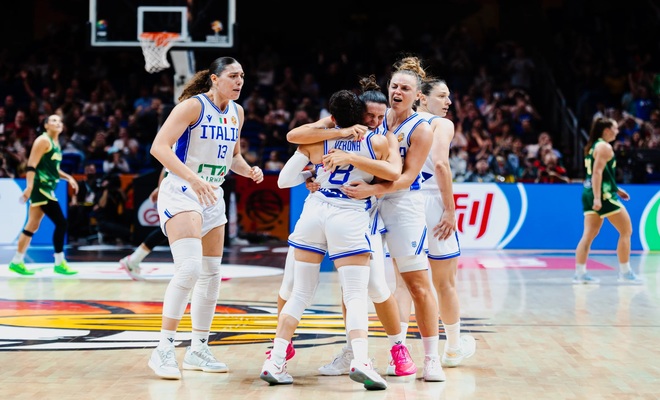
And with 4.2 seconds remaining, Francesca Pasa ran almost the entire length of the floor, put a layup off the glass to tie the game, and watched the ball roll around the rim before falling out.
Australia survived, 82-80, and deservedly moves into the quarterfinals.
Italy goes home.
Basketball can be cruel enough for both of those things to be true at once.
Australia finds the game Italy cannot stop
With Alanna Smith already ruled out for the rest of the tournament, Australia entered another elimination game without one of its most important half-court pieces. The opening possession nevertheless established exactly what the Opals wanted, using a well-designed set to create a low-post touch for Magbegor and an immediate basket.
Italy picked up full court from the beginning and searched for Lorela Cubaj inside, while both teams attacked quickly enough to produce a 7-6 Italian lead in less than two minutes. That early success did not last. Australia began getting into the paint far too comfortably, with its pick-and-roll offense creating problems possession after possession and its empty-side actions proving particularly difficult for Italy to contain.
Magbegor left the game with 5:51 remaining in the first quarter and did not return. Losing another major frontcourt player could easily have disrupted Australia, but instead the Opals produced an 8-0 run that forced an Italian timeout.
Italy’s own problems were growing. Matilde Villa was barely involved early, the half-court offense struggled to create clean advantages, and Italy went almost five minutes without scoring. Even when it shifted into a 2-3 zone late in the quarter, unnecessary fouls kept giving Australia another route to points.
Six of Italy’s 13 first-quarter points came after turnovers. In the settled half court, very little was working. Australia went 7-of-10 on twos and 12-of-15 at the line, while Italy managed only 3-of-12 inside the arc.
The Opals led 26-13.
Borlase punishes every opening
Italy finally found something in the second quarter.
Pasa hit an early three that helped trigger a 7-0 run, cutting the deficit to eight and forcing Australia to stop the game. Italy leaned increasingly on its 2-3 zone, trying to change the rhythm of an Australian offense that had been finding the paint too easily.
Australia kept finding the next answer.
Alex Fowler stopped the run with a basket, and the Opals continued sharing the ball well enough to create closeout after closeout. When Italy committed extra attention inside, Australia moved the defense and attacked the next rotation before it could recover.
The middle of the quarter became a duel of individual bursts. Costanza Verona scored six straight to pull Italy within seven, only for Borlase to respond with six consecutive points of her own and restore a 13-point margin.
Borlase was spectacular.
She reached halftime with 23 points, attacking every opening Italy gave her and becoming the scoring engine of an Australian offense that rarely allowed the defense to settle. Australia had also attempted 22 free throws by the break, converting 18, compared with Italy’s 8-of-10.
That disparity was partly the product of Italy’s growing frustration. The Italians were a step late defensively too often, and Australia kept turning those small delays into contact, rotations and high-value opportunities.
The halftime score was 48-33.
Australia had complete command.
Italy reaches the point where basketball feels impossibly hard
The third quarter looked as though it might end the game completely.
Australia opened with five straight points while Italy immediately added more turnovers. Zitina Aokuso gave the Opals another imposing presence around the basket, and Australian guards continued reaching the rim without enough resistance.
Australia went to its own 2-3 zone defensively, and Italy struggled badly to make it move. The ball was not shifting defenders enough, good looks were difficult to generate and the margin eventually reached 26.
This was the part of the night that felt heavier than a tactical problem.
Italy had spent the tournament showing exactly who it was: physical, stubborn, intelligent and absolutely willing to drag more talented opponents into uncomfortable basketball. It had pushed USA to the final possessions. It had found ways to survive games without beautiful offense. It had made people believe.
Now nothing seemed to work.
Yet Italy closed the quarter on a 7-2 run.
The score was still 69-49. Twenty points remained between the teams. There was no sensible reason to believe one final quarter could undo everything that had happened during the first three.
Italy apparently did not care about sensible reasons.
Thirty-one points of refusal
The fourth quarter began with Italy playing as though the previous 30 minutes had never happened.
Vittoria Blasigh hit a three during a 9-2 opening run that cut the margin to 13. The defensive intensity rose sharply, Australia began turning the ball over and possessions that had once ended with comfortable Opals attacks suddenly became difficult.
Italy kept coming.
The threes started falling. Drives reached the basket. Cubaj and Olbis Futo André supplied important scores from the frontcourt. The pressure that had looked ineffective earlier in the evening now produced hesitation.
Most importantly, Italy stopped looking like a team burdened by everything that had gone wrong.
It looked free.
Verona eventually buried a three with 1:09 remaining to tie the game at 77-77.
A team that had trailed by 26 had erased every point of it.
Australia deserves enormous credit for what happened next because surviving a comeback like that requires its own kind of composure. Borlase found Aokuso on the roll to restore the lead, and after an Italian miss, Australia successfully challenged a call before Sami Whitcomb Wilson went to the line and made both free throws.
With 8.3 seconds left, Australia led by four.
And then came the moment that may stay with me longer than anything else in this game.
Vittoria Blasigh and the reason we love this game
Blasigh is 22 years old.
She gives Italy an extraordinary 13 points in only 15 minutes, making all three of her attempts from beyond the arc. With Italy down four and its World Cup almost over, she received the ball after the timeout and launched from well behind the three-point line.
It went in.
Of course it went in.
For a fraction of a second, she celebrated so naturally that she almost lost track of the defensive assignment waiting at the other end. Not because she did not understand the situation. Not because she did not care.
Because she is 22 years old, had just made an outrageous shot in an elimination game at the World Cup, and joy arrived before thought could catch it.
That smile was basketball.
There is something beautiful about the imperfection of that moment. Elite sport often asks us to talk about players as if they are machines built to execute. Every rotation must be perfect, every emotional response controlled, every possession processed instantly.
But the whole reason any of this matters is because people care.
They dream about these shots. They spend years trying to become good enough to take them. They feel fear, pressure, frustration and joy, sometimes within seconds of one another.
Blasigh made the shot because she was good enough to take it.
She smiled because she loved what she had just done.
Basketball should always have room for both.
Millimeters
Borlase split the free throws at the other end, leaving Italy down two with 4.2 seconds remaining.
Pasa took the ball and ran.
There was no time for an elaborate final set or a sequence of counters. She went the length of the floor, reached the basket and put the ball softly off the backboard.
For a moment, it was going in.
The ball reached the rim, rolled toward the basket and seemed ready to drop. Five more minutes were sitting there. A 26-point comeback, overtime, one more chance for Italy to continue this impossible night.
Then the ball came out.
And the pain of that moment did not belong only to Italy.
Borlase, the 21-year-old hero of the night, raised her arms because Australia had won. She had scored 30 points, carried the Opals through enormous adversity and earned every bit of that celebration. But look around her and the reaction is almost extraordinary. Australian players seem momentarily perplexed themselves, happy to have survived but still absorbing what they had just seen. For a second, winner and loser appeared caught inside the same disbelief.
On the sideline, Sandy Brondello had her hands on her head.
It was the reaction of almost everyone watching.
How did that not go in?
That is part of the strange beauty of sport. Australia had done its job. It deserved to celebrate. Italy had done almost everything required to create one of the great comebacks of the tournament. Pasa had reached the basket and given the ball every opportunity to fall.
And still, the basketball gods offered no overtime.
Only the rim.
Only the ball rolling out.
Only two teams standing there trying to process what had just happened.
There are misses where the process is poor, where the defense forces the wrong decision or a possession falls apart. This was not one of them. Pasa attacked the moment and gave Italy exactly the chance it needed. The difference between another five minutes and elimination was measured in millimeters.
Only the best players in the world ever earn the right to take a shot carrying that much weight.
And sometimes, as spectators, we are lucky simply to be there for it.
To watch a game like this, to feel the hope build, to experience the disbelief of the comeback and then share that final second with players on both sides is one of the privileges of loving basketball. It does not matter whether it happens at a World Cup, in a local gym or on an empty court somewhere nobody is watching.
Sometimes we are lucky enough to be part of something.
Basketball gives us those moments.
Australia earned this
None of Italy’s fourth-quarter magic should obscure how well Australia played.
The Opals were the superior team for three quarters and created their advantage through excellent basketball. Their pick-and-roll offense repeatedly broke down Italy’s defense, the ball moved well enough to create favorable closeouts and their aggression generated 37 free-throw attempts, of which they made 27.
Australia finished with 25 assists, another reflection of how well the offense operated for most of the night.
Borlase was exceptional with 30 points, carrying an enormous offensive load after Magbegor left the game. Aokuso added 15 points and six rebounds, while Steph Talbot produced 14 points, nine rebounds and five assists.
Australia also deserves credit for surviving the psychological force of that fourth quarter. Once a 26-point advantage disappears and the opponent ties the game, the previous three quarters no longer protect you. Australia still found the roll for Aokuso, defended the next possession, won the challenge and made enough free throws to escape.
The Opals earned their quarterfinal place.
Italy made us believe
Verona finished with 23 points. Blasigh produced 13 in those remarkable 15 minutes. Italy somehow scored 80 even with Cecilia Zandalasini and Villa, its two leading scorers, combining for only 14.
But numbers cannot really explain why this one hurts.
Italy’s World Cup ended on a missed layup after it had spent an entire quarter refusing the obvious ending.
For three quarters, the game seemed to be taking something away from them. The offense would not cooperate. Australia was better. Frustration was visible. The margin kept growing.
That feeling exists at every level of basketball. Sometimes you love the game desperately and it does not seem to love you back.
The special teams keep playing anyway.
Italy did more than keep playing. It punched back against that feeling until an impossible game was tied with 69 seconds remaining. A 22-year-old buried a shot from another postcode and smiled like a child who had just discovered basketball for the first time. Pasa ran the floor with the season in her hands and came within the width of a rim of giving them five more minutes.
I am sure none of this will mean much to the Italian players tonight.
They wanted to win.
They came close enough to touch it.
And then it disappeared.
But there will be another tournament. Blasigh will be older. Villa will have another season behind her. This young group will have lived through what happened here and carry it with them.
And when Italy takes the floor again, there will be people waiting to watch.
Because this team made its country proud.
Because it made the rest of us believe.
And because after a game like this, how could you not want to see what they do next?
This article was co-written by the European Hoops Podcast team, André Lemos and João Caeiro. Follow us at @EthosEuroLeague and subscribe to the European Hoops Podcast wherever you listen to your favorite podcasts.
- About the Author
- Latest Posts

From the cliffs of Porto Moniz to the forests of Latvia. With a degree in business and a background in finance, I traded balance sheets for projection models, following a lifelong love of the game. I’ve played it, I’ve lived it and I’ve had the privilege of working inside team front offices at both the club and national level.
For over 20 years, I’ve also been immersed in the world of Fantasy Basketball, studying trends, finding edges and living the grind season after season. That passion has brought me here, to SportsEthos, where I’m honored to be part of our management team alongside the great Aaron Bruski. My mission is simple: help SportsEthos thrive as the premier home for Fantasy Sports and sports coverage. A place where users get real value and where every member of the team can sharpen their craft, find joy in the work and build something special that feels like home.