
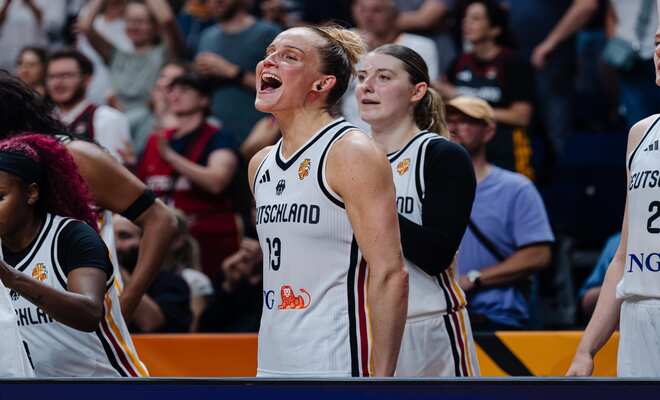
The FIBA Women’s World Cup field is down to 10 teams, with Hungary and Germany claiming two more quarterfinal places on Day 5.
Hungary found scoring beyond Dorka Juhász to end Japan’s run, while Germany leaned into its size and interior advantage to make history on home soil.
Now only two spots remain. Italy faces Australia in a matchup between medal contenders, while Puerto Rico looks to continue its surprise run against China as Day 6 decides the final quarterfinal field.
Hungary Finds More Than Juhász and Ends Japan’s World Cup Run
Hungary knew exactly what Japan was going to try to take away.
These teams had met during the World Cup qualifiers, when Dorka Juhász overwhelmed Japan with 35 points and nine rebounds in a 77-65 Hungarian win. This time, Japan built much of its defense around denying the same kind of influence.
Hungary simply found other answers. Réka Lelik carried the offense early, Virág Takács-Kiss took over the third quarter and Hungary’s perimeter shooting punished Japan whenever its defense committed too much attention elsewhere.
The reward is a place in the quarterfinals against USA.
Japan takes away the first option, Hungary keeps moving
Hungary opened the game 7-0 and quickly showed it had no interest in forcing the obvious matchup. Japan doubled inside and attacked Hungary’s frontcourt in space, but Hungary kept the ball moving. Lelik became the early beneficiary, scoring eight first-quarter points on 4-of-5 shooting.
At the other end, Hungary had a thoughtful plan for Japan’s pick-and-roll game. It used late switches, with the guard veering back toward the popping big while Hungary’s big took the ball-handler, helping deny one of the spacing advantages Japan was trying to create. The scrambling behind those coverages was strong as well, preventing many of the easy looks Japan normally generates once the defense has been shifted.
Japan still found some clever solutions. It attacked Juhász on closeouts, drove aggressively toward the rim and used the gravity of its shooters to open slips in off-ball actions. The process was often good, but the finishing was not. Japan shot just 22 percent in the opening quarter, while Hungary made 53 percent of its attempts and led 20-12 despite Japan holding a 4-1 advantage on the offensive glass.
Japan’s pressure finally creates a game
Japan continued changing the picture defensively in the second quarter. Side pick-and-rolls were blitzed, full-court pressure appeared after dead balls and Japan briefly went bigger with Maki Takada and Ramu Tokashiki together.
For much of the half, Hungary handled those adjustments well. The ball moved quickly, Japan was repeatedly forced into extra rotations and Hungary consistently found perimeter looks when the defense overcommitted. Across the full first half, Hungary went 8-of-17 from three, a major reason it was able to stay in front even as Japan increased the pressure.
Then a Hungarian technical foul helped open the door for Japan. Hungary committed four turnovers during the stretch that followed, and Japan finally found the transition opportunities it had been searching for. Stephanie Mawuli hit a three on the break, while Japan’s pressure began creating the faster, less controlled possessions it needed.
The most difficult moment of the half had nothing to do with the score. Saki Hayashi left the game after suffering what appeared to be a serious arm injury and did not return. It was a painful way for her World Cup to end after one of the tournament’s most memorable individual performances, when she made nine threes against Mali to set the Women’s World Cup record. Whatever comes next, she leaves this tournament having put her name in its history, and hopefully her recovery is a smooth one.
Japan continued pushing after her departure. A sequence of missed free throws still produced second chances, and the deficit fell to just three before Ágnes Studer hit a three at the halftime buzzer.
Hungary led 37-34 despite Japan shooting only 10-of-33 from the field for the half. Japan had compensated by getting to the line, making 10 of 14 free throws compared with Hungary’s 3-of-6, while Hungary’s 8-of-17 shooting from three provided the scoring efficiency that kept it ahead.
Takács-Kiss changes the second half
Hungary started the third quarter the same way it had started the first, with a 7-0 run.
This time, the separation came through Takács-Kiss. She had gone scoreless in the first half, but Hungary began actively searching for her after the break and she responded with 10 points in the quarter.
Japan could not generate enough offense to match her production. It scored only four points over the first seven-plus minutes of the period, and although Norika Konno eventually provided six points during a late response, Hungary had already rebuilt a comfortable advantage.
The foul line widened it further. Japan committed several avoidable fouls, and Hungary punished them by going 11-of-12 at the stripe in the quarter. What had been a three-point game at halftime became a 58-45 Hungarian lead entering the fourth.
Takács-Kiss had given Hungary exactly what it needed.
Hungary keeps Japan from finding another run
Japan’s best route back remained speed, and Hungary did an excellent job preventing transition possessions from developing throughout the game. When necessary, it used fouls to stop breaks before Japan could exploit an unsettled defense.
Japan still searched for solutions in the half court, including a 1-4 alignment into central pick-and-roll with smart cutting around the action. But its scoring never became consistent enough. Hungary’s defense kept forcing difficult stretches, and its bench was also quick to use timeouts whenever Japan appeared capable of putting consecutive possessions together.
Takács-Kiss hit a three to stretch the lead to 17 with 5:26 remaining. Konno answered from deep, prompting another Hungarian timeout, before Juhász contributed six important fourth-quarter points. Dóra Kányási then buried the three with 2:54 left that effectively ended Japan’s hopes.
Hungary had enough answers
Lelik finished with 23 points and eight rebounds, setting the tone when Hungary needed someone else to lead the offense. Takács-Kiss scored all 17 of her points in the second half and added eight rebounds, becoming the decisive scorer after halftime.
Hungary’s shooting was another major separator. It finished 11-of-25 from three, while Japan went just 7-of-33. Kokoro Tanaka was Japan’s only double-digit scorer, while Rui Machida turned back the clock as a creator with 12 assists.
Japan had stretches of excellent basketball. Its pressure changed the second quarter, its movement created intelligent openings and it continued searching for ways to attack Hungary’s defensive coverages. The shots simply did not fall often enough to sustain those stretches.
Hungary moves on to face USA in the quarterfinals.
For Japan, the World Cup ends here, with Hayashi’s record-setting performance against Mali remaining one of the unforgettable moments of its run. Hopefully, the next news about her is good news.
Germany Overpowers Korea and Makes World Cup History on Home Soil
Germany spent part of the first half playing away from its clearest advantage, then corrected course decisively.
Korea’s pressure created some early discomfort, and Germany briefly helped by settling for too many perimeter shots. Once the hosts started consistently getting the ball closer to the basket, using cuts, high-low actions and their frontcourt mobility to attack Korea’s coverages, the game changed completely.
Germany went just 5-of-25 from three but shot 63 percent on twos, a contrast that captured where the game was won and sent the hosts into the first Women’s World Cup quarterfinal in program history.
Korea creates an early problem
Germany opened 5-0, but Haeran Lee quickly gave Korea a foothold by scoring its first eight points and helping tie the game at 8-8. Korea’s pressure also began disrupting Germany’s initiation, pushing the hosts away from the areas where their physical advantage mattered most.
Frieda Bühner steadied Germany with a three, free throws and attacks to the basket, helping build a 23-14 lead after one. Korea responded again early in the second through Leeseul Kang, whose eight straight points, including back-to-back threes, cut the margin to 27-22.
That was the point where Germany’s shot selection became the issue. It was taking too many perimeter attempts and allowing Korea to stay close despite owning a much clearer advantage elsewhere.
The high-low game breaks Korea open
Germany began attacking much more directly. The ball started going inside, cuts came behind Korea’s double teams and the connection between Bühner and Marie Gülich became the centerpiece.
Back-to-back high-low actions produced four straight Gülich points, and Germany later returned to the same concept with Gülich cutting down from the elbow for another finish. Korea tried to crowd those catches, but once the second defender committed, Germany consistently found the next pass before the defense could recover.
The lead grew to 46-29 by halftime, with Gülich scoring 14 points on 7-of-8 shooting and Germany holding a 28-12 advantage in points in the paint.
The important part was not simply that Germany was bigger. It had started using that advantage with precision.
Korea changes the coverage, not the problem
Korea spent the second half cycling through answers. It opened with an active zone that collapsed hard toward Germany’s frontcourt, then returned to man-to-man, mixed in doubles and kept changing the defensive picture.
Germany continued moving the defense, making the next pass and reaching productive scoring areas without relying on the three-ball. The margin reached 61-36 midway through the third, while Lina Sontag and Clara Bielefeld added steals that turned stops into easier offense.
By the end of the period, Germany led 68-40. The fourth became about finishing professionally rather than solving anything new, with Luisa Geiselsöder remaining efficient, Nyara Sabally, Sontag and Bühner continuing to contribute around the basket, and Alexandra Wilke adding a three and an and-one.
Germany closed out a 94-56 win without allowing the game to regain any tension.
Germany’s balance tells the story
Gülich led the way with 19 points on 7-of-9 shooting, adding five rebounds and three assists. Bühner scored 17, Geiselsöder added 12 on 6-of-9 shooting, and Sabally produced 10 points, five rebounds and six assists. Leonie Fiebich affected the game everywhere despite scoring only eight, finishing with 11 rebounds, four assists and three blocks.
Lee was excellent for Korea with 21 points on 10-of-13 shooting, while Kang added 17, but there was too little offense beyond them to keep pace.
Germany also finished with 30 assists against only seven turnovers, another reflection of how cleanly it played once the offense began consistently reaching the right areas.
The defending European champions now wait in the quarterfinals. Belgium will enter as favorites, but Germany has legitimate ways to make the matchup difficult through its physicality, versatility and ability to create from multiple positions. There is also recent history between the teams, with Germany beating Belgium 83-69 during the Olympic group stage.
That result guarantees nothing, but Germany has already shown it can hurt this Belgian core and now gets the chance to do it again with a semifinal place on the line.
This article was co-written by the European Hoops Podcast team, André Lemos and João Caeiro. Follow us at @EthosEuroLeague and subscribe to the European Hoops Podcast wherever you listen to your favorite podcasts.
- About the Author
- Latest Posts

From the cliffs of Porto Moniz to the forests of Latvia. With a degree in business and a background in finance, I traded balance sheets for projection models, following a lifelong love of the game. I’ve played it, I’ve lived it and I’ve had the privilege of working inside team front offices at both the club and national level.
For over 20 years, I’ve also been immersed in the world of Fantasy Basketball, studying trends, finding edges and living the grind season after season. That passion has brought me here, to SportsEthos, where I’m honored to be part of our management team alongside the great Aaron Bruski. My mission is simple: help SportsEthos thrive as the premier home for Fantasy Sports and sports coverage. A place where users get real value and where every member of the team can sharpen their craft, find joy in the work and build something special that feels like home.