
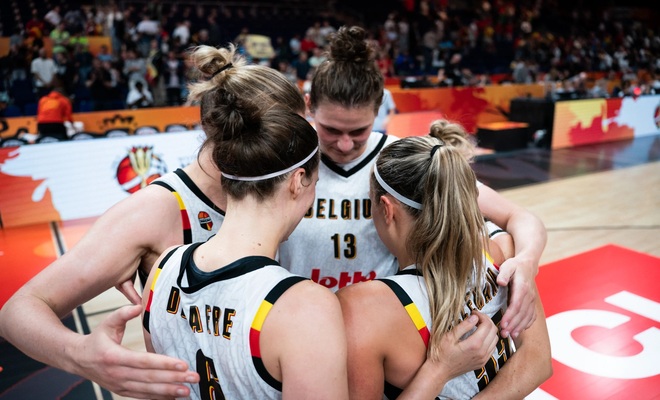
The FIBA Women’s World Cup group stage closed with records, statement wins and the knockout picture finally taking shape.
Belgium claimed first place behind a historic Julie Allemand performance, France rewrote the record book from three, USA and Spain rolled into the next phase, while Puerto Rico kept its tournament alive.
We break down all eight games and look ahead to the first elimination matchups of Day 5.
Belgium came into the afternoon playing for first place in the group and a place on the opposite side of the bracket from USA.
Then Julie Allemand made history, Emma Meesseman nearly produced a triple-double, and Australia spent most of the game chasing a team that always seemed one decision ahead.
Belgium won 80-68 with perhaps its most complete performance of the World Cup so far. The Cats moved the ball beautifully, defended with real collective sharpness and never allowed one of the tournament’s most physical teams to dictate the game.
Allemand entered five assists away from becoming the Women’s World Cup’s all-time leader. She reached the record before halftime. Meesseman finished with 22 points, 10 rebounds and eight assists.
Together, they gave the game its shape.
Belgium’s first pass was rarely the point, and neither was the first screen. One action bent the defense, another forced a new decision, and by the time the shot came, Australia had often been asked to solve two or three problems in the space of a few seconds.
That is what made the afternoon feel special.
Belgium did not simply beat Australia.
It made the game look unmistakably Belgian.
Australia starts chasing almost immediately
Julie Allemand hit a three early and smiled, usually a dangerous sign for whoever is standing across from Belgium.
The Cats had arrived ready to play fast, but speed was only part of the problem Australia faced. The real difficulty was how much happened within each Belgian half-court trip. The ball changed sides, players cut through the defense and one action flowed directly into the next. Belgium could run something, see Australia handle the first part correctly and simply continue until another opening appeared. Even the misses often came from strong process.
Australia’s offense looked more individual by comparison. The Opals searched for Stephanie Talbot on the wing and in the post, tried to establish Zitina Aokuso on the block and used their physical advantages where they could, but many attacks became static and dependent on somebody winning a matchup. Belgium rarely made those wins comfortable.
The Cats were connected defensively from the opening quarter, forcing Australia to work in the half court while also attacking the offensive glass themselves. Belgium grabbed two offensive rebounds almost immediately and had six by halftime, an important detail against an Australian team built to punish opponents physically.
Australia did find opportunities when Belgian turnovers allowed it to run, but once the game settled, the contrast became increasingly clear. Belgium was creating advantages collectively, while Australia was being asked to solve more of its offense individually.
The Cats closed the first quarter on an 8-4 run to lead 23-17, having made eight of their 12 two-point attempts while Australia was just 6-of-15.
And Allemand was only getting started.
Julie Allemand makes history exactly as Julie Allemand should
There are records that tell you how long somebody has played.
This one tells you who Julie Allemand is.
Her pick-and-roll passing was on full display in the second quarter. She waited for defenders to commit, changed the timing of actions, found rollers the instant the window appeared and kept manipulating Australia until the defense finally gave something away.
Allemand entered this World Cup with 87 career assists, then handed out 17 more over Belgium’s first two games. That left her at 104 entering the matchup with Australia, five short of the record. Before the first half was over, she had reached the top of the Women’s World Cup assist list.
Think about the names she passed: Laia Palau, Sue Bird, Dawn Staley. Three of the great guards international basketball has known. Allemand has reached this point in only her third World Cup, with this tournament itself still in the group stage, while Bird and Palau each played five.
But the number alone is not what made the moment beautiful.
Watch Belgium play and the record makes perfect sense.
Allemand does not pass simply because she prefers to create for others. She passes because she sees where the advantage is going to appear. She understands what the defense has already conceded, sometimes before the defense fully recognizes it itself.
Against Australia, that intelligence was everywhere.
Belgium’s defense helped fuel a 7-0 run and a 10-point lead, with all five players moving together and the rotations arriving sharply enough to hold Australia scoreless through several stretches. Ezi Magbegor eventually broke one drought inside, and Australia answered with a 6-0 run to climb back within six.
Belgium needed a response, and Meesseman supplied it without needing the ball for long. A sharp off-ball defensive play became a steal, then smart movement at the other end drew contact and sent her to the line for two free throws.
That is Meesseman in miniature: changing a game without needing every possession to run through her.
Australia had begun doing a better job staying with Belgium deeper into the shot clock, but Billie Massey’s three at the halftime buzzer restored a seven-point advantage.
Belgium 40, Australia 33.
And somewhere inside those first 20 minutes, Julie Allemand had become No. 1.
Julie and Emma start playing basketball in their own language
Australia came out of halftime with adjustments.
Belgium kept finding answers.
One of the Cats’ most effective actions was an empty-side pick-and-roll with Meesseman operating as the short roller. It put Australia in a brutal sequence of decisions: contain Allemand, account for Emma receiving the ball in the middle of the floor, then recover quickly enough to deal with whatever came next.
Because Meesseman catching in space is rarely the end of the action.
More often, it is where the defense’s real problem begins.
She can score. She can find the cutter. She can fire the ball to the perimeter. She can hold it for half a beat and let the defense rotate itself out of position.
Australia also tried to involve Magbegor through the pitch handoff that had worked so well against Türkiye, looking to release her toward her right hand, but Belgium was ready for it. The Cats opened the third quarter 7-3 and pushed the advantage to 11 before Australia answered after a timeout with six straight points.
Julie Vanloo responded immediately with a three out of Belgium’s timeout, another reminder of why this offense can be so difficult to contain. Take away one solution and another appears. Commit more attention to Meesseman and Allemand sees the next read. Collapse on their two-woman game and Vanloo is waiting beyond it.
And when Julie and Emma began working directly together, there were stretches when basketball looked almost impossibly simple. A screen created a read, the read became a pass, the pass led to movement, and the next opening appeared before Australia had fully recovered from the first one.
Two players understanding not only where the other is, but where she is going to be.
Australia did find more success getting its guards downhill during the quarter, and its rebounding improved significantly after halftime. Belgium did not collect a single offensive rebound in the third, while back-to-back turnovers to close the period gave the Opals enough life to remain close.
After three quarters, it was only 60-55.
Australia was still there.
But it had spent almost the entire game solving problems.
Belgium was about to give it several more.
The Cats find another gear
Allemand opened the fourth-quarter separation with the kind of shot that changes the feeling inside an arena: an off-the-bounce three that pushed Belgium back ahead by 10.
The Cats opened the quarter 5-0 and eventually stretched the run to 11-2 as Australia’s execution began to unravel. Four turnovers came during that stretch, each one another sign that Belgium had tightened the game at exactly the right moment. Australia had committed only four turnovers through the first three quarters. It committed seven in the fourth.
That was where the game finally broke.
The Opals responded to a timeout with four quick points, but Antonia Delaere buried a corner three before the momentum could grow. Vanloo followed with four straight points, and Belgium had pushed the margin to 15 with 2:21 remaining.
Australia still tried to summon one last push. Chloe Bibby hit a three and Magbegor finished a layup, leaving just enough time to imagine one final run if Belgium opened the door.
Emma closed it.
Her mid-range jumper with 40 seconds remaining was soft, certain and final, a fitting dagger from a player who had spent the entire game doing almost everything else first.
She scored when Belgium needed scoring, rebounded against one of the tournament’s strongest frontcourts, created for teammates, defended away from the ball and became the decision-maker in the short roll whenever Australia committed two defenders to the initial action.
Twenty-two points. Ten rebounds. Eight assists.
A near triple-double in a game for first place against Australia, and somehow even that line does not fully capture how much of the game she touched.
This is what Belgium can be
Belgium finished with 28 assists to Australia’s 18, and that number is not decoration.
It is the clearest expression of what separated the teams.
The Cats made Australia defend decisions rather than players. They linked actions together, kept cutting after the first advantage disappeared and trusted that one more pass would eventually reveal the opening. At the other end, they were just as collective, allowing only six offensive rebounds against an Australian team capable of overwhelming opponents with size and physicality.
Meesseman was magnificent with 22 points, 10 rebounds and eight assists. Kyara Linskens added a double-double with 12 points and 10 rebounds. Vanloo contributed 12 points and five assists.
And Allemand?
Eleven points. Seven assists. Another afternoon spent deciding where the basketball needed to go, except this one will live forever in the record book.
She reached the World Cup assist record doing what she has always done: seeing beyond herself.
There is something perfect about that. Basketball celebrates scoring because scoring is loud. The crowd rises when the shot falls, and highlights remember the player who finishes the play. Allemand has built a career seeing everything that has to happen before that moment: the defender leaning half a step too far, the roller arriving behind the help, the teammate waiting in the corner, the pass that turns movement into advantage.
And beside her is Meesseman, another superstar whose greatness has never required the game to stop around her. She screens, passes, cuts, rebounds, steals, scores and thinks her way through possessions while making everyone around her better.
That is why watching Belgium at its best can feel different.
It is not simply beautiful because the ball moves.
It is beautiful because the players understand why it should move.
Australia came to Berlin playing for first place in the group.
Belgium made them chase shadows.
The Cats are group winners. Julie Allemand is the Women’s World Cup’s all-time assist leader. Emma Meesseman came within two assists of a triple-double.
And when these two see the game like this, and the rest of Belgium sees it with them, basketball can become something truly special.
Türkiye kept winning extra chances. Puerto Rico kept creating the better shots.
That contrast defined a wonderful back-and-forth game. Türkiye collected 20 offensive rebounds and repeatedly survived poor shooting by winning the ball back around the rim. Puerto Rico answered by attacking inside, where it shot 63 percent on twos and found its most reliable offense.
Then the fourth quarter changed everything.
Pamela Rosado hit the threes that erased Türkiye’s lead, Trinity San Antonio took over the game’s energy, and Arella Guirantes supplied the composure at the finish. Puerto Rico came from seven down after three quarters and won 75-71 in a game with 10 lead changes and six ties.
Türkiye is eliminated.
Puerto Rico gets to keep playing for a place in the quarterfinals.
Türkiye keeps finding another chance
Puerto Rico looked sharper first.
It opened with more activity, attacked Türkiye before the defense could settle and built a 14-10 advantage through the opening five minutes. An early attempt to show zone lasted only briefly after Türkiye immediately punished it from the perimeter, sending Puerto Rico back to man-to-man.
Then Sevgi Uzun began taking over the Turkish offense.
Türkiye’s defense started making Puerto Rico’s creation more difficult, and Uzun supplied the points required to turn that resistance into something tangible. She hit a three to give Türkiye a 15-14 lead, added two free throws moments later and had scored 10 of her team’s first 17 points.
Puerto Rico responded to move back ahead, but Türkiye had already found the other element that would sustain it throughout the afternoon: the offensive glass.
Even while shooting only 32 percent in the first quarter compared with Puerto Rico’s 47 percent, Türkiye collected five offensive rebounds. That work kept it attached to a game Puerto Rico had largely played better.
Then came a final swing with one second remaining.
Derin Erdoğan drew a three-shot foul and converted all three free throws.
Türkiye led 20-19 after one.
Puerto Rico’s best offense is waiting inside
Puerto Rico did not need to search very far for its advantage.
When it attacked the paint, Türkiye struggled to contain it.
The problem was that Puerto Rico did not always stay there.
At halftime, the contrast was almost absurd: Puerto Rico had made 14 of 21 two-point attempts and just 2 of 13 threes. When the ball went downhill, the offense produced. When it drifted toward the perimeter, Türkiye was being given a reprieve.
Trinity San Antonio understood where the opportunities were. She reached halftime with 10 points on 5-of-8 shooting, consistently bringing force to the spaces Türkiye was having difficulty protecting.
Still, Türkiye led 40-37 because the offensive glass kept bailing out poor shooting.
Ten offensive rebounds had already produced a 13-2 advantage in second-chance points. Elif Bayram became increasingly important in that battle, finding the ball around the rim, extending trips and making Puerto Rico defend for longer than it wanted.
Uzun remained the organizer around all of it. Türkiye’s offense became noticeably more difficult when she went to the bench in the second quarter, with Puerto Rico moving ahead 29-28. Once she returned, Türkiye immediately looked more comfortable, turning that deficit into a 35-29 lead.
Puerto Rico fought back by forcing turnovers and running, tying the game at 37.
Uzun answered one more time.
Her third three of the half dropped with 16 seconds remaining, sending Türkiye into halftime ahead 40-37 with 13 points.
Bayram owns the glass, but Puerto Rico stays close enough
Türkiye came out of halftime with its best sustained stretch of offense.
Tilbe Şenyürek Arslan and Uzun hit early threes. Olcay Çakır added another. For the first time, the work Türkiye had been doing on the glass was being paired with enough perimeter shot-making to create real separation.
Bayram remained at the center of everything physical.
By the end of the third quarter, Türkiye had an astonishing 18 offensive rebounds. Bayram accounted for seven of them herself and had already assembled 13 points and 12 rebounds, repeatedly winning loose balls and finishing around the basket.
Türkiye led 58-51 after three.
Yet even then, Puerto Rico’s path remained obvious. Thirty of its points had already come in the paint, while its perimeter shooting sat at just 2-of-15. Guirantes could create, McGee-Stafford gave them a target inside and San Antonio kept bringing the kind of force the game demanded.
Seven points still did not feel safe.
San Antonio changes the fourth quarter
Rosado changed the game first.
Back-to-back threes erased Türkiye’s lead and put Puerto Rico ahead 59-58 with 8:23 remaining. Almost immediately, Bayram went down injured, a brutal interruption to a performance built on relentless work around the rim.
Then San Antonio took over the energy of the game.
Her impact was bigger than the box score. She pressured the ball, disrupted Türkiye’s execution and kept attacking, giving Puerto Rico exactly the lift it needed while Türkiye struggled to reset. When she scored again with 3:28 remaining, Puerto Rico led 67-60.
The final minutes tightened quickly.
Türkiye tried to rescue a broken trip with its final timeout and just 0.4 seconds left on the shot clock, but the restart ended in an offensive foul on Uzun for moving on the back screen. Puerto Rico punished the mistake immediately, with Guirantes finishing a reverse layup to make it 69-65.
Another Uzun turnover released San Antonio in transition, stretching the margin to 71-65 with 39 seconds left.
Even then, Türkiye found one last answer.
Çakır buried a pull-up three to cut the margin to three. McGee-Stafford answered with two free throws, but Şenyürek Arslan drew a three-shot foul on the next trip and made all three, dragging Türkiye back to 73-71 with five seconds remaining.
After nearly 40 minutes of swings, missed chances and second efforts, everything came down to one inbound.
Puerto Rico found Guirantes.
She drew the foul, made both free throws and restored the four-point lead. Erdoğan’s final pull-up three missed with one second left, and Puerto Rico finally had the 75-71 win.
Puerto Rico earns another game
Türkiye finished with 20 offensive rebounds. Puerto Rico finished shooting 51 percent from the field and 63 percent on twos.
That was the game in miniature.
Türkiye created more chances. Puerto Rico made more of the ones it had.
Guirantes finished with 21 points and supplied the composure Puerto Rico needed at the end. San Antonio scored 18 on 9-of-13 shooting, her fourth-quarter energy becoming one of the defining forces of the comeback. McGee-Stafford added 16 points and 14 rebounds.
Uzun finished with 18 points and eight assists after carrying Türkiye through enormous stretches of the game. Bayram had 13 points and 12 rebounds, including seven offensive boards, before her afternoon ended painfully early.
Puerto Rico moves on with a chance to reach the quarterfinals.
Türkiye’s World Cup is over.
Hungary knew where its advantage was.
Korea spent almost the entire afternoon trying to stop them from reaching it.
The size was obvious. So was the damage Hungary could do around the basket. Early in the game, Dorka Juhász and the Hungarian frontcourt were getting exactly where they wanted, while Korea struggled to handle the physical disparity and found itself staring at a 17-9 deficit.
Then Korea changed the game.
Its guards pushed higher, the pressure became more aggressive, Hungary’s entries became harder to make and the high-low game became more difficult to access. By the second half, a game Hungary had looked completely comfortable controlling had become a fight for every possession.
Korea erased the gap, took the lead and stayed within one shot deep into the fourth quarter. Hungary still found a way, leaning on Juhász, the offensive glass and one huge late three to finally create separation.
The reward is second place in the group.
Hungary starts by playing exactly the game it wants
This may have been the most composed Hungary had looked all tournament.
Against a Korean team constantly searching for speed, Hungary refused to be dragged into an open game. It got back defensively, kept Korea out of transition and patiently searched for the size advantages waiting at the other end.
Those advantages were not difficult to find.
Hungary went inside early and often, while defensively switching 1-through-5 with impressive discipline. Korea’s movement normally forces defenders through multiple decisions, but the switches prevented the first action from immediately creating separation. Without transition opportunities to accelerate the game, Korea was being asked to manufacture offense against a bigger defense already in position.
Hungary led 13-6, then 17-9.
Isaem Choi provided Korea’s first meaningful response, scoring five straight points late in the opening quarter and helping reduce the deficit to 19-16. Hungary still carried a 20-16 lead into the second, but Korea had found enough offense to stay connected.
Then its pressure began changing the matchup.
Hungary continued getting production around the basket, with Juhász scoring inside and reaching the line, but Korea started extending its defense farther from the paint. The Hungarian guards suddenly had less time to initiate, passing angles became more difficult and getting the ball to the frontcourt stopped being automatic.
Hungary still had the size advantage.
Korea was beginning to deny access to it.
A brief injury concern added another complication. Juhász came down awkwardly on her left hand and went to the bench to have it checked, while Virág Takács-Kiss also appeared to be dealing with a hand issue. Juhász soon returned, but Korea had already begun changing the terms of the game.
By the final two minutes of the half, Hungary had seven turnovers and Korea’s pressure was making every initiation more uncomfortable. The lead fell to 38-36 before Hungary steadied itself, with Takács-Kiss producing a steal and Réka Lelik converting two free throws.
Hungary led 40-36 at halftime.
The size advantage was still there. The question had become whether Hungary could consistently reach it.
Korea turns pressure into belief
The answer became increasingly complicated in the third quarter.
Hungary briefly pushed the lead to 45-39, then committed four turnovers in less than two minutes. Korea was no longer merely making the offense uncomfortable. It was turning disruption directly into points.
Heji An stole the ball and Haeran Lee finished in transition. Later, Sohee Lee turned two more Hungarian mistakes into five points, first hitting a three and then stealing the ball and scoring in the open floor.
What had been a composed half-court matchup was now being played on Korea’s terms more frequently. Hungary could not get comfortably into its actions, and each mistake created another opportunity for Korea to speed everything up.
Yeeun Heo tied the game at 51 with a three. Turner briefly put Hungary back ahead after an offensive rebound, only for Sohee Lee to answer immediately from deep and give Korea a 54-53 lead.
Hungary recovered before the end of the quarter, carrying a 58-56 advantage into the fourth despite 15 turnovers and 10 Korean steals.
What kept Hungary upright was the glass.
The rebounding margin stood at 31-19 after three quarters, and Juhász had 17 points and nine rebounds. Even while Korea was disrupting the route to Hungary’s preferred offense, the Hungarians were still imposing size in other ways.
That would matter enormously late.
The glass gives Hungary its way out
Jihyun Park tied the game at 62 early in the fourth, and from there neither side could create meaningful separation. Korea continued pressuring Hungary’s guards while Hungary searched for ways to get its size back into the game.
Eventually, the offensive glass provided them.
With Hungary protecting a narrow lead, Ágnes Studer missed two free throws, but Kinga Józsa-Povits collected the miss and scored to make it 68-64. It was her second important offensive rebound in a short span, both producing baskets at a moment when clean half-court offense had become difficult to find.
Korea kept answering. Park scored to cut the margin to two, and after Hungary rebuilt it to five from the line, Choi buried a three to make it 72-70 with just over a minute remaining.
Then the game finally gave Hungary a chance to breathe.
A defensive stop was followed by a Korean five-second inbound violation. With 55 seconds left, Juhász stepped beyond the arc and buried the shot of the afternoon.
77-70.
Heo answered with another three, but Hungary handled the final seconds from the line and on the glass. Appropriately, the last decisive play came when Takács-Kiss grabbed a missed Turner free throw and finished the putback that stretched the margin beyond Korea’s reach.
Hungary survives by reaching its advantage often enough
Hungary finished with 21 turnovers.
Korea generated 10 steals and scored 22 points off those mistakes.
But the other side of the box score explains why Hungary survived.
43-21 on the glass.
Twelve offensive rebounds.
A 17-8 advantage in second-chance points.
Juhász finished with an excellent 22 points and 11 rebounds, including four offensive boards, and made both of her three-point attempts. Takács-Kiss added 14 points, eight rebounds and four assists, while Turner scored 12.
For Korea, Park finished with 21 points, while 42 percent shooting from three kept the game close deep into the fourth.
Hungary takes second place in the group. Korea takes third. Both move into the crossover round with a quarterfinal place still available.
And when Hungary finally needed one shot to breathe, Dorka Juhász stepped outside and made it.
France had already secured first place, while Nigeria was playing only for its first win of the World Cup. The difference in stakes did nothing to soften the mismatch.
Nigeria brought energy and physicality, but France’s length erased space around the basket, its pressure turned mistakes into points, and its shooting quickly made the game impossible to contain. By halftime, France led 65-26.
There was never much doubt about the result. The interest came from seeing just how complete France could make the performance.
Nigeria brings the fight, France removes the space
Nigeria opened with tremendous activity on both ends.
The physicality was immediate, and France did not simply walk into clean offense. Nigeria challenged catches, fought through actions and tried to make every trip demanding.
The problem was what happened at the other end.
France’s length began shrinking Nigeria’s options almost immediately. Drives that might normally reach the rim ran into bodies and arms. Possessions stretched deeper into the shot clock. Even when Nigeria succeeded in creating an opening, finishing through the size waiting inside became another problem entirely.
Nigeria went just 1-of-8 on two-point attempts in the first quarter, a brutal illustration of how little was available near the basket.
France, meanwhile, kept finding solutions.
Marine Johannès supplied the early shot-making, knocking down a three to push the lead to 16-7 before continuing an excellent opening quarter. France moved the ball well, punished the attention Nigeria had to commit elsewhere and finished the period with eight assists and seven made threes.
Johannès already had 11 points on 4-of-5 shooting.
France led 31-13.
There was one uncomfortable moment late in the quarter when Dominique Malonga went down after taking contact around the leg or knee area. She left briefly, creating understandable concern, but returned during the second quarter and was able to continue.
That was about the only moment all afternoon when France looked genuinely unsettled.
The game breaks open from everywhere at once
By the middle of the second quarter, the question was no longer whether France would win.
It was how far the performance might go.
The defensive pressure intensified. Nigeria’s possessions continued to become more difficult, and mistakes increasingly became French offense before Nigeria could even organize defensively. By halftime, France had forced 15 turnovers and scored 22 points off them.
Then there was the shooting.
France reached 11 made threes through roughly 15 minutes. By halftime, it was 14-of-25 from deep.
The shooting was spectacular, but it was not disconnected from everything else France was doing. The ball was moving, the defense was creating transition chances and Nigeria was constantly being forced to cover multiple threats. France had 17 assists by halftime, and the open shots were often the result of the advantage created one action earlier.
Gabby Williams was at the center of the destruction with 19 first-half points. Johannès had 14 on 5-of-7 shooting, including four threes.
Nigeria kept competing.
France kept expanding the problem.
65-26 at halftime.
The game was over as a contest.
France still had basketball to play.
The record arrives
By the end of the third quarter, France led 95-39 and had moved within one three of the mark Japan had set only three days earlier.
There was no need to force it. The same offense that had carried France there kept producing good looks, and with 5:45 remaining, Migna Touré rose and knocked down another three.
Twenty-one.
That was the record.
France kept playing and eventually finished with 22 made threes on 40 attempts, with Malonga adding one of the final makes after returning from her first-quarter scare.
More than a shooting exhibition
The shooting will own the headline, but the performance was broader than that.
Nigeria finished at just 28 percent from the field and committed 23 turnovers. France collected 14 steals, scored 35 points off those mistakes and finished with 29 assists, combining defensive pressure with relentless ball movement at the other end.
France also used portions of the fourth quarter to work in a zone defense. How much that means for the knockout rounds is impossible to know. It may simply have been a useful coverage in a game long decided, or it may be another changeup France wants available later.
Williams finished with 25 points on 8-of-12 shooting and six made threes. Janelle Salaün added 19, Johannès scored 17 and Touré finished with 16. France also received 54 points from its bench, while Malonga returned after the first-quarter scare and was able to finish the game.
The final was 111-56.
France spent the afternoon showing just how much more it still had to offer.
For three quarters, Japan kept making Spain earn everything.
It brought the physicality, the pressure and the speed that have defined so much of its World Cup. It forced mistakes, made bodies hit the floor and repeatedly found ways to pull itself back into a game Spain seemed ready to control. Even after falling behind by 11 in the first half, Japan closed to within three at halftime. Even after Spain opened the third quarter with another surge, Japan found another answer.
What Japan could never quite do was turn all of that disruption into enough offense.
Spain could.
The difference became clearer as the game wore on. Spain dominated the offensive glass, punished turnovers, found cutters when Japan overcommitted and, when the traps became most aggressive in the fourth quarter, consistently identified the player Japan had left behind. A competitive game finally broke open because Spain could survive pressure without losing sight of the advantage it had created.
The 79-59 win sends Spain to the top of Group A. Japan finishes second and will face Hungary for the right to meet USA in the quarterfinals.
Spain creates more chances than Japan can afford to give away
Spain announced one of its intentions immediately, repeatedly going to a stagger cross-screen action in the opening minutes and using it for different players. Japan responded with the expected aggression, making catches difficult and trying to speed the game whenever possible, while Spain hunted mismatches and leaned toward its size.
The early problem for Japan was not its defense. Spain had to work. Japan simply could not produce enough at the other end.
France had already shown how difficult it can be to create clean interior offense against length and size, and Spain presented Japan with a different version of the same problem. The first quarter became increasingly difficult as turnovers accumulated, while Spain began finding just enough shot-making to separate. Iyana Martín hit two threes, Spain started targeting Rui Machida defensively after she entered, and an 8-0 run opened the first meaningful gap.
Japan briefly cut the margin to 18-15 through Saki Hayashi, but Spain closed the quarter with five straight points, including Megan Gustafson’s and-one, to lead 23-15.
The game became more physical in the second quarter, and Spain started finding another source of control: the offensive glass.
Awa Fam was particularly active there, while Spain used double-big lineups with Fam and Gustafson together. Japan could force the initial miss and still find itself defending again. By halftime, Spain had 12 offensive rebounds to Japan’s five and had produced 15 second-chance points.
That was essential because Spain was not actually shooting well.
Japan reached halftime shooting 40 percent from the field compared with Spain’s 31 percent and had a significant efficiency advantage on twos. Spain’s lead was being built elsewhere: on the glass, through defensive activity and by creating far more opportunities to score.
Japan, however, refused to let the first half end quietly.
Spain had stretched the margin to 37-26 and looked ready to create serious separation when Kokoro Tanaka changed the final 90 seconds. She scored seven points during the closing stretch, including a step-back three, as Japan finished the half on a 10-2 run.
Suddenly, it was 39-36.
For all the damage Spain had done through offensive rebounds and turnovers, Japan was one shot away.
Awa Fam gives Spain another way to attack
The third quarter belonged to Fam.
Her impact went well beyond scoring. When Japan shifted extra attention toward her in the post, Fam began finding cutters moving behind the defense, turning Spain’s size advantage into a playmaking hub rather than simply a place to throw the ball and wait for a shot.
That distinction mattered against Japan’s aggression.
Japan wants pressure to make an opponent rush. Spain increasingly used that aggression against it.
Cuts came when defenders gambled. Players moved into the space vacated by overhelp. The ball left Fam’s hands before Japan could complete its rotations. Spain was not merely resisting the pressure anymore; it was beginning to manipulate it.
The result was an 11-3 start to the half and a 50-39 lead.
Fam was everywhere during the stretch, scoring, defending, rebounding and creating from the post. By the end of the third quarter, she had 12 points and nine rebounds, five of them offensive, and had become the most important player in Spain’s effort to keep the game under control.
Japan’s path back remained speed.
Whenever it could make the game move before Spain was set, the offense looked more dangerous. Tanaka and Norika Konno hit important threes, and Japan repeatedly cut into margins that could easily have become decisive.
But every comeback demanded enormous energy.
Spain still led 57-48 after three quarters, still held the advantage on the glass and still had more ways to generate offense when the first action failed.
Japan had stayed alive.
The question was how much longer it could keep doing it.
Spain finally turns pressure into punishment
Japan made one more push at the start of the fourth quarter.
Tanaka cut the deficit to 57-50, and the familiar ingredients were still there: physicality, pressure and the sense that another Spanish mistake could pull Japan right back into the game.
Spain answered immediately.
María Conde hit a three. Martín continued attacking. The lead moved back into double figures, and from there the nature of Japan’s pressure began to change.
Earlier in the game, it had disrupted Spain.
Now Spain was reading it.
The traps arrived, but the ball escaped them. Japan committed a second defender, and Spain found the space that defender had abandoned. The more aggressively Japan gambled, the more clearly the next pass appeared.
With 1:54 remaining, Spain led 74-57.
That was the real separation between the teams.
Japan could still force difficult moments. It could still create turnovers and produce good looks around the rim. But it was not converting enough of those chances, while Spain had become increasingly precise whenever Japan tried to speed the game up.
There were bodies on the floor throughout the fourth quarter. Neither team backed away from the contact. Spain simply matched Japan’s intensity without allowing the physicality to dictate its decisions.
The fourth quarter ended 22-11.
The game was finally gone.
Spain earns first place by solving every version of Japan
The final numbers tell the story without needing much decoration.
Spain won the rebounding battle 47-31, including an 18-8 advantage on the offensive glass. It forced 18 turnovers, collected 13 steals and finished with 19 assists to Japan’s nine.
Those were not separate advantages. They connected.
The offensive rebounds protected Spain when its shooting was poor. The steals created easier offense. The ball movement punished Japan whenever its pressure overextended. By the time Spain began shooting and executing more cleanly, Japan was being asked to survive too many different problems at once.
Martín finished with 20 points on 7-of-12 shooting, adding four rebounds, two steals and a block. Fam produced a superb 16 points and 10 rebounds, including six offensive boards, while also giving Spain playmaking and defensive impact from the post.
Tanaka led Japan with 15 points, and Konno added 12, but Japan finished just 7-of-30 from three and never found enough efficiency to match the number of problems it was creating defensively.
Japan made Spain uncomfortable.
Spain never stopped thinking.
And by the fourth quarter, every aggressive rotation, every trap and every gamble Japan threw at them seemed to reveal the next answer.
Spain leaves Group A in first place.
Japan finishes second, with Hungary waiting next.
One game now stands between Japan and a quarterfinal against USA.
Germany did not play a perfect game against Mali, but every time the game threatened to become uncomfortable, it knew how to find itself again.
The offense was crowded early. Alexis Peterson had a couple of loose turnovers. Mali found brief openings against the zone, hit enough threes to stay attached and came out of halftime with five straight points that briefly suggested there might still be a game to chase. Germany never panicked. The ball kept finding the right places, its size controlled the glass and the threes eventually opened the floor.
By the end, 26 assists on 30 made field goals told the story better than almost anything else.
Germany won 83-58, secured second place in the group and moved on to face Korea for the right to play Belgium in the quarterfinals. Mali’s tournament ends here, but not without leaving something behind.
Mali finds the spaces Germany is willing to give
Germany’s defensive idea was clear almost immediately: protect the paint first.
Germany collapsed bodies toward the interior and asked Mali to create through traffic, making the areas where Mali can be most physically imposing difficult to reach cleanly. When Germany shifted into a 2-3 zone, Mali initially found a useful answer by attacking closer to the basket, scoring four straight points inside to cut the early margin to 9-6.
Then Mali drifted away from it.
More possessions began ending from three, exactly the kind of trade Germany seemed more willing to accept. Rokia Doumbia hit twice from deep and helped keep Mali attached, but the offense never found enough sustained efficiency to punish Germany for conceding those shots.
Germany was hardly smooth itself. The spacing looked congested in the opening quarter, Peterson committed a couple of clumsy turnovers and there were stretches when Germany had nine assists without the offense actually feeling particularly free. Nyara Sabally and Frieda Bühner gave them useful interior production, while Leonie Fiebich kept contributing across the game without needing to dominate the scoring.
That was enough for a 23-18 lead after one. Mali had made Germany work, but Germany had not yet started shooting.
Bühner opens the floor
That changed in the second quarter as the threes began falling and the entire geometry of the game shifted.
Peterson started settling Germany down, and the offense that had looked cramped began creating more space between actions. Mali was still hanging around at 34-29, close enough to keep the game competitive.
Instead, Bühner detonated the margin.
She hit three threes over the final five minutes of the half, while Alexandra Wilke and Marie Gülich also connected from deep. A five-point game became 17, and Germany closed the half on a 15-3 run to go into the break ahead 49-32.
The improvement was not simply about hot shooting. The important part was what the makes unlocked. The floor stretched, passing lanes widened and the ball began arriving earlier and cleaner. By halftime, Germany had 16 assists and was 7-of-15 from three.
Bühner had 13 points, while Luisa Geiselsöder was perfect from the field at 4-of-4 for 10. Mali had stayed alive through perimeter makes of its own, but it was shooting only 30 percent overall and had gone 4-of-17 from deep. Once Germany began converting consistently, Mali no longer had enough offense to keep the margin where it had been.
Germany refuses to let the gap close
Mali came out of halftime exactly as it needed to, scoring five straight points to cut the margin to 49-37.
Germany responded almost immediately.
Peterson got the offense moving again, Geiselsöder scored five straight herself, including a three, and the lead was suddenly 56-37. Mali later cut it to 56-42, only for Germany to score the next eight.
That became the defining pattern of the second half. Mali could reduce the margin, but Germany never allowed those stretches to alter the direction of the game.
There was a maturity to that response. Germany did not need a spectacular individual bailout or a frantic timeout to settle itself. It simply returned to what had been working: better spacing, quicker decisions and the willingness to trust the next pass.
By the end of the third quarter, the lead was 64-44, and the fourth did not become a victory lap. Germany stayed purposeful.
Peterson found Geiselsöder inside, then came up with a steal and hit Bühner in transition for another three that pushed the margin beyond 20. It was a fitting sequence because it captured so much of what Germany had done well: defensive activity, balance and the instinct to keep the ball moving rather than force the first option.
Germany moves on, Mali leaves with something real
Germany finished with 26 assists on 30 made field goals, the clearest expression of why the game steadily moved away from Mali.
It also won the rebounding battle 50-35, shot 45 percent from the field and made 14 of its 16 free throws. Bühner finished with 21 points and went 4-of-6 from three, Geiselsöder added 17 on 7-of-11 shooting, Fiebich contributed seven points, nine rebounds and six assists, and Peterson finished with nine points, five assists and two steals.
Mali shot 33 percent overall and 6-of-28 from three. The fight never disappeared, but the efficiency required to threaten Germany never arrived.
Germany advances in second place and will meet Korea, with Belgium waiting for the winner in the quarterfinals.
For Mali, this is the end of the road, but this World Cup should not be reduced to the final score of its last game. Mali beat Spain, played with physicality, courage and real competitive quality across the group stage, and kept fighting even as Germany steadily pulled away.
The tournament moves on without them, but Mali leaves it with its head high.
USA shot just 7-of-25 from three and still scored 105 points. The Americans dominated inside, controlled the glass and moved the ball with precision, steadily turning those advantages into a 41-point win over a Czechia team that competed confidently despite already being eliminated.
Stewart sets the standard early
Czechia did not begin like a team simply waiting for its World Cup to end. It attacked with confidence, absorbed USA’s early physicality and stayed within 16-10 midway through the opening quarter. The problem was that Breanna Stewart was already influencing almost everything. She scored around the basket, created for teammates and protected the rim, producing 11 first-quarter points while helping establish the standard at both ends.
The defensive activity around her made Czechia’s task increasingly difficult. Napheesa Collier and Rhyne Howard generated steals, Stewart and Paige Bueckers recorded blocks, and USA gradually began turning defensive disruption into cleaner offense. Caitlin Clark helped create for others, while Stewart repeatedly found opportunities near the basket as the Americans pulled away late in the quarter. Czechia had not looked intimidated, but USA’s combination of shot-making and defensive activity stretched the lead to 29-15 after one.
USA finds its advantage inside
Czechia briefly cut the margin to 30-19 early in the second quarter, but USA rebuilt it through interior efficiency and ball movement. Collier scored seven points during one stretch before Jackie Young added five straight as the lead reached 44-24. Bueckers provided late scoring, Angel Reese created extra opportunities around the basket and Stewart continued to move comfortably between scorer and facilitator.
By halftime, USA led 57-33 despite making only five of its 16 three-point attempts. The Americans were shooting 62 percent on twos and had already scored 28 points in the paint. Czechia was actually finishing well inside itself at 10-of-17 on two-point attempts, but the perimeter shooting was a major problem at 1-of-14 from three.
USA’s decision-making created an even sharper contrast. The Americans had 19 assists against only two turnovers, consistently reaching quality shots without giving Czechia the kind of mistakes that might have opened transition opportunities at the other end. Stewart reached halftime with 13 points, six rebounds and six assists, Collier had 12 points and five rebounds, Young had 10, and both Bueckers and Clark had four assists.
Defensive pressure widens the gap
Czechia opened the third quarter with another competitive stretch, finding offense through Eliška Joklová, Julie Pospíšilová and Gabriela Andělová. USA never allowed it to seriously reduce the margin. Howard generated multiple steals, Bueckers added another block and Czechia began losing possessions under the increasing defensive pressure.
Young and Kiki Iriafen contributed through the middle of the quarter before Clark, Bueckers, Aliyah Boston and Sonia Citron helped close it. USA won the period 25-14 and entered the fourth ahead 82-47.
With the result settled, Citron was particularly active in transition and around the basket, while Iriafen and Reese continued creating extra opportunities inside. Bueckers added another jumper and Clark knocked down a pull-up three late in the quarter. Czechia still competed and put together a small run that reduced the margin from 94-51 to 94-57, but the game had long since moved beyond reach.
A 105-point performance built from the inside out
USA shot 35-of-55 on twos, won the rebounding battle 55-35 and turned 19 offensive rebounds into a 22-4 advantage in second-chance points. The ball movement remained just as impressive, with 31 assists on 42 made field goals.
Stewart was outstanding in only 16:47, finishing with 19 points, seven rebounds and six assists on 8-of-11 shooting. Joklová led Czechia with 19 points, but a 3-of-30 night from three left too much ground to recover.
USA had first place secured before tip-off and did not need anything extraordinary to close the group stage. It simply imposed its advantages inside, on the glass and through the quality of its passing until the difference between the teams became impossible to hide.
China imposed the game from the inside out.
Han Xu’s mobility, Zhang Ziyu’s presence and China’s zone crowded Italy’s offense from the start, while the attention they demanded also opened driving lanes for the guards. Italy produced one strong third-quarter response by increasing its defensive pressure, but it never found enough scoring to seriously threaten the result.
The 71-51 win sends China through in second place and into a quarterfinal qualifier against Puerto Rico. Italy finishes third and now faces Australia.
China takes away Italy’s clean looks
China opened 5-0, Cecilia Zandalasini answered with a three, and then the game quickly began tilting toward China.
Han was causing problems with her mobility, while Italy was largely trying to handle her one-on-one. Zhang added another difficult cover, and China kept finding productive scoring areas. By the time Italy called timeout trailing 14-5 with 4:54 remaining, the offensive problems were just as concerning.
Almost every Italian look felt forced. China was 10-of-16 from the field while Italy had started 3-of-14, and the contrast in shot quality was even sharper. China held a 14-0 advantage in points in the paint, consistently creating cleaner opportunities while Italy struggled to generate comparable looks.
The problem extended beyond China’s man-to-man possessions. Its zone also worked well and remained effective even when Zhang went to the bench, with enough length still on the floor to alter attempts and make Italy hesitate. Italy did not score its first points of the second quarter until 7:16.
China changes Italy’s help rules
The influence of Han and Zhang extended beyond their own scoring.
Chinese guards were able to attack with surprising ease, particularly Wang Siyu, because the threats behind those drives complicated Italy’s help decisions. Leaving Han or Zhang carried obvious consequences, and that hesitation created cleaner lanes for China’s perimeter players.
Italy never found the same freedom offensively. The zone kept shrinking available space and affecting attempts even when the initial action appeared to work. Matilde Villa and Zandalasini supplied most of Italy’s useful offense, but the team reached halftime just 1-of-10 from three and 8-of-18 on twos.
The rebounding numbers added another layer. China had already collected eight offensive rebounds, while Italy had only seven defensive boards. A small 4-0 Italian run before halftime softened the margin slightly, but China still took a commanding 40-21 lead into the break.
Italy finally changes the game defensively
Italy’s best basketball arrived after halftime.
China continued looking for Han as the roller, but Italy raised its defensive intensity considerably. Catches became more difficult, the ball was pressured earlier and Lorela Cubaj began making an impact on both ends of the floor.
That produced a 10-0 Italian run and, for the first time, made China genuinely uncomfortable. Italy was disrupting the initial actions rather than simply trying to survive them once China had already reached its preferred spots.
Zhang eventually stopped the run, and Yang Shuyu later hit an important midrange jumper to restore a 15-point advantage.
Italy won the quarter 21-15, but China still led 55-42.
China closes the door
Any possibility that the third quarter might develop into something more disappeared quickly in the fourth.
China opened with an excellent set, using a middle elevator action to create a three, and after the teams traded baskets, back-to-back Chinese threes pushed the lead back to 20 with 7:30 remaining. Italy never cut meaningfully into it again, and China closed out the win without needing the final quarter to become especially productive offensively.
Han was the standout, finishing with 19 points and 10 rebounds as her mobility and overall influence shaped the game at both ends. Yang added 15 points and supplied several important baskets whenever Italy threatened to make things more competitive.
For Italy, Villa scored 15 and Zandalasini added 12. Together they accounted for 27 of Italy’s 51 points, more than half of the team’s offense, which captured how difficult it was for Italy to find reliable scoring elsewhere.
China moves on in second place with Puerto Rico next. Italy now faces Australia, with a quarterfinal place on the line.
This article was co-written by the European Hoops Podcast team, André Lemos and João Caeiro. Follow us at @EthosEuroLeague and subscribe to the European Hoops Podcast wherever you listen to your favorite podcasts.
- About the Author
- Latest Posts

From the cliffs of Porto Moniz to the forests of Latvia. With a degree in business and a background in finance, I traded balance sheets for projection models, following a lifelong love of the game. I’ve played it, I’ve lived it and I’ve had the privilege of working inside team front offices at both the club and national level.
For over 20 years, I’ve also been immersed in the world of Fantasy Basketball, studying trends, finding edges and living the grind season after season. That passion has brought me here, to SportsEthos, where I’m honored to be part of our management team alongside the great Aaron Bruski. My mission is simple: help SportsEthos thrive as the premier home for Fantasy Sports and sports coverage. A place where users get real value and where every member of the team can sharpen their craft, find joy in the work and build something special that feels like home.