
Last Updated on September 6, 2026 6:11 pm by André Lemos | Published: September 6, 2026
Day 3 of the FIBA Women’s World Cup delivered control, survival and one of the tournament’s most unexpected battles yet.
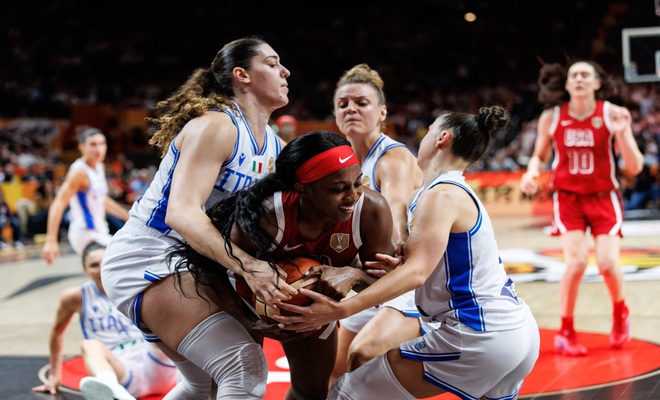
Australia imposed its physicality on Türkiye, China survived 29 turnovers and an overtime scare against Czechia, Belgium handled Puerto Rico behind Julie Allemand’s control, and Italy dragged the United States into a 55-52 fight that lasted until the final possessions.
We break down how each game was won, the adjustments that shaped them, and then look ahead to a decisive final day of the group stage where qualification, second place and the top spots in several groups will all be settled.
Australia never needed one decisive run against Türkiye because it spent almost the entire afternoon controlling the terms of the game.
Even without Alanna Smith, the Opals repeatedly turned their physical advantages into something tangible. They posted bigger wings, found duck-ins, attacked through Ezi Magbegor, crashed the offensive glass and ran whenever Türkiye gave them the opportunity. By the final buzzer, Australia had scored 56 points in the paint and produced 23 assists, two numbers that captured how consistently it was able to reach the areas it wanted.
Türkiye had answers in stretches. Sevgi Uzun was excellent in the pick-and-roll, the zone caused genuine problems when it appeared, and five third-quarter threes kept the game from breaking open earlier. But Australia was never forced away from its identity for long, and that consistency became the difference in an 87-71 win.
Türkiye finds an early answer
Australia announced its intentions immediately with an 8-0 opening run, attacking close to the basket and getting into transition before Türkiye could organize.
Türkiye responded through Uzun and a defensive adjustment. Uzun quickly became the most reliable source of offense, manipulating Australia’s pick-and-roll coverage, while a 1-2-2 press flowing into a 2-3 zone briefly disrupted the Opals and helped fuel an 8-2 response.
By the 3:02 mark, Türkiye had taken a 15-14 lead.
Australia answered by leaning harder into its work around the rim and on the offensive glass. Rather than allowing the zone to completely dictate the shot profile, the Opals kept finding ways to get bodies inside and create another possession when the first attempt failed.
By the end of the quarter, Australia led 21-15.
Australia keeps finding the mismatch
The second quarter showed how many different ways Australia could turn its advantages into offense.
It was not limited to the centers. The Opals began posting their bigger wings, using duck-ins and identifying smaller defenders whenever Türkiye gave away a mismatch. The guards were also finding straight-line drives too easily, while Magbegor became particularly dangerous when Australia used dribble handoffs to get her attacking downhill rather than asking her to create from a static position.
That variation mattered because Australia was not simply throwing the ball inside and hoping physicality would solve everything. It was creating the conditions for its bigger players to catch on the move or establish position before Türkiye could set its defense.
At the other end, Türkiye’s offense became increasingly predictable. The movement disappeared for stretches, possessions slowed down and too much responsibility fell onto individual creation. Kennedy Burke never found her rhythm, while the team’s 2-of-13 first-half shooting from three made it even harder to relieve the pressure on Uzun.
Australia led 40-30 at halftime, and the margin felt representative of the game: Türkiye had produced a few successful tactical stretches, but Australia had been the team consistently determining where possessions ended.
Türkiye finds its range, Australia stays composed
The third quarter finally gave Türkiye the perimeter shooting it had been missing.
Five threes helped produce 25 points in the period and gave the offense a very different look from the first half.
Australia still scored 27.
The Opals continued feeding favorable matchups, found success through the pick-and-roll themselves and punished a Turkish defense that struggled to contain the initial action. Rather than allowing Türkiye’s shot-making to pull them into a different kind of contest, Australia kept generating the same quality of possessions.
That was one of the most impressive aspects of the performance. Türkiye’s offense improved dramatically, but the Opals did not start chasing the game or change their shot profile simply because shots were falling at the other end.
They led 67-55 after three.
Türkiye had produced its best offensive quarter and still lost the period.
Australia closes it out
By the fourth quarter, Türkiye needed disruption, but its own mistakes began feeding Australia instead.
Defensive breakdowns and turnovers created transition opportunities, and the Opals were ruthless once the floor opened. Australia’s defense also did a better job pushing Türkiye deeper into the shot clock, forcing more late decisions and making Uzun work harder to manufacture offense.
Türkiye returned to the zone with 4:55 remaining and again caused some problems, which only reinforced how useful the coverage had been earlier. It was one of the few defensive looks that consistently altered Australia’s rhythm, but by then the margin was too large for it to matter.
Australia finished with a 56-26 advantage in paint points and 23 assists to Türkiye’s 12. The edge was not simply physical; the Opals consistently turned it into connected offense.
Magbegor led Australia with 21 points, while Steph Talbot delivered another excellent all-around performance with 17 points, five rebounds and five assists on 8-of-10 shooting.
Uzun was outstanding in defeat, leading all scorers with 24 points and adding six assists. Burke finished with 10 points on 4-of-11 shooting and never became the complementary threat Türkiye needed.
Australia had entered with questions after Puerto Rico’s zone exposed some weaknesses in the opener. Türkiye showed flashes of the same solution, but this performance looked much more secure.
Even without Smith, the Opals knew where their advantages were and kept returning to them until the game was theirs.
Czechia spent most of the afternoon taking away the basketball China wanted to play.
They crowded the paint, denied entry passes, sent multiple defenders toward China’s bigs and turned loose decisions into transition opportunities. China committed 29 turnovers. Czechia committed 10. For long stretches, that difference allowed Czechia to dictate the game despite being overwhelmed on the glass and around the basket.
And still, China survived.
They survived because Han Xu kept giving them an interior anchor, because the rebounding advantage created possessions that should have disappeared, and because Shuyu Yang kept making shots when China desperately needed someone to manufacture offense.
Then Czechia left the door open.
Two missed free throws gave China one last possession in regulation. Yang drove to the rim with 3.9 seconds remaining and tied the game.
Five more minutes.
By then, a game Czechia had led for more than 33 minutes no longer belonged to them.
China escaped 74-70 in overtime.
Czechia takes away the obvious answer
China began exactly where everyone expected.
Inside.
Its first three makes came at the rim, repeatedly targeting individual mismatches and forcing Czechia to deal with a frontcourt it could not match physically. Han Xu established herself early, and China built a 14-9 advantage with 6:26 remaining in the first quarter.
Czechia called timeout and changed the game.
The initial attempt had been a 2-3 zone designed to limit some of those mismatches, but coming out of the timeout Czechia returned to man-to-man with considerably more aggression. Passing lanes tightened. The paint became crowded. Interior catches were harder to complete.
A three out of the timeout was followed by a steal and a transition basket.
Five straight points.
14-14.
When Zhang Ziyu entered with 4:36 remaining, Czechia became even more aggressive. One defender was rarely enough. Sometimes two came. Occasionally three.
Zhang did a good job moving the ball out of that pressure, but Czechia’s rotations behind the double were excellent. The point was not simply to stop Zhang from scoring. It was to make China complete the next pass, then the next decision, then the next one.
China struggled to do it cleanly.
From the 6:26 mark until just 38 seconds remained in the quarter, China did not score.
Siyu Wang finally ended the drought with an and-one drive, but Czechia had already transformed a five-point deficit into a 22-17 lead.
Czechia wins the possession battle
The same pattern carried through the second quarter.
Czechia was patient against China’s zone, moving the ball rather than forcing the first available shot. When the defense shifted, the ball moved with it. When driving lanes appeared, Czechia attacked them and created kick-out opportunities.
At the other end, the defensive pressure remained relentless.
China could still score once it established the ball inside. The problem was getting there without a pass being deflected, an entry denied or a possession simply losing its structure.
At halftime, Czechia led 41-33.
The contrast was already clear. China was efficient inside, while Czechia was getting more value from the perimeter and from the extra possessions created by defensive pressure.
Julie Pospíšilová supplied the early scoring punch with 11 first-half points, while Veronika Voráčková and Gabriela Andělová helped give Czechia enough creation around her. Han had 11 points and six rebounds for China, but every attempt to play through the frontcourt came with another layer of pressure attached.
Czechia had found a way to make China’s greatest strength expensive.
China pushes back, Czechia adjusts again
China opened the second half poorly, committing three turnovers in the first two minutes.
Yet Czechia suddenly stopped making threes.
That gave China room to breathe.
An 8-2 run cut the deficit to 43-41 and forced Czechia into another timeout with 6:59 remaining. For the first time since the opening minutes, the game appeared ready to tilt back toward China.
Czechia’s response was simple and smart.
If the threes were no longer falling, attack the basket.
Rather than continuing to live from the perimeter, Czechia began looking for paint touches and using penetration to force China’s defense into rotation. The adjustment stabilized the offense and restored some control.
By the end of the quarter, Czechia remained ahead 53-48 after a buzzer-beater created through a drive-and-kick.
China was winning the physical battle.
Czechia was winning the possession battle.
That tension carried the game into the fourth.
The game tightens
China finally began making Czechia feel its own defensive pressure.
Passing lanes became harder to access and the drive-and-kick sequences that had produced so much good offense earlier were no longer arriving as naturally. Han then stepped outside and hit a three to put China ahead 56-55 with 6:12 remaining.
China briefly tried to make the frontcourt even bigger.
Han and Zhang shared the floor with 5:44 remaining, but the experiment lasted only one possession at each end. China turned the ball over on the inbounds, allowing Czechia to score in transition, and Zhang was called for an offensive foul on the next possession before returning to the bench.
It was a tiny sequence that captured China’s afternoon perfectly.
The potential advantage was enormous.
Accessing it remained complicated.
Turnovers and shot-clock violations continued to pile up, and China called timeout with 2:55 left trailing 59-56. By the final minute, both teams were fighting through defensive pressure, poor decisions and possessions that seemed to become heavier with every second.
Czechia still led 64-59 with 27 seconds remaining.
Then the margin for error disappeared.
One last chance
Czechia had an opportunity to close the game at the free-throw line.
Eliška Joklová missed both.
China had 3.9 seconds.
Yang took the ball and went.
No complicated action. No time for one.
She attacked the basket and finished the layup.
64-64.
Overtime.
After everything Czechia had done to keep China from comfortably reaching the rim, the possession that extended the game ended there.
Now Czechia had to recover from being one free throw away from making overtime unnecessary.
Yang finishes the comeback
China entered the extra period with momentum, but overtime carried the same tension that had defined the previous 40 minutes.
Zhang returned with 3:26 remaining for a baseline out-of-bounds possession, another attempt to exploit a matchup Czechia had spent all afternoon trying to erase.
She traveled.
Back to the bench.
China still led 69-66.
This time, Yang provided the stability.
She had spent the second half increasingly taking responsibility for possessions that were becoming difficult to organize, and her shot-making finally gave China the separation it had chased all afternoon.
With 1:22 remaining, she had reached 17 points across the second half and overtime, and China led 73-66.
Even then, Czechia would not disappear.
Another Chinese turnover with 17.2 seconds left became a Czech steal and score, cutting the margin to three.
But there was no second escape.
China finished it, 74-70.
A brutal ending to a game Czechia controlled
Han Xu finished with 22 points, 14 rebounds and four assists, while Shuyu Yang added 18 points and five assists, most of them arriving when China desperately needed someone to create.
Czechia led for 33 minutes and eight seconds.
China led for eight minutes and 38.
For almost the entire afternoon, Czechia had the game where it wanted it.
Then two free throws missed.
Yang attacked the rim.
Tie game.
Overtime.
And after spending so long trying to take the game away from China, Czechia watched it disappear in five final minutes.
Belgium has produced more beautiful basketball at this World Cup. There have been stretches when the Cats have made the game look almost effortless, with quick decisions and precise passing repeatedly creating high-quality shots.
Against Puerto Rico, beauty came in smaller doses.
Belgium went deeper into the rotation and never seemed interested in turning the afternoon into a race. Puerto Rico brought enough physicality to make every possession more demanding, competed on the glass and gave Emma Meesseman one of her most difficult scoring nights of the tournament. Yet Belgium led for 38 minutes and 22 seconds and never trailed.
At the center of it was Julie Allemand.
Her 11 points, 10 rebounds and eight assists tell part of the story. The way Belgium functioned whenever she was on the floor tells more. During the second quarter, one of those assists took her to 100 for her Women’s World Cup career, making her just the fourth player in competition history to reach triple figures.
For one of the finest organizers in international basketball, it was a fitting milestone to reach on a day defined by timing, patience and precision.
Allemand brings order to a messy start
The opening minutes were untidy. Shots came up short, reads were rushed and neither offense immediately found a reliable source of production.
Puerto Rico compensated with energy. Its defenders were active, its effort around the basket was obvious and several possessions created reasonable opportunities, but the finishing was not there. Belgium was hardly sharp itself, yet gradually began separating because its decisions became cleaner.
Allemand did not need to score to change that. By the end of the first quarter, she already had five assists, repeatedly helping Belgium turn ordinary actions into clean opportunities by waiting for the defense to commit and delivering the ball at the right moment.
Julie Vanloo supplied the shot-making around her. Three early threes gave Belgium a perimeter threat Puerto Rico struggled to match, and an awkward opening slowly became a 20-13 Belgian lead.
That became even clearer when Allemand left the floor early in the second quarter. Puerto Rico pushed back, Belgium’s offense became less organized as the rotation deepened and the lead fell to 24-22.
Once Allemand returned, the ball reached better places and the decisions became cleaner. Midway through the quarter, she hit a three to push the margin back to five. By then she had also reached the 100-assist landmark, joining a group only three other players in Women’s World Cup history had entered before her.
Belgium went into halftime ahead 40-32.
Puerto Rico had held its own physically and found more success around the basket, but Belgium’s superior organization and perimeter shooting had created the separation.
Puerto Rico refuses to let the game become easy
There was no Belgian explosion after halftime.
Puerto Rico made sure of that.
Trinity San Antonio was disruptive defensively, and Imani McGee-Stafford increasingly imposed herself inside and on the offensive glass. Every Belgian possession seemed to carry a little more contact, and nobody felt it more than Meesseman.
Puerto Rico denied her comfortable catches and made finishing unusually difficult. Meesseman never found her scoring touch and eventually finished with six points on 2-of-9 shooting.
What mattered was that Belgium never allowed that to distort the offense.
Meesseman continued rebounding, facilitating and protecting the rim, while the Cats simply let the game find other scorers. Vanloo kept spacing the floor, Maxuella Lisowa-Mbaka attacked openings and Kyara Linskens remained productive inside.
That collective structure prevented one poor shooting night from becoming a team-wide problem.
Puerto Rico stayed within range because its physicality kept producing something. McGee-Stafford was excellent, San Antonio disturbed Belgium’s execution and the game remained alive at 58-50 after three quarters.
But Belgium kept finding enough good possessions to stay ahead.
Belgium manages the finish
The Cats opened the fourth quarter well enough to force a quick Puerto Rican timeout, but there was never a sustained attempt to turn the closing minutes into something more chaotic.
Belgium also appeared somewhat fatigued compared with its usual energy. The team had dealt with the disruption of a 2 a.m. evacuation and faced a shorter recovery window than Australia before the teams’ meeting the following day. Whether either factor directly shaped the approach is impossible to know, but Belgium clearly preferred a more measured finish.
The familiar basketball still appeared in flashes: the early read, the extra pass, the perfectly timed cut creating an opening somewhere else. It simply came within a game that increasingly felt less about spectacle and more about getting through the afternoon efficiently.
Belgium did exactly that, closing out a 76-64 victory without allowing Puerto Rico to turn its persistence into a genuine threat to the result.
Lisowa-Mbaka led Belgium with 16 points off the bench, Vanloo added 15 points, six rebounds and five assists, and Linskens scored 12. McGee-Stafford was outstanding for Puerto Rico with 25 points and 13 rebounds, while Arella Guirantes added 15 and San Antonio finished with seven assists.
Yet this was Allemand’s game in a different sense.
Not because she scored the most or produced the loudest sequence, but because she read the game better than anyone else.
She knew when to create, when to hold a possession together and when simply to move the ball onward.
And somewhere in the middle of all that, another pass reached its destination and became career assist No. 100.
Only three women in World Cup history had reached that number before her.
On an afternoon when Belgium did not need to be spectacular, Julie Allemand showed how much can be decided by seeing the game one step ahead.
Italy knew it could not beat the United States by trading athleticism and open-floor creation. Its path was to take away USA’s easiest offense and force the game into the half court.
For nearly 40 minutes, it worked.
USA shot 29 percent from the field, Italy erased a 15-point deficit and moved ahead 50-48 with 4:46 remaining, turning what should have been a talent mismatch into 40 minutes of beautiful ugliness.
The Americans still escaped. Breanna Stewart produced the final lead change, Jackie Young and Chelsea Gray found the baskets that finally created separation, and USA survived 55-52 after being pushed closer to the edge than anyone had managed at this World Cup.
Italy finds the game it needs
The opening minutes were not especially encouraging for Italy. Decisions came too quickly, some reads were rushed and eight first-quarter turnovers gave USA the one source of offense the Italians desperately needed to avoid: possessions that did not require the Americans to solve a set defense.
A game that had been 11-8 stretched to 19-8 by the end of the quarter, and USA eventually pushed the margin to 23-8 early in the second.
Yet the scoreboard was hiding something important. The Americans were not generating consistent advantages once Italy could get its defense organized. Neither team made a three in the opening quarter, the rebounding battle was even, and USA’s early separation had been driven much more by Italian mistakes than by overwhelming half-court offense.
Italy gave the Americans several problems once the game settled. Its 2-3 zone crowded the interior and disrupted USA’s spacing. In man-to-man, the Italians switched effectively in pick-and-roll and their bigs held up remarkably well when USA tried to attack through post-ups, absorbing contact and preventing size from becoming an automatic source of efficient offense.
That combination mattered. USA could not simply move from one obvious advantage to another when the first option failed.
Once Italy cut down the turnovers, the margin began shrinking.
USA’s offense became increasingly labored in the second quarter, while Italy showed the patience missing from its opening possessions. Cecilia Zandalasini became central to the comeback, providing difficult shot-making on a day when clean looks were rare.
The whistle added another layer of tension. Zandalasini picked up her third foul, Italy’s bench was eventually assessed a technical, and several calls tested the Italians’ composure. They stayed in the fight.
By halftime, the 15-point deficit had become six. USA led 30-24 while shooting only 32 percent from the field and had yet to make a three. Italy was hardly efficient itself, but it had a 21-19 rebounding advantage and had already shown that this would not become an easy offensive afternoon for the Americans.
The upset still required an enormous amount of work, but it no longer felt impossible.
Zandalasini turns resistance into belief
Zandalasini opened the second half by knocking down another difficult shot, and Italy kept coming.
There was almost no easy offense available for either team, which gave every successful possession more weight. Two Sara Madera free throws finally completed the comeback midway through the third quarter.
Italy 33, USA 32.
Almost 26 minutes had been played, and the United States had 32 points.
Zandalasini supplied much of the difficult offense required at the other end and reached 14 points by the end of the third quarter. Italy continued competing on the glass as well, ensuring that USA could not simply compensate for its poor shooting through overwhelming second chances.
At one point, the score was 39-36 with 12 minutes remaining.
It was not clean basketball, and that was exactly why it had become so compelling. A rebound could feel like an event. A turnover could change the complexion of the next minute. A made shot mattered because there was no guarantee another one was coming soon.
USA recovered enough to take a 42-39 lead into the fourth, but the nature of the game had changed completely.
Italy was no longer trying to stay close.
It could win.
Villa creates what the game has been denying
USA missed its first six field-goal attempts of the fourth quarter.
With 7:05 remaining, Italy tied the game at 44.
Then Matilde Villa began doing something almost nobody had managed consistently all afternoon: creating separation off the dribble.
When USA gave her a mismatch, Villa used her handle and shiftiness to move the defender and attack the resulting opening. Recognizing a favorable matchup was not enough in this game; someone still had to create something from it.
Villa could.
With 4:46 remaining, she scored again.
Italy 50, USA 48.
The team that had trailed 23-8 was now less than five minutes from one of the biggest results of the tournament.
USA first trimmed the deficit to 50-49 at the free-throw line. Then, with 3:20 remaining, Stewart knocked down a jumper to move the Americans back in front, 51-50. It was the eighth lead change of the afternoon and the last.
Seventeen seconds later came one of the game’s most consequential whistles.
Zandalasini attacked and was called for an offensive foul on a play that had the potential to become an and-one opportunity. In a game being decided possession by possession, the difference between those outcomes was enormous, and the call deepened Italy’s frustration with the officiating on an afternoon when the physicality had not always appeared to be judged consistently.
But USA still had to take advantage.
Young scored to make it 53-50. Gray followed with another basket, and suddenly the Americans led 55-50 with 1:07 remaining. After nearly an entire afternoon without breathing room, USA had finally found five points of it.
Villa immediately took two back, cutting the deficit to 55-52 with 57 seconds remaining.
Italy was still alive, but there would be no final basket.
USA survives the game Italy built
The final shooting numbers are extraordinary.
USA finished 16-of-56 from the field and 1-of-12 from three. Jackie Young was the only American player to make more than two field goals.
Italy even won the rebounding battle 43-42 and held a 22-20 advantage in points in the paint.
Where it hurt itself was with the ball.
Eighteen turnovers gave USA four more than Italy could force at the other end, and the Americans converted enough of those mistakes into offense to survive. The free-throw line became another crucial source of points, with USA going 22-of-30 compared with Italy’s 14-of-20 on a day when made field goals were exceptionally difficult to find.
Young led USA with 10 points. Angel Reese added eight, while Bueckers finished with seven points, five rebounds, two assists, two steals and two blocks. Stewart shot 1-of-9 but collected 11 rebounds.
For Italy, Zandalasini finished with 14 points and seven rebounds after carrying a significant share of the difficult shot creation while navigating foul trouble. Mariella Santucci scored nine off the bench, and Villa’s six points hardly describe the importance of what she produced late.
USA was the fair winner because it made enough plays when the final possessions arrived. Italy had turned a 23-8 deficit into a 50-48 lead with fewer than five minutes remaining and pushed the tournament favorite to the final handful of possessions.
The Americans still found a way out, 55-52.
This article was co-written by the European Hoops Podcast team, André Lemos and João Caeiro. Follow us at @EthosEuroLeague and subscribe to the European Hoops Podcast wherever you listen to your favorite podcasts.
- About the Author
- Latest Posts

From the cliffs of Porto Moniz to the forests of Latvia. With a degree in business and a background in finance, I traded balance sheets for projection models, following a lifelong love of the game. I’ve played it, I’ve lived it and I’ve had the privilege of working inside team front offices at both the club and national level.
For over 20 years, I’ve also been immersed in the world of Fantasy Basketball, studying trends, finding edges and living the grind season after season. That passion has brought me here, to SportsEthos, where I’m honored to be part of our management team alongside the great Aaron Bruski. My mission is simple: help SportsEthos thrive as the premier home for Fantasy Sports and sports coverage. A place where users get real value and where every member of the team can sharpen their craft, find joy in the work and build something special that feels like home.