
Last Updated on September 13, 2026 4:24 pm by André Lemos | Published: September 13, 2026
Some tournaments leave behind a champion. The rare ones leave behind a feeling.
Berlin gave us records that barely had time to stand, history arriving where nobody expected it, beautiful basketball, impossible comebacks and one ball circling a rim while an entire World Cup seemed to stop breathing.
The medals are permanent. So are the moments. Before the numbers settle into history, this is what the 2026 FIBA Women’s World Cup felt like.
A World Cup Measured in Millimeters: The Joy, Beauty and Heartbreak of Berlin 2026
The medals have been handed out and the 2026 FIBA Women’s World Cup has found its place in history. Before we get to the games that decided them, this tournament deserves to be remembered for everything that made us feel along the way.
Francesca Pasa had 4.2 seconds and almost the entire court in front of her. Italy had spent three quarters looking like its World Cup was slipping away. Australia had led by 26. The game had become difficult, frustrating and increasingly cruel, until somehow Italy made all 26 points disappear. Now Pasa had the ball, Italy was down two and there was no time to organize anything more sophisticated than belief. She ran the length of the floor, reached the basket, put the ball off the glass and watched it find the rim.
For a moment, it looked as though 40 minutes would not be enough.
The ball rolled around the rim and came out. Australia had won 82-80. Italy had produced a 31-13 fourth quarter, erased a 26-point deficit and come within the width of a basketball rim of forcing overtime.
That is the moment we keep returning to when we think about this World Cup. Not because it decided the champion, because it did not. Not because it was necessarily the best play of the tournament, because there are plenty of candidates for that. It stays with us because somewhere inside those few seconds was almost everything this tournament gave us: hope, disbelief, joy, cruelty, courage and the impossibly small distance between going home and getting five more minutes.
Sometimes basketball measures that distance in points. Sometimes it measures it in millimeters.
This World Cup made us feel every single one of them.
It Told Us What Kind of Tournament This Would Be Almost Immediately
On the opening day, Mali grabbed 43 rebounds against Japan, 16 of them offensive. They battered the paint, punished switches and kept collecting possessions that seemed determined not to end. Japan responded by changing the mathematics of the game altogether. Twenty threes fell, a Women’s World Cup record. Nine belonged to Saki Hayashi, another World Cup record. Japan won 102-97 in a game where Mali could look at almost everything it had done, from dominating the glass to shooting efficiently inside to scoring 97 points, and still wonder how it had possibly lost.
It was the perfect introduction to the tournament because neither team was trying to solve basketball the same way. Mali wanted the game played through size, physicality, post touches, drives and extra possessions. Japan wanted movement, pace and enough shooting to make all of those advantages insufficient. There is something especially wonderful about international basketball when two identities meet this clearly. Different programs arrive with different player profiles, different philosophies and different answers to the same questions. Sometimes those answers collide, neither one bends, and the result is 40 minutes where every possession seems to belong to a completely different version of basketball.
The wonderful part is that Mali’s story did not end there. It had another game to play and another piece of history waiting for it.
Mali Did Not Wait for Permission to Belong
Spain entered its second game looking to build up on their strong start. Mali entered it having just scored 97 points and lost. It would have been easy for that first game to leave frustration behind, but Mali carried something much more useful into the next one: belief.
The game was close at halftime, with Spain ahead 34-32, but Mali found another level after the break. Six made threes on seven attempts powered a 31-point third quarter and turned a two-point halftime deficit into a 10-point lead. Yet reducing the result to a hot shooting stretch would miss what made the performance so memorable. Mali did not panic when it realized it might actually beat Spain. It did not suddenly start playing as though history was happening to it. It kept playing as though this was exactly where it belonged.
Sika Koné was enormous on both ends, scoring inside and out, moving her feet defensively, protecting the rim and finishing possessions. Djeneba N’Diaye kept producing. Mali ran when the advantage was available, but once it had control it showed surprising maturity, slowing possessions, taking time from the clock and continuing to find quality looks instead of simply trying to survive. Spain looked increasingly doubtful; Mali looked increasingly free. The final score was 82-73, giving Mali its first Women’s World Cup victory and its first win over European opposition.
There was no buzzer-beater and no final-possession chaos. Sometimes history arrives much more quietly. Sometimes it arrives when a team gets a lead against one of the great basketball countries in the world, looks at the scoreboard, realizes exactly what is happening and calmly decides it is not giving the game back.
Belgium Made Basketball Feel Beautiful
Some teams earn your respect. Some teams make you afraid of them. Belgium made you fall in love with possessions.
There was something different about watching the Belgian Cats when everything was flowing. A Julie Allemand pick-and-roll moved the first defender. Emma Meesseman caught on the short roll and moved another. Julie Vanloo relocated into the space created by the first two actions. Antonia Delaere waited for the defense to finally decide it had helped enough. Kyara Linskens found space around the rim. One advantage became another, then another, until an ordinary possession had turned into the kind of sequence you wanted to rewind just to see where the defense had first lost control.
The ball rarely seemed to stop long enough for the opponent to feel comfortable. The players did not simply execute an offense; they appeared to understand the next read together.
Yet before any of that became the defining image of Belgium’s World Cup, there was a moment after its opening win over Türkiye that told us even more about the group. Meesseman had just delivered 27 points, nine rebounds and five assists, setting a Belgian Women’s World Cup scoring record. Vanloo had scored 22 points and made six threes while playing through the grief of losing her grandfather. Meesseman received the Player of the Game award and then handed it to Vanloo.
Maybe that was Belgium before anything else. A basketball team can have perfect spacing, smart actions, extraordinary passing and elite talent, but what made this group so easy to love was that its basketball seemed connected to something deeper. They trusted one another. They enjoyed one another. They played like people who understood that another teammate succeeding did not diminish them. It completed the possession.
Perhaps no player embodied that better than Allemand. Against Australia, she became the Women’s World Cup’s all-time assists leader, moving ahead of a list featuring Dawn Staley, Sue Bird and Laia Palau. She reached the top in only her third World Cup. Of course it was an assists record. What else could it have been?
That game against Australia might have been Belgium at its purest. The Cats finished with 28 assists, Meesseman came within sight of a triple-double with 22 points, 10 rebounds and eight assists, Allemand controlled the rhythm and Vanloo supplied the audacity. Belgium’s defense moved with the same connectivity as its offense, and for long stretches Australia seemed to be chasing the game rather than playing it.
There are teams that move the ball because their offense requires it. Belgium moved it as though keeping it for too long might spoil the fun.
Then came Germany, because this World Cup never allowed beauty to come with protection. Germany found ways to make Belgium’s usual advantages far harder to create. Its size and length changed possession quality without relying on turnovers, and Belgium finished the quarterfinal with just five giveaways and 20 assists yet never found the control it usually imposes. Germany generated cleaner offense, shot more efficiently and repeatedly forced Belgium to work for things that usually came naturally.
Meesseman was magnificent, finishing with 29 points and eight rebounds, but Belgium lost 93-74. There would be no medal, no final chapter with Emma and the Julies standing together on the podium.
That hurts precisely because of how much fun the journey had been. Part of loving a team is allowing the ending to hurt when it arrives too early. Trophies, however, are not the only way a team leaves something behind.
Belgium made this World Cup prettier.
That matters too.
Italy Made Us Believe Once
There are 55-52 basketball games that disappear almost immediately after the final buzzer. Italy-USA will not be one of them.
It was physical, uncomfortable and often ugly in the most compelling possible way. Possessions became wrestling matches, shots came late and nothing felt easy. USA wanted to run, and Italy kept dragging the game back into the half court. USA wanted its athleticism and depth to become overwhelming, and Italy kept shrinking the floor. The Americans led by as many as 15, yet Italy stayed close enough for every possession to continue mattering.
Cecilia Zandalasini kept making difficult shots. Lorela Cubaj kept fighting inside. Italy competed on the glass and refused to allow the game to become the track meet USA wanted. By the middle of the third quarter, Cubaj made two free throws and Italy moved ahead 33-32. USA had scored 32 points in almost 26 minutes of basketball.
It was a beautiful ugly game.
By the fourth quarter, Italy had dragged the defending champions exactly where it wanted them. At 7:05 it was tied at 44. USA had yet to make a field goal in the quarter. Then, with 4:46 remaining, Matilde Villa got the mismatch she wanted, used her handle to create the advantage and put Italy ahead 50-48. For a few minutes, something that had sounded unreasonable before tip-off became frighteningly real: Italy could beat the United States, not through an unsustainable shooting night or complete chaos, but by making USA play Italian basketball.
The Americans eventually found their way out. Jackie Young scored. Chelsea Gray followed. Zandalasini was called for an offensive foul on a possession that could have become an and-one in a one-point game. Villa answered again, but there was not enough time left. USA escaped 55-52 after being forced into exactly the type of game Italy wanted.
Italy had lost, but it had discovered something more valuable than a moral victory. It had proof. Proof that if it could control the terms of the game, defend hard enough and stay stubborn enough, there was nobody in this tournament it had to fear.
That belief would matter again.
Then Italy Made Us Believe Again
Three quarters into the qualification game against Australia, there was very little romance left. Australia had been excellent. Isobel Borlase was having the game of her life. Italy was frustrated, the offense could not consistently move the defense and the Opals kept getting wherever they wanted. The lead had reached 26, and even after a small Italian response, Australia entered the fourth quarter ahead 69-49.
Twenty points. Ten minutes. An entire World Cup hanging on the wrong side of both numbers.
Then Vittoria Blasigh hit a three and Italy started playing as though the first 30 minutes no longer existed. The defensive pressure rose. Australia turned it over. Another shot fell. Then a drive. Then another stop. You could feel the game changing before the scoreboard had fully caught up with it. The comeback stopped being about respectability and became something much more dangerous.
Thirteen became ten. Ten became single digits. Single digits became a game.
Costanza Verona hit a three with 1:09 remaining to make it 77-77. Twenty-six points had disappeared.
Australia deserves enormous credit for what came next. Borlase, brilliant throughout the game, found Zitina Aokuso rolling to the basket to break the tie. The Opals then survived another possession, won a challenge and created enough space at the free-throw line to go up four with 8.3 seconds left. The sensible comeback should have been finished.
Italy, fortunately, had already stopped caring about sensible things.
Blasigh caught the ball well beyond the three-point line and fired. It dropped. Down one.
And she smiled.
It was only there for a moment because there was still a game to play, but that smile deserves a place in the memory of this tournament. She had just hit the kind of shot kids imagine when they are alone with a basketball and a countdown in their head. World Cup. Elimination game. Season alive. Three points. There was still a defensive assignment to find and another possession waiting, but joy arrived first.
Australia split the following free throws, leaving those final 4.2 seconds. Pasa took the ball and ran. The layup touched the glass. The ball reached the rim, rolled around it and somehow stayed out.
Australia celebrated. Italy stopped. For a second, it felt as though everyone was trying to understand how the ball had not fallen.
The comeback was real, and the ending was real too. Basketball can hold both truths without apologizing. Italy lost. Italy was extraordinary. Australia deserved to advance. Italy deserved our hearts. None of those statements contradict one another, and maybe that is why the moment stays with us.
The World Cup Was Never Gentle With Its Heroes
Tournament basketball compresses entire emotional arcs into days. One night, you are rewriting a record book. A few nights later, you can be watching from the sideline. Saki Hayashi knew that better than most. On opening day, she made nine threes against Mali, the most ever by a player in a Women’s World Cup game. Later in the tournament, against Hungary, she suffered the injury that ended her World Cup. The distance between one of the greatest shooting nights the competition had ever seen and an abrupt ending was only a handful of days.
Puerto Rico experienced another version of that cruelty. Trinity San Antonio produced the kind of stat line that should live forever, filling every section of the box score against China and carrying Puerto Rico through long stretches. Yet individual brilliance could not keep the tournament alive. The final buzzer does not care how special the performance was before it arrived.
Germany’s tournament went in the opposite direction. The hosts opened their World Cup by losing 83-53 to Spain. Thirty points. The kind of defeat that could have made everything planned for the following two weeks suddenly feel very far away. Germany instead kept evolving. Its size became more than a physical advantage. Its bigs became creators as well as finishers, its wings found better matchups, Alexis Peterson settled into a valuable role and the defense grew more comfortable imposing itself.
Then Germany beat Belgium.
A team that had opened its tournament with a 30-point defeat had reached the first Women’s World Cup semifinal in program history. France ended that run one game later, but Germany’s journey had already brought it back to the opponent that started everything. Spain, the team that had beaten Germany by 30 on opening day, would be waiting again in the bronze-medal game.
That is the strange rhythm of a World Cup. The first game can lie to you. Sometimes the third game does too. Teams change while we watch them, and by the time two opponents meet again, neither matchup is quite the same one we thought we understood the first time.
Records Barely Had Time to Become Records
Japan made 20 threes on opening day and set a World Cup record. The record survived for three days.
Then France made 22.
Against Nigeria, the French shot the ball as though the basket had expanded. Gabby Williams made six threes and scored 25 points. Janelle Salaün added 19, Marine Johannès scored 17 and France finished with 29 assists. Its defense was just as overwhelming, forcing 23 turnovers and producing 35 points from them.
Yet perhaps the most impressive part of France’s tournament was how little it depended on one version of basketball. There were nights driven by perimeter shooting and others controlled by pressure defense. There were stretches built around Johannès improvisation, Gabby Williams attacking space or Dominique Malonga changing what opponents were comfortable doing around the rim. France showed that it could play fast, execute in the half court, switch, pressure and win ugly if necessary.
The semifinal against Germany was a perfect example. Germany spent the opening quarter proving that France could be challenged. The hosts cut well, used Nyara Sabally as a play initiator, inverted ball screens and repeatedly made the French defense solve different actions. France did not immediately remove every option. It just started making each one more expensive.
An entry pass had to travel farther. A post catch came another step away from the rim. The next read arrived under more pressure. A passing window that existed in the first quarter disappeared in the third. Germany committed 25 turnovers, the most ever in a Women’s World Cup semifinal, and France converted those mistakes into 29 points. Gabby Williams had announced the tone on the opening possession with a steal and a three, then finished with 22 points, five rebounds, five assists and four steals.
France won 86-64 and reached the first Women’s World Cup Final in program history. There may be prettier ways to dominate a basketball game than making ordinary passes feel frighteningly difficult. There are not many more exhausting ones.
And waiting on the other side was the team everybody had been trying to reach all tournament.
And USA Was Still There
Every major international tournament eventually arrives at the same question: who can beat the United States?
This World Cup gave us a more interesting variation along the way. How uncomfortable could you make them before the talent eventually found an answer?
Italy showed one method. Slow everything down, take transition away, make every possession physical and turn 40 minutes into a fight over inches. Spain showed another in the semifinal. Make USA defend multiple actions, control the pace, use different alignments, attack the guards in pick-and-roll and change coverages enough to stop the Americans from ever fully settling.
Spain led early, survived American runs and kept forcing USA to solve the game rather than simply overwhelm it. The third quarter ended tied 58-58 after Spain went back to its zone and held USA scoreless against it for an important stretch.
Then Breanna Stewart started influencing everything. USA became more deliberate about the matchups it wanted, its defense tightened and Spain found fewer clean possessions. That is part of what makes champions so difficult to remove. They do not always get their preferred version of the game. Sometimes an opponent takes it away. Sometimes the threes disappear. Sometimes the beautiful basketball never arrives. The responsibility remains the same: find something, survive and advance.
USA did.
Its 76-66 semifinal victory created the matchup the tournament had been building toward: France, playing for its first world title, against the United States, the standard everyone else had spent the tournament trying to reach.
Before we get to what happened there, and before returning to Spain and Germany for the bronze-medal game, it is worth stopping for a moment. Because by that point, two games remained on the schedule, but the World Cup had already given us enough moments to make the tournament unforgettable.
Before We Get to the Medals
We know now who went home with gold, silver and bronze. We know which players stood on the podium, who was named MVP and which five eventually made the tournament’s All-Star team. Those are the results that will live permanently beside Berlin 2026 in the record books, and they deserve the detailed breakdown that follows.
But a tournament becomes smaller if we remember it only through the podium.
Before the final weekend decided the medals, this World Cup had already become a collection of people experiencing basketball at its most unforgiving and most beautiful.
Mali refusing to give Spain its lead back. Saki Hayashi watching a ninth three fall. Emma Meesseman handing an award to Julie Vanloo. Julie Allemand passing legends on the all-time assists list, naturally with another pass. Belgium making five players feel like one thought. Cecilia Zandalasini dragging Italy through one difficult possession after another. Matilde Villa putting Italy ahead of USA. Trinity San Antonio doing everything she could while Puerto Rico’s tournament slipped away. Germany rebuilding itself after losing its first game by 30. Gabby Williams stealing the opening possession of a semifinal and setting the tone for everything that followed. Blasigh hitting from somewhere she had no reasonable business shooting from and smiling because, for one second, there was nothing else in the world to do.
And Francesca Pasa running.
That one can have its own paragraph.
Four-point-two seconds. One court. One layup. One basketball rolling around a rim.
This World Cup reminded us that sport does not promise courage will be rewarded. Italy knows that. It does not promise that the most beautiful basketball will win the tournament. Belgium knows that. It does not promise that a record will last longer than three days. Japan knows that. It does not even promise that the night of your life will be followed by another one.
What basketball gives us instead is possibility. The possibility that Mali can beat Spain. That Germany can lose by 30 and still end up playing for a medal. That Italy can trail Australia by 26 and make an entire arena believe. That a pass can be every bit as beautiful as a shot. That five players moving together can make a court suddenly look enormous. That the favorite can be made human. That a 22-year-old can forget everything except the joy of watching her shot go in. That 4.2 seconds can somehow feel like an eternity.
Maybe that is why we watch these tournaments. Not because we know what is going to happen, but because we do not. Somewhere between the opening tip and the final buzzer, basketball occasionally gives us a few seconds that stop feeling like sport and start feeling like something we will carry with us.
Berlin gave us plenty of them.
The medals tell us who finished first, second and third.
They do not tell us what any of it felt like.
That part is ours.
And now, finally, we can talk about how this World Cup ended.
Bronze Medal Game: Spain Turns Extra Possessions Into Bronze
There was something fitting about Spain and Germany meeting again with a medal on the line. Their World Cups had started against each other, with Spain winning 83-53 in a game that suggested the two teams might be heading toward very different tournaments. Germany spent the days that followed proving how misleading an opening result could be, eventually reaching the first Women’s World Cup semifinal in program history. Spain experienced its own turbulence, including the historic loss to Mali, but survived long enough to reach the final day as well. Now they were back where they started, only this time 40 minutes separated one of them from bronze.
Germany received encouraging news before tip-off with Nyara Sabally available after playing reduced minutes in the semifinal, while Spain again leaned into size by starting Awa Fam alongside Megan Gustafson and bringing Raquel Carrera from the bench.
Spain Wins the Possession Battle Early
From the opening possessions, the most important difference was not size. It was how cleanly each team was able to access what it wanted. Spain moved Germany’s defense, attacked the spaces created by its rotations and consistently turned those advantages into quality opportunities. Germany wanted to establish its interior game but repeatedly struggled to complete the entry passes needed to get there.
Spain led 18-9 when Germany called its first timeout, with three early turnovers already adding to the problem. Even when Germany managed to defend the initial action, Spain often simply gave itself another chance. Seven offensive rebounds in the opening quarter kept possessions alive and forced Germany to defend for longer than it wanted, while Marie Gülich’s late work around the rim provided only enough offense to keep the margin from growing further. Spain led 25-15 after one, having established the two themes that would eventually decide the bronze medal: Germany was giving possessions away, and Spain was creating new ones.
Germany deserves credit for how it responded. The second quarter looked much more like the team that had played its way into the semifinals. Its rotations became sharper, Spain’s offense became less fluid and a 12-5 German run cut the margin to 30-27. Iyana Martín’s importance to Spain was especially obvious during the stretch she spent on the bench. Without her ability to break the first line of defense and make the next read, Spain found far fewer easy opportunities.
Germany eventually tied the game at 33, turning what had threatened to become another difficult matchup against Spain into a real fight for bronze. Yet even during Germany’s best stretch, the warning signs never disappeared. Leonie Fiebich had matchup advantages that Germany struggled to access consistently, and the possession battle continued tilting heavily toward Spain.
The final play of the half captured the problem perfectly. With six seconds remaining, Raquel Carrera intercepted Alexis Peterson’s pass, went coast to coast, drew the foul and made both free throws. Germany had erased a double-digit deficit and briefly tied the game, but its 11th turnover sent Spain into halftime ahead 40-36.
Germany Is More Efficient, Spain Simply Has More Basketball
The halftime numbers almost looked contradictory. Germany was shooting 57% from the field to Spain’s 39%, including 64% on twos, and had also been the better three-point shooting team. Normally, that level of efficiency would suggest control of the game. Instead, Spain had taken 10 offensive rebounds to Germany’s one and forced 11 turnovers while committing only five itself.
Those extra possessions translated into a 14-7 advantage in points off turnovers and a 9-2 edge in second-chance scoring. Germany was more efficient when it actually got into its offense. Spain simply made sure it got to play far more offense.
That distinction mattered because Germany had shown it could score efficiently enough to win. Peterson and Sabally each had nine points at halftime, with Sabally perfect from the field, and points in the paint were even at 18. The concern was everything happening before the shot. Germany had to take better care of the ball, finish defensive possessions and find a way to involve Fiebich more consistently after she managed only four first-half points, all from the free-throw line.
Spain, meanwhile, had already discovered how essential Martín was to its structure. She entered halftime with 11 points and four assists, and the contrast between Spain’s offense with and without her had been impossible to miss.
Martín and Carrera Change the Game
The start of the third quarter became the moment Spain began turning its structural advantage into real separation. Fiebich finally hit from the field with a three that cut the lead to one, but Maite Cazorla answered immediately. Carrera, inserted into the second-half starting group, then took over. She scored six consecutive points during a 9-0 run that pushed Spain ahead 49-39, and Germany responded to its timeout by turning the ball over again.
Elena Buenavida then collected another offensive rebound, Carrera went to the line and suddenly a one-point game had become 51-39. Martín followed with a long two, Germany committed another turnover and Fam attacked inside to extend the margin to 16. The start of the second half was always going to be a defining stretch after Germany had spent so much energy getting back into the game, and Spain won it emphatically.
Germany did find another response. Frieda Bühner hit from deep, Fiebich attacked Gustafson and created an easy cut for Lina Sontag, and Sontag made her presence felt on both ends before another Bühner three cut the margin to eight. Germany had spent the entire tournament showing an ability to keep fighting, and once again it found enough to prevent the game from escaping completely.
Sabally then scored inside against Gustafson to make it 58-51. Germany had reduced a 16-point deficit to seven and had a chance to enter the fourth with momentum.
Then Martín delivered the shot Germany could least afford.
With eight seconds remaining, she knocked down a three to restore Spain’s double-digit lead at 61-51. Germany then committed its 14th turnover on the ensuing inbounds. After doing so much work to make the game competitive again, Germany finished the quarter with another sequence that perfectly captured why it could never quite take control.
Spain Slams the Door
Spain made sure there would be no final comeback. María Conde and Cazorla opened the fourth with back-to-back threes, both created through excellent ball movement, and within 90 seconds the lead had ballooned to 67-51. Germany called timeout, but the game had already begun to feel different. Earlier deficits had been answered by improved organization and defensive stretches. This time Spain was moving the ball too well, Germany’s shot selection was deteriorating and bronze was beginning to slip away.
Martín continued controlling everything. She found Fam for a finish that gave her a ninth assist, then later collected an offensive rebound herself and converted the putback before attacking the basket again on the following stretch. In the middle of Spain’s run she crossed 100 points for the tournament, becoming only the third player over the last 20 years, after Candace Parker and Liz Cambage, to reach that mark at a younger age. It was an appropriate milestone for one of the breakout players of the competition, and it arrived while she was putting together perhaps her most complete performance of the World Cup.
There was an unfortunate moment when Gustafson appeared to dislocate a finger, while frustration also began to show on the German side as Fiebich was assessed a technical foul. Germany briefly found some scoring through Peterson and a Fiebich three, cutting the deficit to 16, but Spain never allowed the game to become alive again. Cazorla answered with another three to make it 77-58, and from there Spain closed the afternoon at the free-throw line.
The final score was 81-58, almost eerily close to the 83-53 result from the first meeting. Yet the path between those two games had completely changed what this one meant. Germany was no longer simply the team Spain had overwhelmed on opening day. It had beaten Belgium, reached a historic semifinal and spent the bronze-medal game showing, at least in stretches, how much it had grown. Spain, meanwhile, had been shocked by Mali, challenged repeatedly throughout the tournament and forced to find different answers. When a medal was finally there to be won, it produced one of its cleanest performances.
Bronze Belongs to Spain
The final numbers make the decisive areas impossible to miss. Germany committed 18 turnovers to Spain’s eight, allowing Spain to create a 21-9 advantage in points off turnovers. Spain collected 15 offensive rebounds to Germany’s seven, won second-chance points 14-5 and finished with 12 steals. The overall shooting difference was relatively modest, 42% to 39%, but Spain had spent the entire game manufacturing additional opportunities. By the end, it also had 20 assists to Germany’s 13 and a 39-30 rebounding advantage.
Martín was exceptional, finishing with 22 points, nine assists, four rebounds and two steals on 8-of-15 shooting, including three made threes. Her +32 reflected how thoroughly Spain controlled the game around her, but her influence went beyond the final line. Spain’s offense noticeably lost some of its ability to create advantages when she sat in the first half, and she repeatedly delivered whenever Germany threatened to change the game, none more important than the three that closed the third quarter.
Carrera’s move into the second-half starting lineup also changed the game. She finished with 15 points, five rebounds, three assists and two steals while going a perfect 7-of-7 at the line, and her six straight points helped launch the decisive third-quarter run. Conde added 12 points, five rebounds, three assists and three steals, Fam finished with 10 points, nine rebounds and three assists on 5-of-6 shooting, and Cazorla went a perfect 3-of-3 from deep. Spain did not need one player to carry the medal home. It needed everyone to keep making the next correct play.
Germany’s most efficient offense came through Sabally, who finished with 13 points on 6-of-7 shooting. Peterson also scored 13 but committed five turnovers, while Fiebich finished with 10 points and seven rebounds on 2-of-11 shooting. Her final line was one of the clearest signs of Spain’s defensive success. Germany knew there were situations where Fiebich could have an advantage, particularly in the post, but never consistently managed to put her in those positions. By the time it did find more ways to involve her, Spain had already taken control elsewhere.
Germany left Berlin without the medal it wanted, but its tournament should not be defined by the final margin. A team that lost its opening game by 30 responded by reaching the semifinals and earning the opportunity to play for bronze in front of its home crowd. That journey remains one of the tournament’s best stories.
Spain, though, owned the final chapter between them. The first meeting announced Spain as one of the tournament’s most dangerous teams. The second required something different. Spain had to withstand Germany’s comeback, survive the stretches where its own offense stopped flowing and trust that the details it had controlled from the opening quarter would eventually matter.
They did.
Fifteen offensive rebounds. Twelve steals. Twenty assists. Eight turnovers.
And one bronze medal.
Spain 81, Germany 58. Bronze belonged to Spain.
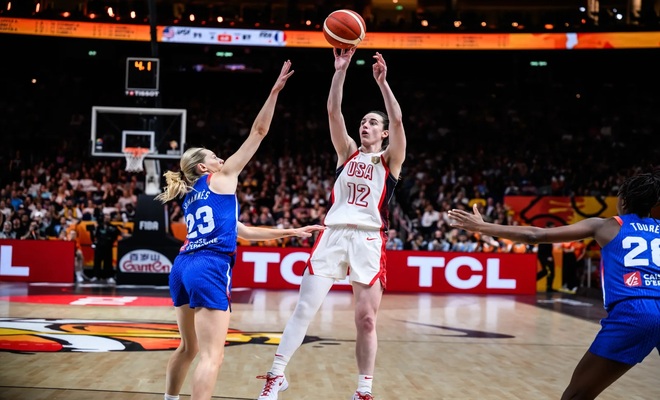
Gold Medal Game: USA vs. France, One Half of French Belief and One Quarter of American Dominance
France had already made history simply by reaching this stage. Never before had the program played for a Women’s World Cup title, which meant the final would end with either its first gold or its first silver medal. Across the court stood the opponent every contender eventually has to face, and the player whose career had become almost inseparable from winning. Breanna Stewart entered the final having never lost a World Cup, Olympic or NCAA tournament game, and she was guaranteed a fifth World Cup medal, matching Sue Bird. If USA won, Stewart would stand alone as the only woman with five World Cup gold medals.
The matchup carried another layer because USA had not moved through this tournament untouched. Italy had dragged the Americans into a 55-52 fight, and Spain had taken them into the fourth quarter of the semifinal tied. France, by contrast, had spent most of its run controlling games with its defense, versatility and ability to make opponents uncomfortable in different ways. The final was therefore not simply a question of whether France could match USA’s talent. It was whether the things that had made France so difficult to play against could survive 40 minutes against the deepest and most physically imposing team in the tournament.
For 20 minutes, the answer looked like yes.
France Makes USA Play Its Game
France immediately showed how it wanted to defend Stewart. Marième Badiane drew the initial assignment, but the French were switching, and USA wasted no time attacking the mismatches that created. On the first possession, Leïla Lacan found herself on Stewart, who went directly at her and earned two free throws. France responded with the same aggression at the other end. Gabby Williams attacked Stewart and finished at the basket, then Lacan drove past her defender on the next possession to put France ahead 4-2.
Both teams were switching heavily, but France’s version was initially more disruptive. USA could find advantages, particularly whenever Stewart identified a smaller defender, yet very little came automatically. France was touching passes, shrinking driving lanes and forcing the Americans to make repeated decisions before reaching the shot they wanted.
Jackie Young hit a pull-up three to make it 9-6, only for Janelle Salaün to answer immediately. Chelsea Gray then scored twice and Stewart added another basket as USA moved ahead 15-10, but France never allowed the early American efficiency to become control. Williams hit from three, Marine Johannès found Dominique Malonga in transition to tie the game and then stepped into one of her trademark step-back threes to give France an 18-17 lead.
The quarter also revealed the problem that would keep USA from fully taking advantage of its shooting. The Americans made seven of their first 13 attempts and shot 54% from the field, but five turnovers erased much of that efficiency. Napheesa Collier committed three, while Caitlin Clark turned it over twice after finally checking in alongside Paige Bueckers more than seven minutes into the game.
France was also making its size felt. Malonga did not need to dominate offensively to influence the game, cleaning the defensive glass, protecting the paint and giving USA another long body to solve around the rim. The Americans finished the first quarter with only four rebounds, while France closed the period ahead 20-17 after two Malonga free throws.
USA had shot well. Stewart had been excellent. France still led.
That was already a victory for the French defensive plan.
Gabby Williams Gives France a Real Chance to Dream
France did not enter the second quarter satisfied with hanging around. Carla Leite drew a foul on a deep three and made all three free throws, Valériane Ayayi connected from beyond the arc and Leite attacked off the dribble for another jumper. Suddenly France led 28-17.
Then Williams hit another three.
31-17.
Fourteen points separated France from the United States in a World Cup Final, and for a stretch it did not feel accidental. France was playing with conviction, its defense was making USA work for every half-court advantage and the movement before the main offensive action was repeatedly shifting the American defense just enough to open the next window. USA looked a step slow defensively, and Williams was attacking whoever stood in front of her.
Her first step became one of the defining problems of the half. It did not seem to matter whether USA put length, strength or athleticism in front of her. Williams kept creating separation, and with 3:05 remaining she used a hesitation to get downhill before finishing a reverse layup that gave France a 41-35 advantage.
For a few minutes, the possibility started to feel real.
USA responded the way champions usually do. Not by suddenly solving every French coverage, but by finding enough difficult answers to survive. A 10-2 run reduced the 14-point deficit to six, with much of the damage coming through transition opportunities and elite shot-making rather than sustained half-court creation. Gray hit a difficult fadeaway. USA hunted switches inside more effectively. France also had to absorb several close officiating decisions as the margin tightened.
Salaün hit an important three to restore some space at 45-39, but France could not quite carry that cushion into halftime. A late turnover gave USA one more transition opportunity, Young pushed the ball and Clark buried a three with three seconds remaining.
France walked into the locker room ahead 45-43.
It had been the better team for longer stretches. It had led by 14. Williams had 16 points, three assists and three steals, while France had made eight of its 14 threes. Yet USA was only two points behind because Young had 13, Stewart had 12 and Gray had 10, and because every small French mistake had the potential to become American points before the defense could recover.
The numbers captured the tension perfectly. USA was actually shooting slightly better overall, 55% to 52%, while France’s 57% shooting from three had provided the difference. The turnover battle was nearly even, nine for USA and eight for France, and the Americans had recovered from their poor start on the glass to lead 15-12 in rebounding.
France had made the court feel small defensively. Its switching had disrupted USA’s rhythm, and when Lacan left the floor and France moved away from switching everything one through five, the American offense became even more difficult. At the other end, France had used movement before its primary actions to prevent USA from simply loading up on the first option.
After 20 minutes, the first-time finalist was two quarters away from a world championship.
Then the game changed.
USA Changes the Terms
The first possession of the second half was simple enough to look harmless. France had a defensive lapse, Stewart saw the space and drove cleanly to the rim to tie the game at 45. USA got a stop, Collier used her interior advantage on the next possession and suddenly the Americans were ahead.
The difference went beyond the scoreboard. USA’s energy had changed.
Loose balls that had been neutral in the first half started ending in American hands. Offensive rebounds appeared. France’s possessions became harder and more rushed, while USA began creating the additional opportunities that had been missing earlier. Collier grabbed an offensive rebound before Kahleah Copper hit a three to make it 52-47, and Young finished a Eurostep shortly afterward to push the margin to seven and force France into a timeout.
France tried to change the picture with a 2-3 zone. USA initially generated two open corner threes and missed both, which should have represented two successful French possessions. Stewart turned them into something else by keeping the ball alive on the offensive glass, eventually drawing a foul on the second extra opportunity.
That became the story of the quarter. France could survive the first action. It could force the first miss. What it increasingly could not do was finish the possession.
Williams and Malonga briefly rediscovered one of France’s best actions, connecting in pick-and-roll for a finish that cut the lead to 55-51. Young immediately answered from the top against the zone. Malonga scored again inside, but France was no longer moving USA’s defense with the freedom it had shown in the first half. The offense became more direct, more hurried and increasingly dependent on creating something late in the possession.
USA wanted exactly that game.
Gray attacked Johannès and made a fadeaway to push the lead to 60-53. France turned it over. Rhyne Howard began jumping passing lanes, producing consecutive steals as the game accelerated. Transition opportunities followed, and the calm, deliberate French offense that had built the first-half lead began disappearing into a faster and far more chaotic version of the final.
Then came the sequence that broke the quarter open completely.
With 50 seconds remaining, Malonga and Johannès were both assessed unsportsmanlike fouls on the same sequence involving Copper. Copper made three of the four resulting free throws, USA retained possession, and Clark found Aliyah Boston for a layup. Five points arrived from one sequence, extending the lead to 71-54.
Migna Touré managed to answer with a three, but Clark hit a pull-up jumper at the buzzer.
USA 73, France 57.
A final France had led by 14 had been transformed in 10 minutes. USA won the third quarter 30-12, not because it suddenly discovered a radically different offense, but because it changed where and how the game was being played. The Americans won the effort possessions, attacked the offensive glass, increased the physicality, forced France to rush and turned mistakes into points before the French defense could become organized.
The first half had belonged to France’s structure.
The third quarter belonged to USA’s force.
Stewart, Young and USA Never Let France Back In
France needed the fourth quarter to begin perfectly. Instead, it began strangely. Clark was called for an offensive foul and then assessed a technical, giving France a free point and a chance to create momentum before the quarter had really begun. Williams missed the technical free throw. France then turned the ball over.
Clark answered with a step-back three.
76-57.
It was the type of sequence that tells you when a game has changed permanently. France had been offered a small opening and, within seconds, USA had made the deficit larger.
Badiane scored inside, but Collier answered with a pull-up. Clark made two free throws. Stewart grabbed yet another offensive rebound, scored through contact and completed the three-point play to make it 83-59. Clark attacked the basket herself on the next stretch, and the lead reached 26.
France did eventually find something through Malonga. The young center stepped outside to hit a three, attacked the offensive glass, finished through contact and repeatedly gave Williams a target around the basket. She scored five straight French points before a timeout and continued producing afterward, helping France cut the margin to 88-72 with a little over three minutes left.
It was too late for the result, but not meaningless. Malonga had spent the tournament showing glimpses of how enormous her future could become, and in the final quarter of the World Cup she became France’s most reliable offensive solution while everything around her had become difficult.
USA still had every answer it needed. Copper hit from three to restore a 17-point margin. Stewart made two free throws. Angel Reese attacked for another basket. Williams continued fighting and knocked down a pull-up three, but the final had already been decided.
When the buzzer sounded, the scoreboard read 97-79.
USA was world champion again.
The Third Quarter Decided the World
The final statistics tell two different stories because the first and second halves barely resembled the same game. France led 45-43 at halftime after controlling much of the opening 20 minutes. USA then won the third quarter 30-12 and never surrendered control again.
The possession battle became the biggest separator. USA won the rebounding battle 38-25, including 12-6 on the offensive glass, and converted those extra opportunities into an 11-3 advantage in second-chance points. The Americans also won points off turnovers 23-15 and transition scoring 17-9. France finished with only one more turnover overall, 16 to USA’s 15, but once the game opened up, American mistakes and French mistakes stopped carrying the same cost.
USA shot 56% overall and a remarkable 62.2% inside the arc, finishing with a 38-28 advantage in paint scoring. France remained excellent from outside at 45.8%, but the perimeter shooting that had helped produce the 14-point first-half lead could not compensate once USA began controlling the glass, loose balls and transition game.
Stewart delivered exactly the performance the final demanded. She finished with 22 points, 10 rebounds and four assists on 7-of-10 shooting, while five of her rebounds came on the offensive glass. Those extra possessions became particularly valuable in the second half, when France’s zone and switching could still force misses but could no longer consistently end possessions. Stewart finished with a game-high 30 efficiency rating and completed another undefeated run through a major tournament.
Young was outstanding beside her, adding 18 points, six rebounds and five assists while making four threes. She supplied several of USA’s most important baskets as the momentum began shifting, repeatedly punishing France whenever it appeared close to stabilizing the game.
Copper added 15 points, Gray finished with 12 points, five assists and four rebounds, and Clark scored 12 in just over 13 minutes while shooting 4-of-5 from the field. Her role was smaller in terms of playing time, but her timing was enormous. The three before halftime reduced what could have been a more comfortable French lead to two points, and her scoring burst early in the fourth made sure there would be no final French push.
For France, Malonga finished with a team-high 21 points and six rebounds on 8-of-12 shooting. Williams added 20 points, seven assists and three steals, and for the first half she looked like the best player on the floor. USA contained her far more effectively after halftime, forcing more difficult attempts and removing many of the driving opportunities that had powered France’s early lead, but her final line still reflected the influence she had on France’s historic run.
Johannès finished with five points and three assists while committing five turnovers on 1-of-6 shooting, one of the clearest examples of how USA’s increased second-half pressure affected France’s decision-making. Salaün and Badiane added seven points apiece, but France never rediscovered the collective offensive rhythm it had established in the opening half.
The game featured six ties and six lead changes. France spent more than 14 minutes in front and built a 14-point advantage. USA eventually led by as many as 27.
That swing is the final in miniature.
France showed that the gap could be closed. For 20 minutes, it did more than survive against the United States. It dictated matchups, defended with intelligence, attacked without fear and made a first World Cup gold medal feel possible. Then USA raised the physicality, controlled the glass and transformed the game into one that rewarded its depth, strength and ability to create offense from chaos.
France could not follow it there.
USA could.
Five Straight Golds, and a Historic First Silver for France
The final score does not erase what France accomplished. This was the first Women’s World Cup Final in program history and therefore the first silver medal France has ever won at the tournament. It came after a run defined by defensive versatility, collective intelligence and one of the competition’s great individual performances from Williams. France did not arrive in the final because the bracket opened for it. It arrived because it was one of the best teams in Berlin.
For a half, it also made the best team in the world look vulnerable.
But USA remains the standard.
The Americans leave Berlin with a fifth consecutive Women’s World Cup gold medal, another title added to a dynasty that continues finding answers even when opponents successfully remove the obvious ones. Italy proved USA could be dragged into a possession-by-possession fight. Spain proved it could take the Americans into the fourth quarter tied. France proved it could build a 14-point lead in a World Cup Final.
None of them could finish the job.
Stewart leaves with her fifth World Cup medal and, with all five now gold, becomes the only woman to win five World Cup gold medals. Her final performance was the perfect conclusion to that history: 22 points, 10 rebounds, four assists, five offensive rebounds and control of the possessions that mattered most.
France made USA solve the game.
USA solved it.
97-79.
Five consecutive World Cup titles.
The United States are world champions again.
This article was co-written by the European Hoops Podcast team, André Lemos and João Caeiro. Follow us at @EthosEuroLeague and subscribe to the European Hoops Podcast wherever you listen to your favorite podcasts.
- About the Author
- Latest Posts

From the cliffs of Porto Moniz to the forests of Latvia. With a degree in business and a background in finance, I traded balance sheets for projection models, following a lifelong love of the game. I’ve played it, I’ve lived it and I’ve had the privilege of working inside team front offices at both the club and national level.
For over 20 years, I’ve also been immersed in the world of Fantasy Basketball, studying trends, finding edges and living the grind season after season. That passion has brought me here, to SportsEthos, where I’m honored to be part of our management team alongside the great Aaron Bruski. My mission is simple: help SportsEthos thrive as the premier home for Fantasy Sports and sports coverage. A place where users get real value and where every member of the team can sharpen their craft, find joy in the work and build something special that feels like home.