
Last Updated on September 12, 2026 4:36 pm by André Lemos | Published: September 12, 2026
One team has reached its first World Cup Final. Another survived the kind of semifinal that exposed exactly where it can be hurt.
France overwhelmed Germany with a defense that turned every possession into work. USA had to solve Spain deep into the fourth quarter before finally finding enough answers.
Now the tournament has one day left: Spain and Germany for bronze, then France and USA for the world title.
France’s Defense Overwhelms Germany and Sends Les Bleues to a Historic World Cup Final
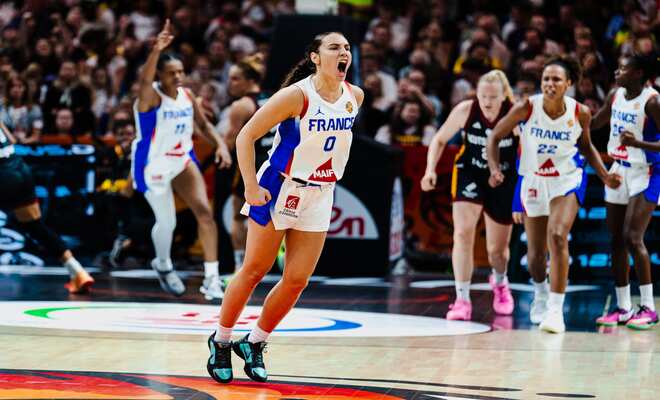
For the first time in their history, France are going to a World Cup Final.
Germany gave the hosts plenty to think about early. It found success with 45 cuts, used Nyara Sabally as a play initiator and repeatedly searched for creative ways to manipulate France’s aggressive defense. Through one quarter, only two points separated the teams.
From there, France made basketball increasingly difficult. Passes that normally feel routine became contested, post catches moved farther from the basket and pick-and-roll reads came under pressure from multiple directions. Germany remained close enough to threaten into the second half, but 25 turnovers eventually became impossible to survive.
France turned those mistakes into 29 points and pulled away for an 86-64 win, with Gabby Williams setting the tone for one of the most disruptive defensive performances of the tournament.
Germany finds answers early, Williams sets the standard
Williams needed only one possession to announce herself, opening the semifinal with a trademark steal and three.
France’s pressure was immediate. It picked Germany up aggressively and built an 8-2 lead in less than two minutes, but Germany responded with some of the offensive intelligence that had carried it this far.
The hosts attacked France’s positioning with 45 cuts and used Sabally as a creator rather than simply a finisher. Germany also went to inverted pick-and-rolls, searching for ways to force French defenders into uncomfortable assignments and get its bigger players involved in initiating offense.
There were openings. France’s pick-and-roll defense allowed Germany to reach the paint at times, and the Germans were moving the defense well enough to produce a 7-2 response.
What Germany did not always do was recognize the next advantage quickly enough. Mismatches appeared without being consistently punished, and France’s recovery speed meant those opportunities rarely remained available for long.
Williams was everywhere, finishing the opening quarter with seven points, three rebounds, two assists and two steals as France took a 25-23 lead. Germany was competing well, but had already committed five turnovers.
France starts making every possession expensive
The second quarter was where the pressure began accumulating.
Germany scored only three points across the opening three-plus minutes before a well-designed baseline out-of-bounds action freed Leonie Fiebich for three. Sabally continued giving Germany a useful alternative as an initiator, including an action built around a flat ball screen that allowed her to attack with her right hand.
But Germany was having to work exceptionally hard.
France pushed post touches farther from the basket and attacked Germany’s switching defense at the other end, deliberately hunting matchups involving Frieda Bühner and Emily Sontag. Williams repeatedly attacked Sontag in space, while Marine Johannès began finding her own scoring opportunities out of the pick-and-roll.
Germany’s turnover count reached 12 by halftime, already exceeding its tournament average of 9.8 per game. France converted those mistakes into 18 points.
That became the central tension of the semifinal. Germany was not without solutions, but too many possessions were ending before those solutions could fully develop.
Johannès pushed France’s advantage to nine midway through the quarter, and although Sabally answered with an and-one after the timeout, France continued to control where Germany was receiving the ball and how difficult the next decision became. The Germans also left points at the line, shooting 7-of-13 on free throws before halftime.
France led 45-38, in what had already become the second-highest scoring semifinal in World Cup history.
The French defense becomes a nightmare
France opened the third quarter with a 7-0 run to establish its first double-digit advantage.
Germany briefly changed the picture with a 2-3 zone and then generated a 7-0 response of its own behind Sabally, cutting back into the margin. France also helped with several offensive fouls and went more than four minutes without a field goal, but Germany could not fully exploit the opening.
France’s defense kept shrinking the available space. When Germany found a mismatch, France was willing to send help after the dribble rather than allow the isolation to develop cleanly. Off the ball, defenders sat in gaps and challenged passing lanes. Even when Germany generated good perimeter looks, the process required an enormous amount of work.
One possession captured the problem particularly well: Germany found Johannès matched onto Bühner and never managed to properly exploit it before the opportunity disappeared. France was making the Germans process everything faster than they wanted to.
A 5-0 French burst restored a 13-point lead late in the quarter, while Germany finished the period 4-of-15 from the field with eight turnovers. By then, the offensive difficulty had become the defining feature of the game.
Germany makes one last push
Germany still had a run left.
Bühner opened the fourth with a well-designed score, and the hosts started the quarter 5-0 to pull within nine. Carla Leite immediately answered with a three, but Germany kept coming.
Emily Bessoir’s three cut the deficit back to nine with 5:43 remaining. From that point, however, France closed the door.
Williams continued beating defenders off the dribble. Germany tried searching for high-low opportunities, but France’s length made entries difficult. When Bessoir was left on Johannès, France immediately attacked the matchup rather than allowing Germany to hide it.
Dominique Malonga, shaky during her first stint, then produced an excellent two-minute stretch with four points, an offensive rebound and a block. Johannès supplied the final blow with a three at 2:35 that pushed France ahead by 17, and Germany did not score again over the final 4:23.
France closed on a 17-4 run.
France makes history through defense
Germany finished with 25 turnovers, the most ever committed in a Women’s World Cup semifinal, and France turned them into 29 points. Eleven came directly from French steals.
Those numbers capture the night better than almost anything else.
Germany did find things that worked. Its cutting hurt France early, Sabally was effective initiating offense and the hosts repeatedly demonstrated why they had reached this stage for the first time. For much of the game, they were close enough that France could never simply relax.
But France made sustaining good offense almost impossible.
Williams was magnificent with 22 points, five rebounds, five assists and four steals, combining elite creation with the defensive activity that defined the game. Janelle Salaün added 14 points and 11 rebounds, while Johannès scored 13 points and supplied the shot that effectively ended Germany’s final resistance.
For Germany, Marie Gülich finished with 12 points and 10 rebounds, Sabally scored 12, and Fiebich added nine points, eight rebounds and four assists.
Germany’s historic run ends one game short of the Final, but it took the hosts deeper into this tournament than they had ever been before. France goes one step further.
One of these teams was always going to play in the first World Cup Final in its history. Germany had the home crowd, the tactical variety and enough stretches of quality to make the possibility feel real, but France had a defense that simply would not let go.
Now, for the first time, Les Bleues will play for a world championship.
USA Survives Spain’s Half-Court Test and Advances 76-66
Spain gave USA exactly the kind of game it wanted to avoid. It slowed the pace, made the Americans defend through multiple actions and repeatedly found ways to stress USA’s half-court defense. At the other end, Spain kept one of the tournament’s most talented offenses from consistently creating clean advantages.
After three quarters, the game was tied at 58. USA finally found the difference in the fourth, with Breanna Stewart raising her impact on both ends, the Americans attacking favorable matchups more deliberately and their defensive intensity forcing Spain into poorer decisions.
The 76-66 win sends USA through, but this was far from comfortable. Spain showed there are real ways to make the defending champions vulnerable.
Spain gets the game it wants
Spain started with Raquel Carrera and Awa Fam together, leaving Megan Gustafson on the bench, and immediately imposed its preferred tempo. A 5-0 opening became 9-1 before Chelsea Gray hit an important three to settle USA.
Spain’s offense was generating quality looks, particularly when the Americans lost track of actions away from the ball. Defensive breakdowns around screens repeatedly opened clean opportunities, while USA struggled to create similar advantages through its own structure. Aliyah Boston’s presence inside became especially important because she gave the Americans a direct source of offense when the perimeter actions stalled.
Spain controlled most of the quarter before three consecutive turnovers changed the game late. USA produced an 11-0 run, while Spain scored only two points over the final 4:20.
That stretch flipped the quarter completely. USA led 21-18 after one despite Spain shooting 6-of-10 on twos, with seven turnovers proving far too costly.
Spain keeps forcing USA to work
USA’s bench brought better defensive intensity in the second quarter and made fewer mistakes away from the ball, but Spain continued to keep the game under control.
Iyana Martín hit an important off-balance three to keep the deficit manageable, while empty-side pick-and-roll became one of Spain’s most useful actions, particularly when it flowed into it early before USA’s defense was fully organized. The action repeatedly created penetration and forced help.
Spain also mixed in a 2-3 zone, including on sideline out-of-bounds possessions, while USA experimented with Paige Bueckers at point guard for several minutes. Caitlin Clark played only 5:56 in the first half.
The biggest statistical difference came at the free-throw line. USA attempted 27 free throws before halftime, making 19, while Spain went just 3-of-4. That allowed the Americans to lead despite Spain shooting considerably better from the field, 15-of-34 compared with USA’s 9-of-26.
Spain cut the margin to two late before USA reached halftime ahead 39-36.
Spain finds the zone, USA finds Stewart
The third quarter became the most interesting tactical stretch of the game.
The teams initially traded threes, with Spain making three to USA’s one and briefly taking the lead. Napheesa Collier answered with a mid-range jumper that started a 7-0 American run and restored a six-point advantage.
USA then began deliberately involving Gustafson in pick-and-roll, testing her ability to defend in space. Spain responded by using more Horns alignments with Fam and Gustafson, while its guards continued finding success getting downhill.
Two missed Fam layups at the rim stood out as opportunities Spain may look back on, particularly in a game with so little separation. Yet Spain’s defense prevented those misses from turning into a larger American run, even while its own offense went more than four minutes without scoring.
The 2-3 zone then changed the quarter. Spain used it partly to protect Gustafson, but it also completely disrupted USA’s offense for a stretch. The Americans failed to score against the coverage, and Spain answered with a 7-0 run to tie the game at 58 with 1:32 remaining.
Spain won the quarter 22-19, leaving the semifinal completely open entering the fourth.
USA finally identifies the right advantages
Spain returned to man-to-man in the fourth, and USA immediately looked more decisive. The Americans opened 4-0 before Spain finally scored with 7:46 remaining, while Stewart became increasingly influential on both sides of the floor.
Martín picked up her fourth foul with 6:24 remaining, and USA began identifying mismatches earlier in possessions. Instead of allowing actions to drift, the Americans attacked Martín and Maite Cazorla on the block and became more deliberate about creating favorable matchups.
Spain still found some offense through María Conde, who scored four straight, but its decision-making began to deteriorate. Five fourth-quarter turnovers repeatedly stopped possessions before they could develop, while USA’s defensive intensity rose at the same time.
Jackie Young’s mid-range jumper pushed the lead back to 10 with 2:33 remaining and forced another Spanish timeout. Spain went to full-court pressure with 1:12 left, but by then the game had moved beyond reach.
USA won the fourth 18-8 and closed out the victory.
Spain exposed problems, USA found the finish
This was not USA at its most convincing, but it was enough.
The clearest statistical separation came at the free-throw line, where USA went 27-of-35 and Spain finished an efficient 10-of-11. The difference was not accuracy but access: USA attempted 24 more free throws, providing a major source of offense in a game where the teams otherwise produced relatively similar statistical profiles.
For Spain, Iyana Martín and María Conde scored 17 points each, combining for 34 of the team’s 66.
For USA, Breanna Stewart was the player who steadied the game when it mattered most. She finished with 16 points and six rebounds, while her defense and composure helped USA take control of the fourth quarter.
Spain pushed the defending champions deep into the game.
USA still found the finish.
This article was co-written by the European Hoops Podcast team, André Lemos and João Caeiro. Follow us at @EthosEuroLeague and subscribe to the European Hoops Podcast wherever you listen to your favorite podcasts.
- About the Author
- Latest Posts

From the cliffs of Porto Moniz to the forests of Latvia. With a degree in business and a background in finance, I traded balance sheets for projection models, following a lifelong love of the game. I’ve played it, I’ve lived it and I’ve had the privilege of working inside team front offices at both the club and national level.
For over 20 years, I’ve also been immersed in the world of Fantasy Basketball, studying trends, finding edges and living the grind season after season. That passion has brought me here, to SportsEthos, where I’m honored to be part of our management team alongside the great Aaron Bruski. My mission is simple: help SportsEthos thrive as the premier home for Fantasy Sports and sports coverage. A place where users get real value and where every member of the team can sharpen their craft, find joy in the work and build something special that feels like home.