
-
 January 1, 2026, 2:09 am
Last Updated on January 1, 2026 2:09 am by Anthony Kates | Published: January 1, 2026
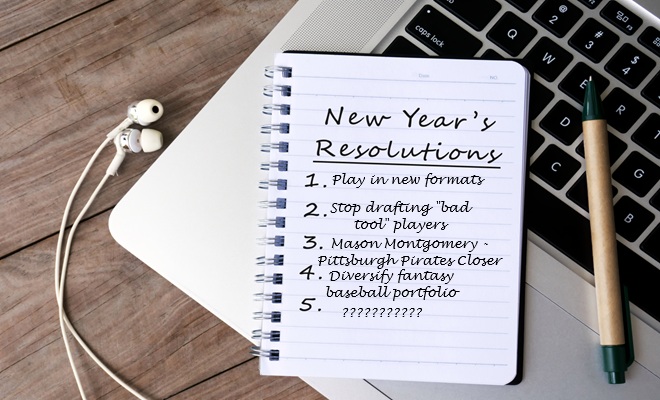
As the clock struck midnight last night, revelers the world over were sharing hugs and kisses with their loved ones, the people they cherish most, their friends and family, strangers, their pets, whoever. Maybe they shared their New Year’s resolutions with those around them. You know, the usuals: lose weight, ask for a raise, read more books, change their diet, start a new job, go back to school.
Well, Paul and I decided to share with you, the reader, some of our resolutions, with a fantasy baseball twist.
So read on to find out why Paul is changing his draft strategy, how I am going to broaden my fantasy experience and more.
Paul
I resolve to stop playing the ADP game
Last year, my rankings did not reflect my teams.
For example, I was probably the most aggressive in ranking Yandy Diaz last year yet he wound up on only two of my 8 teams.
I was heavy on Tyler Glasnow but I only had him on two teams (Granted, injuries limited him again).
The main culprit?
I thought I could wait in drafts and scoop them up. Instead of drafting Diaz in the top-100, I tried to wait closer to his ADP to try and get as much value as possible out of the pick.
In hindsight, I could have had him in more spots rather than being stuck with late-round options I wasn’t nearly as high on.
This was just one example, but, let the lesson learned lead to more successes.
Don’t get stuck playing the ADP game, especially once you get to the middle-rounds.
Minor word of caution – You don’t want to go to crazy and if you think that random middle reliever will be the closer by the end of year, that does not mean you should draft him in your tenth round.
But if someone is going around pick 200 and you think they’re top-100 value.
Take him near pick 100.
You never know who else has him pegged a bit higher and beats you to the punch.
I hope that Michael Harris II resolves to keep making contact in the zone
MH2’s 2nd half resurgence is well documented at this point. Starting on July 1, he had a .285 average, .338 wOBA (.342 xwOBA), with 14 homers and nine steals in his final 315 plate appearances.
He had an extremely high O-Sw% all year (42.6%) but maintained an elite overall contact% of 77.3% and the Z-Con% was 90% all year (up to 92.0% in the second half).
When you have a hitter making so much contact in the zone, eventually you will see that contact turn into quality contact, and this is what we saw with Harris.
Lots of chase (even an insane amount of it like MH2) does not mean they are going to struggle.
If they can maintain a high contact rate inside the zone, eventually a talented hitter will start to make the most of it.
I am in on Harris for next year as we saw an entire season of elite in-zone contact% that gives me a good amount of confidence in him.
I hope the Pirates resolve to name Mason Montgomery their closer
This dude’s stuff is electric and if there is one name across MLB that I’m DYING to see take the next step and become their team’s closer, it is the former Texas Tech Red Raider.
In his first season as a major leaguer, Montgomery threw 46.0 innings and he showed off the kind of swing-and-miss potential that makes him such an intriguing high-leverage reliever.
He had a 30.1% K%, 67.9% contact% and a 16.3% SwStr%. That is comparable to Andres Munoz, Aroldis Chapman and Jhoan Duran.
Yes, Montgomery has a walk problem. But he already does a good job of inducting soft contact (39.0% hard-hit rate) and a slightly elevated 9.2% barrel rate can play with the elite amount of swing-and-miss he has, leading to less contact and thus, less barrels.
With the now improved team context in Pittsburgh (half-way respectable offense and potent starting rotation), there will be more saves available and this makes Montgomery a potential top-5 closer.
And that isn’t an exaggeration.
I resolve to play in different fantasy baseball formats
I almost have exclusively played roto leagues.
In recent years I’ve added more head-to-head leagues and even a points league.
But now I want to try my hand at auction leagues and draft and holds. I need to find a new dynasty league and find me a keeper league.
Writing for Ethos has really rekindled my love for fantasy baseball and now that I’m as engaged in the activity as I ever have been, now is the time to spread my horizons.
It will be fun to find different things to like about certain players in the different formats.
I’ve exclusively thought about player values in terms of basic 5×5 roto formats for the vast majority of my fantasy baseball life.
But I realize that is (potentially) a slowly dying scoring system.
And for good reason.
The dynasty league I am in uses SLG% and OBP% for hitters and K:BB and quality starts for pitchers and I find those categories more closely aligned with what makes up a competitive baseball team in real life and for me, that makes it more fun to play for fantasy.
My love for fantasy comes from my love of building rosters in the ‘franchise’ modes of video games.
But fantasy value, especially for traditional 5×5 setups, is far from lining up with their real-life value.
I love having multiple ninth-inning options for real baseball but that tanks their fantasy value, and it shouldn’t.
This year I will try and expand my fantasy horizons I vow to play in more non-roto and non-traditional scoring system leagues.
Anthony
I resolve to no longer draft prospects with questionable hit tools and/or high strikeout rates, hoping they will “figure it out”
This is mainly a dynasty take, but that is where most of my fantasy focus is.
I have a long history (read: very long history) of drafting players with very high upside, but a major wort or two, in the hopes that they will fix their problem and reach their true potential.
Daz Cameron. Jeren Kendall. Elijah Green. The list could go on. I like to take risks when drafting these prospects because the ceiling is so high, even though the floor is very low.
But, by drafting like this, I have missed out on some really safe options that have been very productive big leaguers: immediately after I took Cameron, Ian Happ was drafted; five picks after Kendall, Brent Rooker; two picks after Green we saw Jackson Holliday drafted (the jury is still out on most of that draft, to be fair, with Zach Neto finding the most success, but he was drafted 12 picks later and was never in consideration for a top pick that year).
Tools + production + no big warts = finding more draft success. More draft success usually equals more fantasy success (two of the most successful managers of the last six years of my long term dynasty league have hit big on multiple prospect draft picks) and builds a positive long term outlook for your dynasty team.
Oh, also, no drafting high school pitchers who were taken in the first round (that’s a whole different article, but needless to say very few have found big league success over the past decade or so).
I resolve to diversify my fantasy baseball portfolio
Much like Paul above, my fantasy portfolio is not very diverse. I primarily play in 14-16 team, head-to-head or roto re-draft leagues, with one true dynasty league, one auction keeper league and not much else. I haven’t played in a points league in nearly a decade (which is why I give almost no advice in that area), I haven’t participated in a startup dynasty league in over five years and I cannot remember the last time I took place in a FULL auction draft (my keeper league has many players and dollars off the board before the draft starts, so it’s not the same as a fresh, every team with a full budget and every player available auction draft).
That changes this year.
Not only will I be participating in the Rotowire Online Championships on NFBC this upcoming season, I also plan to join an Auction Championship, a Gladiator (every team drafts just their 23 man lineup, no free agent moves throughout the season, nothing) and a Best Ball Cutline Championship (you draft 42 players and the computer sets your optimal lineup every week). All three of these bring about different preparation and different challenges, which will expand my fantasy knowledge, show me new angles to the game I love and open me up to new interactions.
I hope the Mets resolve to bet on their young bats in 2026
Late in the 2025 season, the Mets made the decision to call up and lean on their three top prospect pitchers, from the middle of August through the rest of the year: Nolan McLean, Jonah Tong and Brandon Sproat.
All three worked out to varying degrees, with McLean finding the most success and a lock for the Mets rotation this upcoming season.
This year, they need to bet on their top prospect hitters, notably Carson Benge and Jett Williams.
For Benge, it seems he has already been dealt a winning hand. Three different outfield eligible players became free agents and the Mets traded away Jeff McNeil, leaving them with just Juan Soto, Tyrone Taylor and Jared Young as their only outfield experienced players. Soto is, well, Soto, so we don’t have to discuss him much, but Taylor is a glove first, second and third player who has never had more than 405 plate appearances and hasn’t been an above league-average hitter since 2002 and Young has spent parts of three of the last four seasons in the big leagues, with one year in the Korean Baseball league mixed in, and has fewer than 120 big league plate appearances.
So needless to say, they need some help. It doesn’t seem like they are going to shell out the money it would take to pry Kyle Tucker to Queens, there have been no Cody Bellinger rumors and everyone else leaves a lot to be desired.
What’s that mean? Time to call up the young guns. Benge is the Mets 2024 first round draft pick and played his way across three levels in 2025, ending the year in Triple-A where, yes he struggled, but he also had a .188 BABIP. He had a respectable strikeout rate (under 19%), a good enough walk rate (8.7%) and roughly one-third of his hits went for extra bases. He’s an above average defender who is good-to-great across the board, he has 20/20 offensive upside, a solid hit tool, great eye at the plate and he makes great decisions at the plate.
As for Williams, he has an even better power-speed combo than Benge, though the hit tool is a bit more questionable and he tends to whiff more, but he has solid plate discipline, routinely makes smart swing decisions, can play almost anywhere on the field and probably would have gotten a cup of coffee with the Mets in 2025, but he lost most of the 2024 season due to a right wrist injury that required surgery, robbing him of nearly a year of development.
These are the two best bats in the Mets system and both are regularly ranked as top 100 overall prospects, who I think give the Mets a better chance at winning games than Tyrone Taylor, Jared Young or 33 year old Free Agent X.
Come join us at SportsEthos by filling out an application by clicking here
Click here to join us on Discord!
Follow us on X by clicking here
Follow us on Bluesky by clicking here
Follow Paul on X at PaulW_34
Follow Anthony on X at @akfantasybb
Follow Anthony on Bluesky at @akfantasybb.bsky.social- About the Author
- Latest Posts

I grew up in Crosby, TX, just about 30 minutes east of Houston, TX. Yes, I am a major Houston Astros fan, and love my Texans and Rockets.
I graduated Crosby High School in 2006 (Go Coogs!) and attended San Jacinto College (Go Gators!) before attending and graduating from Texas Tech in 2012 (Go Tech!). I got my degree in journalism.
Throughout my academic life I was on some form of debate team, and it was the greatest experience of my academic career.
Now I couldn’t be more happier. Sports Ethos is allowing to me to live a life long dream: to be a sports writer.
 MLB FantasyPass Homepage
 Go To NBA FantasyPass
 Go To NFL FantasyPass
 Go to MLB 2025 Draft Guide
 Go To WagerPass
 Go To DFS Pass
Working the wire
Fantasy Baseball streamers
Anthony's “Week in Review”
Paul's “Call to the Pen”
Weekly FAAB Pickups
Blurb feed
Buying, Selling/Rising, Falling
Larry's Weather Report
Who's Hot, Who's Not
Nathan's Player Profile
Prospect Hot Sheet
Dynasty Breakdowns
Williamson 300
AK Dynasty 300
Top 100 Prospects Update
Go To DFS Pass
Working the wire
Fantasy Baseball streamers
Anthony's “Week in Review”
Paul's “Call to the Pen”
Weekly FAAB Pickups
Blurb feed
Buying, Selling/Rising, Falling
Larry's Weather Report
Who's Hot, Who's Not
Nathan's Player Profile
Prospect Hot Sheet
Dynasty Breakdowns
Williamson 300
AK Dynasty 300
Top 100 Prospects Update