-
 May 12, 2026, 3:52 pm
Last Updated on July 16, 2026 9:18 am by André Lemos | Published: May 12, 2026
Real Madrid vs Hapoel
Real Madrid traveled to Bulgaria with a 2-0 series lead, looking to close things out while dealing with its road struggles.
Coach Itoudis made a major adjustment for Game 3, putting Ish Wainright on Campazzo and switching every screen from 3 through 5. The change disrupted Real Madrid’s rhythm, making offense difficult both in the PnR and from the block.
Hapoel stayed true to its identity offensively, leaning heavily into 1-on-1 basketball. Whenever Lyles entered the game, Hapoel targeted him defensively. Their best stretches came when they pushed the pace.
Scariolo responded with a different lineup, using Trey Lyles at the 5. It gave Real Madrid more offense, but the defensive issues forced them into a 3-2 zone to cover weaknesses.
Hapoel won Game 3 by controlling the glass, allowing only seven offensive rebounds, and by increasing defensive pressure, forcing 12 turnovers. For comparison, they forced 15 turnovers combined in the first two games.
In Game 4, Itoudis kept the same matchups, but this time Scariolo and Real Madrid were prepared, looking to establish Mario Hezonja on the block. Hapoel found success early in offense, with Micic creating problems attacking off drag screens.
Usman Garuba and Theo Maledon changed the game off the bench for Real Madrid. Garuba’s defensive impact and efficiency offensively stood out, while Maledon’s downhill attack gave Real Madrid another layer.
As the game progressed, both teams simplified the offense into matchup hunting. Hapoel targeted Llull or Lyles whenever they were on the floor, while Real Madrid consistently involved Micic in actions, often using Feliz as the screener.
Real Madrid was stronger throughout the game, and its depth proved decisive in closing the series on the road and securing a spot in Athens.
Olympiacos vs AS Monaco
Expectations were high for this 1st vs 8th series, but Olympiacos controlled it from the opening tip. They arrived in Monaco up 2-0 and looking to close the series immediately.
Game 3 started with Monaco on the front foot, as Mike James tried to extend the series by scoring in isolation and taking advantage of a slow start from Olympiacos. Olympiacos settled in by posting up Thomas Walkup and playing off those actions, while a rise in defensive intensity shifted the game. The Greeks generated stops and pushed in transition, taking advantage of Monaco’s short rotation.
Olympiacos’ offensive movement remained the biggest separator. The ball moved freely throughout the game, leading to 29 assists on 37 made field goals. Monaco, meanwhile, relied heavily on individual creation, either through isolation or pick-and-roll, with particular success rejecting the screen.
Three-point shooting decided not only Game 3 but the entire series. Olympiacos went 18/33 from three in Game 3, while Monaco finished 8/29. Across the series, Monaco shot 18/87 from deep, 20.1%, while Olympiacos went 43/98, 43.9%. That gap helps explain the +74 point differential over three games.
Olympiacos was clearly the better team throughout the series and deservedly advanced to the Final Four. The question now is whether the lack of close games leading into the biggest stage of the season will matter.
Fenerbahçe vs Zalgiris
Entering the two games in Kaunas, Fenerbahçe held a 2-0 lead and wanted to make sure the series did not return to Turkey, while Zalgiris fought to keep its season alive.
Game 3 did not start well for Zalgiris, with Fenerbahçe opening on a 10-2 run. Over time, adjustments started to show. Going under on Talen Horton-Tucker actions limited his impact, especially early. Offensively, Zalgiris found success in early offense, sprinting the floor, forcing crossmatches, and attacking from there.
In the half court, Fenerbahçe continued to make driving difficult, rotating well and limiting paint touches. Coach Masiulis adjusted by placing three players across the baseline and using guard-to-guard screens, bringing Nando de Colo into actions and attacking him effectively.
The second half brought a major defensive shift from Zalgiris. Touches became tougher for Fenerbahçe, and the offensive flow slowed down. Sylvain Francisco’s third foul made him a clear target, with Fenerbahçe forcing him into the main action repeatedly.
Tubelis was the biggest difference maker in Game 3. He shot well from deep and closed the game as the primary offensive option, with Zalgiris repeatedly going to him on the block. He delivered in key moments to help secure the win.
Game 4 featured another round of adjustments. Fenerbahçe looked to attack Francisco inside early, posting up Devon Hall. Zalgiris tried to establish Tubelis inside, but Fenerbahçe countered by fronting him and denying entries.
Coach Saras also adjusted by setting flatter ball screens higher on the floor for Talen Horton-Tucker, creating cleaner driving lanes. That proved effective. Fenerbahçe also attacked from inside with strong results.
Coach Masiulis answered in the second half, trying to avoid easy switches and instructing players to foul if necessary. Saras responded with a major defensive adjustment, returning to a switch-everything PnR scheme. That slowed Zalgiris in the half court, though transition opportunities still produced offense.
With the game tight late, Wade Baldwin IV stepped up, hitting key shots to force overtime.
In overtime, Fenerbahçe executed better and avoided mistakes, finishing with zero turnovers in the extra period. That proved decisive.
Fenerbahçe had fewer offensive rebounds than Zalgiris, 15 to 16, and committed more turnovers, 15 to 10. But they converted those areas more effectively, leading 18-14 in second-chance points and 14-8 in points off turnovers.
Zalgiris played well, especially at home, but Fenerbahçe’s defense and improved offense carried them to the Final Four.
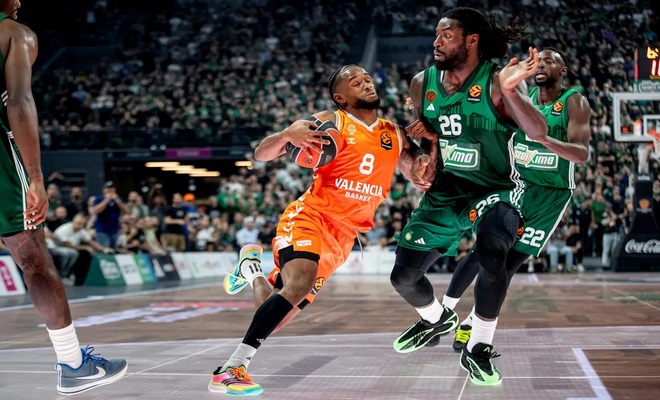
Valencia vs Panathinaikos
Valencia arrived in Athens with its back against the wall, trailing 2-0 and facing a hostile environment.
Coach Pedro Martinez made adjustments heading into Greece. In Game 3, Valencia soft doubled Kendrick Nunn, showing two bodies in the PnR. In late-clock isolation situations, the doubles became more aggressive, forcing the ball out of his hands and leading to turnovers. Nunn committed eight turnovers across Games 3 and 4 combined.
Panathinaikos adjusted offensively by posting up Grant to attack Jean Montero and playing off those actions. With TJ Shorts on the floor, Valencia made another adjustment, sagging off him in the half court and going far under on the PnR, disrupting Panathinaikos’ rhythm.
Valencia’s defense also fueled its offense. They pushed the pace and dominated transition scoring, finishing with a 27-9 edge in fastbreak points in the fastest-paced game of the series. In the half court, Valencia looked more like itself, playing fast, moving the ball, and creating quality looks through sharp cutting and manipulation of the help defense. Coach Ataman responded defensively by switching 1 through 5, which briefly slowed Valencia before they adjusted.
The possession battle played a major role. Valencia grabbed five more offensive rebounds and committed two fewer turnovers, a significant edge in a close game.
Game 4 carried similar tactical themes, leading Coach Ataman to rethink the rotation. TJ Shorts played only 6:47, while Toliopoulos, who had not appeared earlier in the series, logged 7:07 because of his shooting.
But this became a players’ game. Lessort dominated out of the short roll with five assists and punished Reuvers on the block. Cedi Osman was relentless in transition and attacking downhill. Kendrick Nunn thrived playing off the ball and coming off screens.
Still, no player stood out more than Jean Montero. “El Problema” exploded for 29 points, seven rebounds, and seven assists, posting a 45 PIR while controlling the game and hitting major shots to force a Game 5.
It is the only series going the distance. The question now is whether the trend continues, with the road team winning again, or if Valencia reaches its first Final Four.
This article was written by the European Hoops team: Tiago Cordeiro, João Caeiro and André Lemos. Make sure you give us a follow on Twitter at @EthosEuroleague!
- About the Author
- Latest Posts

From the cliffs of Porto Moniz to the forests of Latvia. With a degree in business and a background in finance, I traded balance sheets for projection models, following a lifelong love of the game. I’ve played it, I’ve lived it and I’ve had the privilege of working inside team front offices at both the club and national level.
For over 20 years, I’ve also been immersed in the world of Fantasy Basketball, studying trends, finding edges and living the grind season after season. That passion has brought me here, to SportsEthos, where I’m honored to be part of our management team alongside the great Aaron Bruski. My mission is simple: help SportsEthos thrive as the premier home for Fantasy Sports and sports coverage. A place where users get real value and where every member of the team can sharpen their craft, find joy in the work and build something special that feels like home.

Worldwide Sports Coverage • Fantasy • DFS • Gaming
