-
 December 1, 2025, 8:08 am
Last Updated on July 16, 2026 9:19 am by André Lemos | Published: December 1, 2025
The Games of week 9:
Hapoel vs Real Madrid (74-75)
Botevgrad, Bulgaria turned into a neutral-site pressure cooker, and the traveling fans got the kind of chaotic, high-level theater you hope for when the EuroLeague drops anchor in an unexpected port.
Both coaches tinkered with the starting groups: Hezonja and Okeke replaced Deck and Lyles for Real, while Hapoel countered with Wainright over Mobley. Hapoel opened by feeding the Chris Jones (PnR machine) seven of the team’s first twelve, yet the early rhythm was more ping-pong than punch. Real answered by dragging Hezonja to the block, and the Croatian happily feasted for six straight. On the other end, Real’s tweaks in PnR coverage, weakening ball handlers, finally bit helping them close Q1 up 22–18.
And Real didn’t let go. A 6-0 burst stretched the lead to ten, forcing Hapoel into a smaller, switch-everything look with Wainright at the five and Malcolm glued to the Lyles matchup like Velcro. Scariolo countered with his 3-2 zone, but that didn’t slow the Israelis either: a 5-0 run in under three minutes forced Tavares back onto the floor to stabilize things. Malcolm buried a three to shave the deficit to one, but Los Blancos leaned on the offensive glass, four O-boards to none, to protect a 39-36 halftime lead. Hapoel’s issue was structural: only nine two-point attempts all half, compared to sixteen from deep.
The second half opened with Real revealing their full duality: perfect shooting (3/3 from deep) and a pile of self-inflicted turnovers (three in the same window). Hapoel steadied themselves through the Micic–Oturu two-man game and after an Oturu block, Bryant went coast-to-coast to give them the lead. Real found Lyles in the post for a kick-out three to take it back, but that sparked an 8-0 Hapoel reply, Motley and Blakeney from deep, Micic slicing to the rim, flipping momentum and forcing Scariolo into a timeout. His guys responded with an 8–0 run of their own to reclaim a 60–58 edge entering the fourth despite six turnovers in the quarter, matching their entire first-half total.
Real built on that surge, scoring five straight out of the break, until Micic, using the full bag, got to the rim to stop the bleeding. With Garuba anchoring, Real switched everything and shaded extra bodies toward isolations, briefly throwing Hapoel off, but the Israelis’ guards solved the puzzle quickly. With Hezonja back, Real returned to the block actions, only this time Hapoel brought sharp doubles and cashed in with a transition layup to break a tie with three minutes left.
Tavares hit both at the line, then a sloppy Hapoel turnover turned into a Deck layup for a two-point Real edge entering crunch time. Itoudis tried going ultra-small with Bryant at the four with three guards, but Hezonja blew it up, jumping a passing lane and hammering home the dunk that swung the game to two possessions with under two minutes left. Motley answered with a three to cut it to one, but the scoreboard froze from there; Real walked out of the leader’s home with a win.
Hezonja led the charge with 19 and the game-breaking steal-and-slam, but the real separator was in the margins: second-chance points, 13-4.
Hapoel put four scorers in double digits, but in a wire-to-wire knife fight, they ran out of edges.Crvena Zvezda vs Olympiacos (91-80)
Olympiacos opened the game like they hit snooze on the team bus. Zvezda threw the first punch, 8-2 and after a pair of baffling Ward turnovers, the Serbians threw another. Their defensive aggression was so extreme that Olympiacos found themselves running pick-and-rolls at half court, getting trapped at every screen, coughing up steals and generally looking startled.
On offense, Zvezda spammed Spanish PnR to drag Milutinov out of the paint, opening runway for Moneke to attack Vezenkov curling off pindowns. Olympiacos sputtered with five early turnovers until Fournier stepped off the bench with his trademark microwave scoring to settle things. Walkup, meanwhile, was a non-entity on offense, going under every screen during a cold-shooting night will do that.
Olympiacos tried to supersize in the final minutes of the first quarter, but the scoring issues persisted. The second period flipped the mirror: Zvezda’s half-court defense held firm, but they were getting crushed on the defensive glass. Olympiacos ended the half with more offensive rebounds than Zvezda had defensive ones, which single-handedly kept them afloat. Fournier carried his spark into an 11-point first half with three triples. Both sides committed double-digit turnovers, but Olympiacos somehow reached halftime up one.
Olympiacos opened the third with an eight-point push: getting stops, running and letting Dorsey and Sasha heat up from deep. Zvezda looked rattled until Obradovic hit timeout and suddenly the Serbians flipped the script, turning Olympiacos over and running it right back at them to cut the lead to four. Zvezda struggled against Olympiacos’ switching, hunting Milutinov and settling for isos, but Milutinov held his ground and the lead stretched toward double digits.
Then the fourth quarter flipped everything again. Zvezda pressed like they did in the first half and Olympiacos obliged by committing the same collection of head-scratchers. Jared Butler breathed life into the offense by refusing to settle, and when he and Graham buried back-to-back transition threes, Zvezda swung an 8-0 run into a two-point lead with eight minutes left. Bartzokas probably needed a timeout after the first one; skipping it only cranked the Belgrade volume up another level.
Zvezda kept leaning on mismatches and elite guard play, and Olympiacos never found their counters. They missed opportunities to find Milutinov late and Hall offered no support on either end. Zvezda’s offense wasn’t spectacular outside the three-point shooting, but the defense was: 17 Olympiacos turnovers told the story.
And with Graham debuting, Zvezda had the luxury of adding an elite piece to a group already humming without him.
Fenerbahçe vs Virtus (66-64)
A sold-out Ulker Sports and Event Hall braced for a heavyweight clash between the champs and Virtus Bologna and got a low-scoring, defensive rock fight that still delivered tension until the final horn.
The opening 2:20 looked like both teams were shooting at baskets with lids on them, before Carsen Edwards finally cracked through. Fenerbahçe spent the early minutes trying to attack the Virtus guards, Vildoza and Edwards, using guard-to-guard screens or forcing switches to punish them on the block. But even with advantages created, they couldn’t convert. Virtus didn’t fare much better; their attempts to exploit switches devolved into Edwards isolations without payoff. With Smailagic out, Dusko threw Niang at the five early, but two quick fouls on Bacot Jr sent him right back to the bench. Virtus escaped Q1 ahead 17-15.
With Morgan entering, Virtus leaned on off-ball actions to free him, but Fenerbahçe top-locked and disrupted everything. Both offenses struggled, combining for 22/66 shooting (33%) in the half as Virtus took a 31-30 lead into the break.
The second half opened just as slowly, four total points in the first two and a half minutes, before a Vildoza triple nudged the rhythm back toward basketball. Shots started falling, teams traded counters, and Virtus found a useful wrinkle: the boomerang pass to get Morgan attacking a big after a switch. Baldwin IV answered with a three to give Fenerbahçe a 50–47 lead entering the fourth, with free throws (9/9 vs 6/10) as the difference.
Both coaches adjusted to start the final quarter: Dusko paired Morgan and Edwards, though Morgan picked up a foul after 30 seconds; Saras countered with Colson at the four and Jantunen at the five. Dusko’s group won the early minutes, opening on a 6–2 run behind Edwards. Baldwin IV scored Fener’s first four of the quarter, a preview of the takeover ahead, before Bonzie Colson ignited the arena, stealing an inbound and drilling a three to tie it at 57, forcing a Virtus timeout.
Dusko went with a three-guard look (Vildoza/Edwards/Morgan) and got a clean Horns-into-pindown action for an Edwards middy to break the tie. Fener answered through Baldwin IV: a contested three despite shaky spacing, then a trip to the line to build a three-point cushion. Virtus came back with a sharp ATO, floppy for Morgan, for two free throws, then another baseline action to free him for a three to even it up after Baldwin’s free throws.
Fenerbahçe ball, tie game, under a minute: Baldwin hunted the Diouf switch, rose for the midrange, missed, but Nicolò Melli, the ultimate detail guy, used his size to tip it in for a two-point lead with 45 seconds left. Virtus still had a chance, but Melli showed up again, switched onto Edwards, drew an offensive foul on a DHO attempt, and gave his team the ball back with 37 seconds.
Baldwin returned to the same script, Diouf switch, midrange, but this time he chased down his own miss, played keep-away from Virtus’ fouling attempts and bled the clock dry to secure the 66–64 win.
Baldwin IV finished with 18-11 in the final quarter, the driving force late. Morgan led Virtus with 13, Edwards added 11 on a tough night (3/16), but the road magic didn’t follow them once again.
Key Performances of the Past Week:
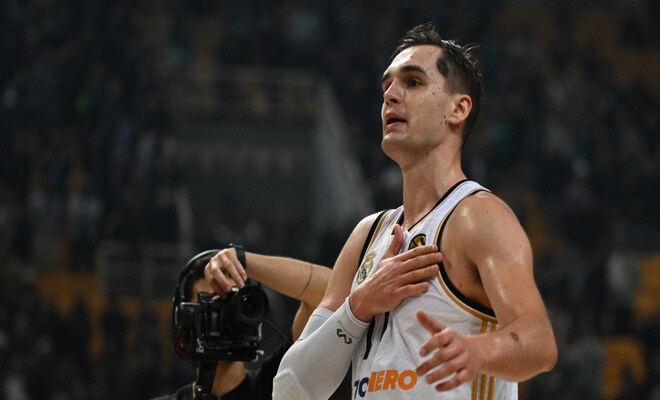
Mario Hezonja vs Hapoel
In the biggest game of the round, Mario Hezonja didn’t just show up, he took over the room, dimmed the lights and told everyone else to sit down. The Croatian forward was the brightest star on the floor, and the timing of his punches mattered just as much as their impact.
Hezonja went 5-of-6 from two, splashed in two threes, grabbed six boards, and swiped three steals. But the headline wasn’t the stat line, it was the sequencing. He dropped 11 points in the first quarter, single-handedly powering Real to the four-point lead that ended up being the hinge moment of the entire night. It was the only quarter Los Blancos actually won, and Hezonja was the reason they didn’t walk into halftime digging out of a crater.
He’s one of the most polarizing players in the competition, equal parts game-winner and chaos agent, depending on the night. This time, the needle pointed firmly toward “winner.” Hezonja didn’t just tilt the game; he decided it.
Honorable Mentions
This was one of those rounds where the PIR column read like an all-you-can-eat buffet of big nights.
Kendrick Nunn lit up Partizan with 26 points, hit 75% of his threes, added 7 rebounds and 4 assists, and pretty much scored from everywhere short of the VIP lounge. It was a surgical effort. The only thing holding him back from Performance of the Week? Context. PAO ran Partizan off the floor in a blowout, and those performances, as impressive as they look, lose a bit of edge when the competitive tension evaporates before the fourth quarter arrives.
Then there was Wright IV of Dubai BC, who delivered something far more valuable than a shiny box score: impact in a one-point win over Paris. Wright poured in 24 points, grabbed 5 rebounds, handed out 4 assists, shot 60% from the field and turned into a free-throw machine, going 10-of-11 at the line. And that’s the separator, plenty of guys can fill it up, but getting to the stripe like that is the dividing line between an average scorer and a high-level closer. He was the difference between leaving Paris with a win or a regret.
Standings Watch:
EuroLeague finally looks like the chaos machine it was engineered to be. Three wins separate first place from thirteenth. That’s not parity, that’s a pressure cooker, the kind of standings grid where one bad week can knock a team from contender to crisis mode. This is the league at its absolute best, where every possession feels like it carries a month’s worth of consequences.
And if you’re trying to make sense of the standings right now… good luck. The segment itself is a mess because the standings are a mess, don’t get us wrong, a great mess. Six teams: Zalgiris, Monaco, Olympiacos, Valencia, Fenerbahçe and Barcelona are all tied with the same record, jammed between fourth and ninth like rush-hour traffic on a single-lane bridge. Somewhere in EuroLeague headquarters, someone is probably staring at tiebreaker spreadsheets wondering why they didn’t choose a calm, quiet job.
But buried inside this gridlock is the team that deserves a loud spotlight: Fenerbahçe.
After a rocky start, they’ve ripped off five straight wins, climbing all the way into eighth. They’re still dealing with their very real issues at the center spot, and they remain the 18th-ranked team scoring inside, which is never a great thing to have attached to your résumé. And yet, here they are, winning, climbing and suddenly looking like the kind of team no one wants to catch during a hot stretch.
The standings may be a headache for everyone else, but for Fener?
Right now, they’re the ones causing the headache.Week 10 Games to Watch:
Olympiacos vs Fenerbahçe
A proper European classic, two historical giants meeting with identical records and absolutely little margin for error. That’s the kind of setup that makes a game feel big before the ball even goes up.
Fenerbahçe roll into Piraeus riding five straight wins, looking like the team nobody wants to see right now. Olympiacos, meanwhile, have been wobbling, dropping two of their last three. But playing at home, in that building, with that crowd behind them? That usually brings out the best version of Olympiacos.
Everything about this matchup screams “CAN’T MISS!”
Two teams tied in the standings, both with something to prove, both built on cultures that don’t accept losing streaks. Strap in.Monaco vs Paris Basketball
Round 14 delivers a French derby with some real juice. Monaco and Paris both bring elite guard play, pace and a sense that the backcourts are always quietly keeping score against one another. The Strazel vs Hifi dynamic is becoming its own subplot, two guards who always seem like they have something to prove when the other is on the floor.
Panathinaikos vs Valencia
If offense is your thing, this is the one you circle in bright neon ink.
Valencia play a fast, collective, relentlessly fun brand of basketball. Panathinaikos bring their own offensive identity, fueled by dynamic guard play and that unmistakable OAKA energy that tends to turn routine games into events.
One of the most exciting matchups this season on pure aesthetic value.
For anyone who loves offense, pace, or guards running wild, this is a must watch.What’s at Stake:
Paris Basketball are in a full-on free fall and the standings aren’t exactly offering a soft landing. Six rounds into the season, they were sitting pretty at 4–2, flashing a real defensive backbone and looking like one of the league’s early surprises. Since then? One win in eight games and the slide has been loud.
The numbers tell the story with blunt honesty. That early-season defense, a league-best 111.6 DRTG, has turned into a middling 118.3, good for 11th at the moment. Combine that with an offense that’s been below average from day one and you get exactly what the record says: a team struggling to keep its head above water.
The scoring burden is almost exclusively on the guards.
Hifi (20.7 ppg) and Robinson (16.5 ppg) are the only reliable creators in sight. No other player is above 10 points per game and not a single frontcourt player is clearing even eight. It’s hard to survive in this league with that sort of imbalance, especially when teams have already adjusted to Paris’ early-season defensive surprise.If they don’t address the scoring problem, they’ll be looking at the Play-In from the wrong side of the glass.
And then there’s the other pressure point across the league: coaches’ jobs. The season hasn’t even hit its deepest stretch, and we’ve already seen four departures, Zeljko, Penarroya, Messina and Kokoskov. Head coaches are always the first to take the hit and this year has been no different.
If FanDuel had a “Which coach is next?” prop, it would probably be one of the most emotional lines on the board.
If you’re asking where the heat is highest, the answer might surprise some: Bartzokas. It sounds wild at first, but Olympiacos invested too much, waited too long and expects too big to settle for anything less than at least one EuroLeague title under his watch. The team isn’t playing at its peak, and they don’t look like the classic Olympiacos group thriving inside his system. That’s why this season matters so much, they need to win. Otherwise this might be his last chance at the job.
There are rumblings around the Dubai BC position as well, but that’s a new project with a long runway. Golemac probably gets more time, as new projects usually do.
The stakes everywhere else? They’re rising by the week and every loss feels just a little heavier than the one before.
EuroLeague Headlines:
Coaching changes are part of the basketball ecosystem and the EuroLeague is no exception, but every now and then you get a week so wild it feels like the sport tilts a little. This one delivered the dismissal of a former NBA coach in Igor Kokoskov, plus two of the greatest European coaches of all time: Zeljko Obradovic and Ettore Messina, all gone in rapid succession. Even by EuroLeague standards, that’s seismic.
The Kokoskov firing is the simplest story of the three. First season, a roster filled with talent, results that never matched it and a team sitting two wins off the Play-In. That math usually ends one way. The Serbian coach got axed without much mystery or mythology.
Messina and Zeljko? Those are different chapters entirely. Messina essentially dismissed himself from the head-coaching role, while staying on as GM for EA7 Milano and he did it while tied with Real Madrid for the last Play-In spot. If this turns out to be the end of his coaching career, nobody can say it wasn’t a historic run. One of the true giants of the European game stepping away on his own terms, mid-battle, still feels surreal.
And then there’s Zeljko Obradovic, whose situation somehow out-dramaticed them all. The Partizan legend resigned, walked back into Belgrade and was showered with love so warm it felt like a coronation. Then came the twist: the board refused to accept his resignation. Meeting after meeting, attempt after attempt to change his mind, all met with the same answer. If this truly marks the end of an era, it ends exactly as you’d expect for Zeljko: emotional, complicated and bigger than basketball.
Zeljko is one of the last names in Europe that stands taller than the sport itself and now he’s out of his team. He gave Partizan a pair of memorable runs: the EuroCup days in 2021–22, then that first year back in the EuroLeague with that special core that felt perfectly balanced, perfectly bought-in, perfectly Zeljko. He could never assemble the same mix of talent and uncompromising role stars again and the cracks eventually showed. Things simply aren’t going well for the black-and-white of Belgrade anymore and the next chapter is suddenly wide open.
Who comes next? Maybe Trinchieri. Maybe someone we aren’t even talking about yet. The Efes seat is still open too. At this point you just lean back and wait, the coaching carousel is moving and it feels like it’s nowhere near done spinning.
This article was written by the European Hoops team: Tiago Cordeiro, João Caeiro and André Lemos. Make sure you give us a follow on Twitter at @EthosEuroleague!
- About the Author
- Latest Posts

From the cliffs of Porto Moniz to the forests of Latvia. With a degree in business and a background in finance, I traded balance sheets for projection models, following a lifelong love of the game. I’ve played it, I’ve lived it and I’ve had the privilege of working inside team front offices at both the club and national level.
For over 20 years, I’ve also been immersed in the world of Fantasy Basketball, studying trends, finding edges and living the grind season after season. That passion has brought me here, to SportsEthos, where I’m honored to be part of our management team alongside the great Aaron Bruski. My mission is simple: help SportsEthos thrive as the premier home for Fantasy Sports and sports coverage. A place where users get real value and where every member of the team can sharpen their craft, find joy in the work and build something special that feels like home.

Worldwide Sports Coverage • Fantasy • DFS • Gaming
