-
 December 11, 2025, 3:26 am
Last Updated on February 14, 2026 12:50 pm by Anthony Kates | Published: December 11, 2025
Nothing is more enjoyable in this little game of ours than when one (or more) of our draft picks has an absolutely fire start to the season. An incredible first half can set up and even better second half and turn a good season into a great one. Unfortunately, today, we will be breaking down the seasons of some players who had a great first half of the year and then had an absolutely dreadful second half.
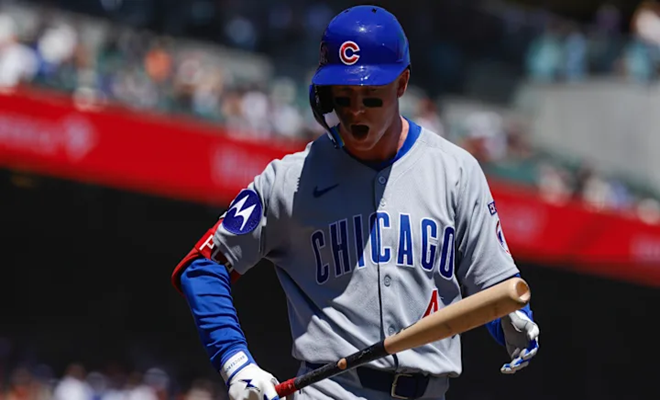
Pete Crow-Armstrong – OF – Cubs
1st Half wRC+: 131
2nd Half wRC+: 72
wRC+ difference: -59I mean, was there really any other choice for the first name on the list? PCA had the second lowest wRC+ in the second half of the season out of all the players that finished inside the top 100 fantasy hitters at the end of the season (only Lawrence Butler was lower at 70). He had the largest drop in wRC+ from the first half to the second and, as you’ll see with the next few players, was one of just six players that dropped by 50 or more points.
Now, why was that? Was it purely bad luck (1H BABIP: .286, 2H BABIP: .259)? Was it a skills issue (1H Con%: 73.1%, Chase%: 45%, SwStr%: 16.5%; 2H Con%: 73.5%, Chase%: 36.9%, SwStr%: 15.2%)? Or maybe, it was how he performed in different counts…
Count Type First Half Second Half Pitcher's (2-2, 1-2, 0-1, 0-2) 88 85 Neutral (1-1, 2-1, 3-2) 89 84 Hitter's (1-0, 2-0, 3-0, 3-1) 151 73 A slight dip in pitcher’s counts, in neutral counts and then, holy cow, a SEVENTY-EIGHT POINT drop in hitter’s counts. How could that happen? How does his production suffer that much in situations that are advantageous to him and not the pitcher? Well, let’s see how he performed in those situations:
BABIP BA OBP SLG Whiff% avgEV Barrel HardHit 1H Hitter's Count (1-0, 2-0, 3-0, 3-1) .333 .415 .538 .902 25.2% 88.8 MPH 12.2% 41.5% 2H Hitter's Count (1-0, 2-0, 3-0, 3-1) .174 .174 .345 .261 26.5% 84.9 MPH 13% 26.1% So, we can tell that he was luckier in the first half than the second (league average BABIP is .300), hitting for more power more often. He swung-and-missed at nearly the same rate, but he swung more often in these counts in the second half. He had a 54.3% swing rate in the first half in hitter’s counts, but a 63.5% swing rate in the second half. So, even though the whiff rates were nearly equal, he was hurt more in the second half by the rate because he swung more often. And, because he hit for less power and less often, more of those fly balls turned into fly outs.
Overall, his second half performance was more in line with how he had performed over his first 429 major league plate appearances, with his first half numbers representing some of the best numbers of his professional career. He had never demonstrated the type of power that he produced in the first half in any full season in the minor leagues (he had some ISO’s over .200, though he did have a .255 ISO in 117 PA in Triple-A in 2024, it was lower in the majors that year), but he had also never been attacked by pitcher’s like he has in his brief big league career (career 69.2% first pitch strike rate over 977 plate appearances; never a first pitch strike rate over 49.4% in the minor leagues).
He is currently OF10 on Draft Champions draft boards, with an ADP of 29. That’s an expensive price to pay for someone who was virtually unplayable for the final two-plus months of the 2025 season. If he is not performing well in hitter’s counts, he is a below average offensive producer, producing value with his glove only. The price is wrong for PCA in 2026 and I will be avoiding him everywhere.
James Wood – OF – Nationals
1st Half wRC+: 150
2nd Half wRC+: 93
wRC+ difference: -57For Wood, figuring out what went wrong is much easier than it was with Crow-Armstrong.
In the first half, he made more contact, whiffed less, barreled more balls and hit more fly balls.
GB% FB% Contact Whiff Barrel HardHit First Half 50.2% 30.5% 71.4% 11.0% 18.5% 55.6% Second Half 48.9% 19.7% 65.3% 14.4% 12.4% 57.7% The huge drop off in fly balls in the second half wasn’t because he hit more grounders. Instead, his line drive rate jumped by 12.1 points, which is why he hit the same amount of doubles in the second half as he did in the first half, in 151 fewer plate appearances. The drop off in power can be explained away by the drop in quality contact and the drop in fly balls. Though, his 31 home runs on the year should be considered pretty impressive, since his launch angle was under seven degrees for the year (6.1 first half, 6.8 second half).
The high strikeout rate shouldn’t be surprising, since Wood’s hit tool has always been his worst asset, though maintaining a dreadful strikeout for as long as he did (he had a 35% strikeout rate from May 23 through the end of the year) is a sign that if he doesn’t work on that hit tool, the fantasy ceiling may be lower than we think.
Wood is an incredibly powerful hitter who could be a 40 to 50 home run hitter one day, but he will need to make some serious adjustments if he wants to reach his absolute ceiling. Vladimir Guerrero is able to find success with a poor launch angle and low fly ball rates thanks to a high batting average floor and hitting in the middle of a very talented Blue Jays lineup. The Nationals are not nearly as good as the Blue Jays and Wood’s batting average ceiling is much lower than Guerrero’s floor, so he has less room for error.
I believe that Wood can make the necessary adjustments to recover from his poor second half (though his three best months of the season were the first three of the year, he had wRC+’s of 104 and 116 in August and September), we just need to see it on the field. Lifting the ball more and making more contact is Wood’s pathway to absolute superstardom. If he can’t do that, he will have to settle for merely being a star in a “small” market.
He has an ADP of 28 and is the OF9 in Draft champions drafts and though he did have some second half struggles, I am willing to buy him at that price because I do believe his ceiling is achievable.
CJ Abrams – SS – Nationals
1st Half wRC+: 132
2nd Half wRC+: 75
wRC+ difference: -57Statistically speaking, 2025 was Abrams’ best fantasy season. He set career bests in runs scored, batting average, on-base percentage, line drive rate, barrel rate and ground ball rate. He tied his career best in stolen bases and slugging percentage, performed better against splitters and sliders than he ever had and was the tenth best offensive performer at shortstop in the big leagues.
Yet, it felt a bit disappointing, no? At the All-Star break, Abrams was the third most productive shortstop. He was top-7 in home runs, runs, stolen bases and batting average, was tied with J.P. Crawford for the second best wRC+, had an .836 OPS and was one of just two shortstops that were hitting .280 or higher with a BABIP under .320 (so he also wasn’t extremely lucky on that front).
And then what happened? His season kind of fell apart. His contact rate dropped nearly a full six points, his whiff rate jumped nearly four full points, his hard hit rate dropped and, though he hit more fly balls and less ground balls, he also hit fewer line drives (more line drives usually means more base hits). Now, his barrel rate went up and his fly ball rate went up, but his ISO dropped 46 points because he hit the ball with less authority.
He had the same problems in 2024. His fly ball rate jumped in the second half, his line drive rate cratered (7.8% post-All-Star break), he walked less, struck out more, hit for less power, with a lower barrel and hard hit rate.
It’s not a pattern yet, but it is something to consider. It hurts more in head-to-head leagues than it does in roto, though a drop off like the ones he has suffered does not help in any league.
He is the SS7 in Draft Champions drafts so far, with an ADP of 49, after finishing as the ninth most valuable fantasy shortstop in 2025. Healthier seasons from Jeremy Pena and Zach Neto or a hotter start for Willy Adames would have pushed him lower down the end-of-year value list. At that cost, I am avoiding Abrams and grabbing Pena, Geraldo Perdomo or Trevor Story 45 or more picks later.
Ceddane Rafaela – 2B/OF – Red Sox
1st Half wRC+: 115
2nd Half wRC+: 59
wRC+ difference: -56Rafaela’s fantasy season was essentially defined by seven incredibly hot weeks and nineteen below-average weeks:
First nine weeks of the season – 30 R, 2 HR, 19 RBI, 7 SB, .221 BA, .605 OPS, 64 wRC+
May 27 through July 13 (7 weeks) – 26 R, 12 HR, 29 RBI, 6 SB, .329 BA, 1.017 OPS, 175 wRC+
July 18 through the end of the season (10 weeks) – 29 R, 2 HR, 15 RBI, 7 SB, .218 BA, .587 OPS, 59 wRC+
The Red Sox game on May 27 kicked off an eight game hit streak for Rafaela, including eight hits in the final four games of the month, after he had just nine hits over his previous 15 games. His statcast data was essentially elite for these seven weeks, with a 12.5% barrel rate, 49.2% hard hit rate and an average exit velocity of 91.3 MPH, with a 42% fly ball rate, 24% HR/FB, 78% contact rate and just a 12.9% whiff rate. Compare that to his numbers before (13.3% barrel, 45.9% hard hit, 90.5 MPH avgEV, 37.6% fly ball, 4% HR/FB, 73.3% contact, 16.1% whiff) and after (3.9% barrel, 26.3% hard hit, 84.5 MPH avgEV, 40.4% fly ball, 2.8% HR/FB, 75.3% contact, 13.9% whiff).
And it’s not like this is the first time he has done this. Last year, from June 12 through the end of July he had a 134 wRC+, .842 OPS and a .318 BA. Prior? 59 wRC+, .595 OPS, .210 BA. After? 62 wRC+, .593 OPS, .232 BA.
It was as if he gets possessed by Elly De La Cruz for seven-to-nine weeks of the year and Gabriel Arias the rest of the time.
If it wasn’t for his elite defense, he would see far fewer at-bats and likely only be on deep league radars. As it stands, though, he finished the 2025 season as the #8 2B and #30 OF and is currently the 7th 2B drafted in Draft Champions leagues and the 35th OF.
Based on his performances the past two seasons, his inconsistency and overall poor performance for 65% of the season, I will be avoiding unless I can get him much, much later than his current ADP of 147.
Zach McKinstry – 3B/SS/OF – Tigers
1st Half wRC+: 132
2nd Half wRC+: 81
wRC+ Difference: -51You know, I was going to break down McKinstry, because he did have such a tremendous drop in wRC+, but he’s not really fantasy relevant. Sure, he finished as the #8 fantasy 3B last year, but that should tell you how poor 3B was, not how good he was. Only six 3B earned more than $10 worth of value last year. McKinstry earned $4.6. He’s being drafted as the 30th SS, 30th 3B and 76th OF in Draft Champions leagues. He’s essentially an afterthought except for Tigers fans and fantasy managers who play in very deep leagues.
Just know that he had a career year at 30 years old, he does not have a guaranteed starting spot in the Tigers lineup and he had hit more than nine home runs in a season only one other time in his professional career, back in 20219 as a 24 year-old in the Dodgers organization. He is reserve depth at best, waiver wire fodder at worst.
J.P. Crawford – SS – Mariners
1st Half wRC+: 132
2nd Half wRC+: 82
wRC+ Difference: -50Incredibly, last year was the second best offensive season of Crawford’s career and he was still just the 22nd best fantasy shortstop.
Unlike the other player’s we’ve covered so far, though, Crawford only had a bad two month stretch. He had a wRC+ of 115 or higher in four out of six months, with July and August his two worst performing months (72 and 92 wRC+, respectively).
Through the end of June, Crawford had a .279 BA, with a .760 OPS and a 126 wRC+, with a 17.8% strikeout rate and 14.1% walk rate. From July 1 through the end of August, though, he had a .231 BA, .620 OPS, 82 wRC+, 20.1% strikeout rate and 7.5% walk rate. And then an incredibly hot (for Crawford, at least) September, with a .295 BA, .822 OPS, 138 wRC+, 18.6% strikeout rate and 9.3% walk rate. He hit three home runs in July and August combined, but hit three in the months of May and September individually.
Crawford has had windows of fantasy relevancy and in 2023 was a legitimate top eight fantasy shortstop, but, in reality, is more of a deep league target or injury fill-in at middle infield or shortstop. He is being drafted as the 35th shortstop around pick 378 in Draft Champions, after prospects that fantasy managers are hoping to see make their big league debuts on Opening Day.
If that doesn’t tell you how he is valued, I don’t know what will.
Eugenio Suarez – 3B – Mariners
1st Half wRC+: 140
2nd Half wRC+: 91
wRC+ Difference: -49Suarez has a long history of significant 1H-2H wRC+ splits, so to his 2025 performance is only significant in that the higher wRC+ plus happened in the first half and not the second.
1H wRC+ 2H wRC+ Difference 2025 140 91 -49 2024 87 154 +67 2023 101 109 +8 2022 129 138 +9 2021 63 121 +58 2019 102 166 +64 2018 156 106 -50 In three of the last five years and five of the last seven full seasons, he has had a wRC+ swing of at least 49 points from the first half to the second half, with his wRC+ improving in five of the seven seasons in the second half. He has been a better second half performer than first half throughout his career, with his three best offensive months happening in July, August and September: 119 wRC+ in July, 121 wRC+ in August and 117 wRC+ in September (career).
He hit 49 home runs for the second time in his career, but posted the lowest walk rate he’s had in a season with at least 400 plate appearances, the second lowest contact rate and the highest whiff rate of his career. And his numbers were even worse after he was traded to the Mariners, with a 66.6% contact rate, 16.6% whiff rate and a .683 OPS. Prior to the 2020 season, Suarez had a batting average between .249 and .283 every single season, with a contact rate of 73.1% or higher and his whiff rate was 10% or higher only twice..
Since then, however, he has had a batting average of .236 or lower in four of the last five seasons, his highest contact rate is 72.8% and his lowest whiff rate has been 12%…back in 2021. The power is great more often than not with Suarez, who has hit 30 or more home runs six times in his career (and 20 or more in every season with at least 500 plate appearances), but he is a three-category producer who drains your batting more often than not.
He finished the 2025 season as the third best fantasy producer at third base, pacing the position in home runs and RBI, tied for third in runs and sixty-third in batting average. He is the seventh third baseman off the board in Draft Champions drafts at the moment, with an ADP of 115. In roto leagues, I think this is a more than fair spot to take him, even though we don’t know where he will end up in free agency, since his slow periods can be tolerated more and you can draft high average producers elsewhere to offset the batting average sink, but he should be drafted later in head-to-head leagues, since he tends to be a black hole for weeks to months at a time and you never know which half of the season will be the time he decides to go off. I will grab him in roto leagues if I am unable to grab one of my first five choices, but will be avoiding him in head-to-head leagues unless I can get him later than a few others (like Jordan Westburg, Noelvi Marte, Matt Chapman and Alex Bregman).
Elly De La Cruz – SS – Reds
1st Half wRC+: 128
2nd Half wRC+ 80
wRC+ Difference: -48Last, but not least, the player who will be drafted the highest of the group, the most likely to hit 40 home runs and steal 70 bases and the one with the highest ceiling (apologies to James Wood).
In some ways, De La Cruz’s 2025 was worse than his 2024 and in some ways it was better. He hit fewer home runs, stole fewer bases, scored (three) fewer runs, had a lower OPS and a lower wRC+. But he also drove in more base runners, dropped his strikeout rate by nearly five points, had a two-and-a-half point rise in his contact rate and had a better stolen base rate.
He may have the only plausible excuse for his play suffering post-All Star break out of the group, though, since it was revealed on November 20 that he had played through a left quad strain from late in July through the end of the season. And whaddaya know, he had his two worst months to end the year.
His wRC+ by month: Mar/Apr: 112, May: 97, June: 190, July: 124, Aug: 47, Sept: 86. His stolen base attempt rate dropped, from one attempt per every thirteen plate appearances to one attempt per every twenty plate appearances, his strikeout rate jumped four points and his walk rate dropped by two. And though he dropped his ground ball rate by five-and-a-half points, his fly ball rate also dropped, by nearly two points, but his line drive rate was up seven points.
With how De La Cruz performed at the beginning of the second half (59 PA from July 18 to 31: 5 2B, HR, 4 SB, .294 BA, .841 OPS, 133 wRC+), I don’t believe we would have seen such a stark difference in halves if he hadn’t been playing through an injury.
He still finished the season as the third best fantasy shortstop and in 2026 Draft Champions drafts, has been the number two shortstop off the board and has an ADP of 8.59. He has been drafted as high as three and as low as thirteen and will be on my team if he is available at any of my picks after pick six.
Come join us at SportsEthos by filling out an application by clicking here
Click here to join us on Discord!
Follow us on X by clicking here
Follow us on Bluesky by clicking here
Follow Anthony on X at @akfantasybb
Follow Anthony on Bluesky at @akfantasybb.bsky.social- About the Author
- Latest Posts

I’m a husband, father and fantasy sports fanatic. I’ve been playing some fantasy sport or other since the fall of 1996, thanks to one of my childhood best friends, Brent. I enjoy watching all major sports, reading fantasy novels, watching TV shows and movies, playing video games and writing about fantasy baseball. I started at Sports Ethos in 2023, just writing one article a week and cutting my teeth in fantasy sports writing and I am now a co-lead of the Fantasy Baseball department, co-host of the Fantasy MLB Today podcast and the author of two weekly articles, our dynasty baseball rankings and a handful of random articles a year. I support the Houston Astros, Dallas Mavericks, Tennessee Titans and all things Texas Longhorns.

Worldwide Sports Coverage • Fantasy • DFS • Gaming