-
 March 30, 2026, 2:12 pm
Last Updated on March 30, 2026 2:12 pm by André Lemos | Published: March 30, 2026
The Game of week 25:
Valencia vs Olympiacos
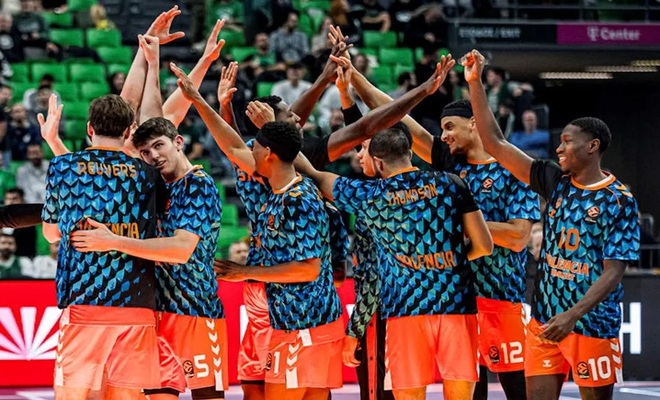
A packed Roig Arena got exactly what it came for.
Valencia and Olympiacos walked into one of the marquee games of the round and delivered a thriller that felt big from the opening tip and somehow kept getting bigger. Tempo, counters, stars making plays, coaching adjustments, late game shotmaking, a teenager stepping into pressure that should have belonged to veterans. This one had all of it.
The game opened fast, with both teams pushing pace and hunting transition chances. Sasha Vezenkov landed the first punch, scoring Olympiacos’ first six points and immediately setting a tone. Then came the first real coaching wrinkle. Once Reuvers checked in for Valencia, Olympiacos immediately tried to punish him by feeding Milutinov inside. Valencia’s response was equally clear. Reuvers stretched the floor, pulled the Serbian big away from the paint, and forced a different geometry on the game.
In pure scoring terms, Reuvers probably won that mini duel. But two quick fouls sent him back to the bench, and the board reset.
Valencia, though, found another lever. They ramped up the defensive intensity and pushed Olympiacos away from the three point line. The opening quarter was sloppy in the best possible way, frantic, physical, both teams making things happen and undoing them just as quickly. They combined for 10 turnovers in the first, but Valencia’s shooting steadied everything. The Taronja hit 5 of 8 from two, 5 of 7 from three, piled up nine assists, and came out of the chaos leading 25-23 after one.
The second quarter slowed down, at least briefly. Only five total points came in the first three plus minutes, and it looked like the game might be settling into a grind. Then Georgios Bartzokas found something.
He started placing Tyson Ward on the weak side and skipping the ball to him, letting Ward attack hard closeouts. Olympiacos also used pin downs effectively, and that stretch gave them a 6-0 run that broke the tie and forced Pedro Martinez into a timeout with 1:45 left in the half.
Valencia found some answers late, but Olympiacos kept building. By halftime, the Greeks led by eight, and the free throw line told a huge part of the story. Olympiacos had attempted 14 free throws in the first half. Valencia had attempted none.
Then Valencia came flying out of the locker room.
A 7-0 burst to open the third, fueled by three early Olympiacos turnovers, instantly changed the feel of the game. Thomas Walkup got to the line and split a pair to slow the bleeding, but a Badio three tied it. Olympiacos’ offense looked stuck. Their first field goal of the quarter did not come until 2:48 remained. Before that, all seven of their points had come from the stripe.
And then, just when it looked like they might be unraveling, one basket flipped the switch.
Olympiacos answered with an 8 0 run, capitalizing on back to back Valencia turnovers and forcing another timeout with 38 seconds left in the quarter. That could have been the moment the game tilted for good. Except Valencia never seems to believe the clock applies to them. In those final 38 seconds, they closed on a 6 2 spurt and kept the damage manageable.
Still, Olympiacos entered the fourth up 69-67.
The last quarter was a grind. Not ugly, but definitely tense. Defenses were sharper than the offenses, and by the media timeout with 4:54 left, Olympiacos had only edged the quarter 5 3. That was the kind of possession by possession game the Greeks wanted. They slowed the pace, made Valencia uncomfortable, and tried to force the Taronja into half court frustration.
But Valencia does not die easily. We know that by now.
Jean Montero got fouled on a three point attempt and made two free throws to tie the game at 79 with 1:22 left. On the very next possession, Braxton Key blew the roof off the place with a huge steal and a fastbreak layup that put Valencia ahead by two with under a minute to play.
Olympiacos had a response. Of course they did. Vezenkov got to the line and calmly knocked down both, tying it again.
Then Montero went hunting.
He got Vezenkov in a switch, invited him to dance, and drilled a long two with 27.7 seconds left. That felt like the dagger. It was not. Evan Fournier answered with a three to put Olympiacos back in front with 13.7 seconds to play, the kind of cold blooded shot that usually ends road classics.
And still, there was one more twist.
Montero took the ball again, called for the isolation, rose into a pull up, and got fouled. But he could not shoot the free throws. With more experienced options sitting on the bench, Pedro Martinez handed the moment to teenager Sergio De Larrea.
That is a coaching decision that either becomes legend or gets replayed forever for the wrong reason.
De Larrea buried both.
Valencia up one. Three seconds left. Final possession. Fournier cast in the hero role one last time. No miracle this time.
Valencia survived, 85-84, and completed the season sweep of Olympiacos in a game that felt like it could matter again in May.
The numbers underneath it are telling. Valencia finished with 27 assists, 10 more than Olympiacos, which is notable against a team that leads the league in assist percentage. Four Taronja players scored in double figures, with Badio leading the way at 15. For Olympiacos, Vezenkov and Ward combined for 32, but the guard play never quite gave them enough to close the deal.
In a game loaded with counters and clutch shots, Valencia’s identity held. Ball movement, resilience, and a refusal to fold when the game tilts the other way. And on a night that already had stars everywhere, a teenager ended up delivering the calmest two free throws in the building.
Maccabi vs Dubai
This one had a little bit of everything. Pace, matchup swings, tactical pivots, a near collapse, overtime nerves, and a closer who decided the game possession by possession.
Dubai came out hot and immediately looked like the sharper team. Maccabi’s smaller lineups were getting punished, and Dubai’s forwards were the reason why. The size mismatch showed up early, but the real tone setter was Wright IV, who was playing at a speed Maccabi simply could not match. He pushed the rhythm, got downhill, and made Dubai look like the team dictating every part of the game.
Then Maccabi changed the picture.
Around the middle of the first quarter, they shifted into a 2-3 zone, and the game tilted. Dubai suddenly had trouble scoring inside, and the roles flipped. Instead of being the team bullying smaller matchups, they were now looking at Maccabi’s size with Brissett and Hoard manning the three and four spots. That gave Maccabi a different kind of control.
Kabengele became a major factor in that stretch. His presence as a lob threat bent the defense, and his rebounding gave Maccabi extra life. It was not just about finishing plays, it was about changing the feel of the paint.
Then came the third quarter, and for a while it looked like Dubai had cracked it open.
The bank was open. Shots were dropping. Dubai ripped off a 21-10 run in the first seven minutes of the third and looked ready to run away with it. That stretch had all the signs of a game slipping out of reach.
And then, just as suddenly, Dubai started rushing.
The decisions got faster, but not better. Possessions lost shape. Maccabi started walking them down, step by step, point by point. That is when Jimmy Clark III stepped into the center of the game. He was the ignition for Maccabi, scoring, assisting, making the right reads, and stabilizing every possession that mattered. By the end of the quarter, what had looked like a disaster was down to only a three point gap.
The fourth quarter was a nail biter, exactly the kind of tense, back and forth basketball that feels heavier with every trip. Buckets were traded all quarter, but Maccabi found the run that mattered most, and once they did, the ending started to lean toward chaos.
Inside the final 37 seconds, Maccabi trailed by three. Dibartolomeo knocked down a free throw to cut it to two. Then Dubai coughed up the ball in the final 14 seconds, the kind of turnover that instantly changes the emotional temperature of the building. Maccabi got a chance, missed the initial layup, but followed it with a putback off the rebound.
Tie game. Overtime.
That was the pivot point.
Dubai’s offense stagnated in the extra period, and in a game that had already featured stretches of rushed decisions, that finally cost them. The movement dried up, the rhythm faded, and the possessions no longer had the same bite.
Maccabi, meanwhile, knew exactly how to close.
Jimmy Clark III was the biggest reason why. He had already helped drag them back into the game, and in overtime he looked like the player most comfortable with the moment. The shotmaking, the playmaking, the poise, it all showed up when the game got tightest.
Dubai had the faster start. They had the huge third quarter burst. They had the lead late.
Maccabi had the last answer. And in a game this wild, that was the only one that mattered.
Key Performances of the Past Week:
Jimmy Clark III vs Dubai
Jimmy Clark III did not post the biggest scoring total in Maccabi vs Dubai, and that is exactly why this performance deserves the spotlight.
Because this was not about leading the box score. It was about owning the biggest moments.
Clark finished with a 23 point, 10 assist double double and committed just one turnover, a stat line that already tells you he was walking a very fine line between aggression and control. But the real story was when those plays came.
In the third quarter, with Dubai threatening to blow the game open, Clark became the answer. He met that run with a scoring burst of his own and layered in the playmaking that kept Maccabi from spiraling. It was not just shotmaking. It was game management. He understood exactly when to attack and exactly when to create.
Then overtime came, and the script repeated itself.
Once again, Clark was the stabilizer. The same calm, the same decision making, the same feel for when the game needed a bucket and when it needed a pass. That is what separated his night from a simple scoring performance.
Plenty of players can put up numbers in a wild game. Fewer can bend the game back in their team’s favor when it starts slipping away.
That was Jimmy Clark III against Dubai.
Twenty three points. Ten assists. One turnover. And, more importantly, a hand in every crucial moment that mattered.
Standings Watch:
Fenerbahçe is wobbling a bit, and at this point in the season that wobble can get expensive.
What once looked like a firm grip on the No. 1 seed suddenly feels a lot less secure. The recent struggles have opened the door, and in EuroLeague, doors do not stay cracked for long. There is always that old first seed curse floating around, the idea that whoever finishes first never ends up winning gold. Maybe that is a fun superstition for another time. Right now, nobody in Fenerbahçe’s building is interested in dodging the top spot.
At this stage, everybody wants the No. 1 seed.
More importantly, everybody needs to keep winning, and not just winning, but winning well.
That urgency is what makes the chase so interesting, because Olympiacos and Real Madrid are sitting just one win back. And if there are two teams you do not want breathing down your neck in late season positioning battles, it is probably those two. Both know how to close a season. Both know how to turn the final stretch into a pressure campaign.
The bigger concern for Fenerbahçe might be on the defensive end.
This is a team that usually wins by controlling games, by making opponents uncomfortable, by keeping scores in the range they want. Lately, that edge has softened. In each of their last two games, they have allowed more than 90 points. Two weeks ago, Olympiacos hung 104 on them. That is not just a bad night. That is the kind of trend that starts to matter when the margins at the top are this thin.
So yes, the standings say Fenerbahçe is still in front.
But the real story is what is happening behind them and what is happening to their defense.
The top seed is still there for them to take. The question now is whether they tighten up in time, or whether Olympiacos and Real Madrid turn this into a sprint they know exactly how to win.
Games to Watch Week 26:
Zalgiris vs Barcelona
This is one of those games where the phrase must win actually fits.
Zalgiris comes into this one on a tear. They just beat Real Madrid, then followed it up with another statement win over Fenerbahçe, and the confidence in Kaunas has to be through the roof. When a team starts stacking wins like that against heavyweights, it changes the feel of every game that follows. Suddenly, it is not just about form. It is about belief.
Barcelona, meanwhile, walks into this with a very clear incentive. They need this one if they want to jump ahead of Zalgiris in the standings, and at this point in the season those swings are massive. One result can shift not just placement, but the entire mood around a playoff race.
The matchup to watch is obvious.
Barcelona’s defense has been better lately, but this is a very different test. If they are going to win in Kaunas, they will have to deal with Zalgiris’ backcourt, a group that has been driving the engine during this recent surge. That means containing the rhythm, surviving the pick and roll pressure, and not letting the guards dictate the game the way they have against Madrid and Fenerbahçe.
Simple setup, huge implications.
Zalgiris is hot. Barcelona is chasing. And the standings may look a little different when this one is over.
What’s at Stake:
For Dubai, the season hangs in the balance. Last week they were on the verge of making a statement, a real chance to punch their ticket, and it slipped. Now Maccabi is breathing down their neck, pressing in on the Play-In picture.
Dubai had the moment against Panathinaikos, and again against Maccabi, but they couldn’t convert. Momentum is a fragile thing in March, and right now it’s tilting toward the Israelis.
Maccabi still has a game in hand. If they win, they pull to just one win behind Dubai, and suddenly what looked like an opportunity for Dubai becomes a fight for survival. Every possession, every matchup, every call matters. This is more than a game, it’s a crossroads for both teams’ seasons.
This article was written by the European Hoops team: Tiago Cordeiro, João Caeiro and André Lemos. Make sure you give us a follow on Twitter at @EthosEuroleague!
- About the Author
- Latest Posts

From the cliffs of Porto Moniz to the forests of Latvia. With a degree in business and a background in finance, I traded balance sheets for projection models, following a lifelong love of the game. I’ve played it, I’ve lived it and I’ve had the privilege of working inside team front offices at both the club and national level.
For over 20 years, I’ve also been immersed in the world of Fantasy Basketball, studying trends, finding edges and living the grind season after season. That passion has brought me here, to SportsEthos, where I’m honored to be part of our management team alongside the great Aaron Bruski. My mission is simple: help SportsEthos thrive as the premier home for Fantasy Sports and sports coverage. A place where users get real value and where every member of the team can sharpen their craft, find joy in the work and build something special that feels like home.

Worldwide Sports Coverage • Fantasy • DFS • Gaming
