-
 March 10, 2026, 8:28 am
Last Updated on March 10, 2026 8:28 am by André Lemos | Published: March 10, 2026
The Game of week 22:
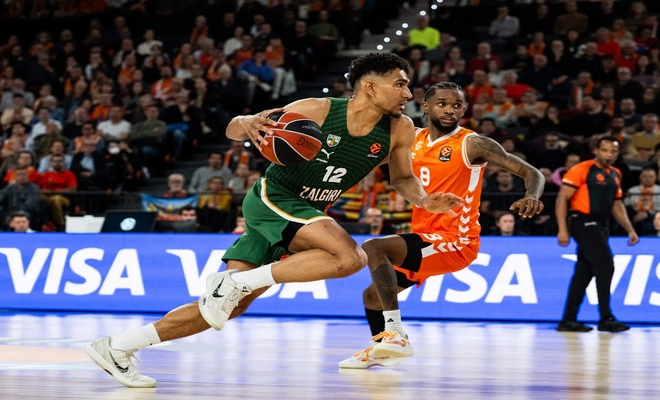
Valencia vs Zalgiris
Inside Roig Arena, Valencia and Zalgiris delivered the kind of clash you expect when two of the most entertaining teams in the competition meet. Tempo against control. Fluid offense against methodical execution. For stretches, it felt like two different basketball philosophies sharing the same floor.
The only early surprise came from Zalgiris, with Sylvain Francisco coming off the bench. Everything else followed familiar patterns. Valencia sprinted into the game at a breathtaking pace while Zalgiris tried to slow the rhythm to a crawl. On the first three possessions alone, the Lithuanians dragged the shot clock under five seconds, forcing Valencia to defend full possessions.
It worked for a moment, but then Darius Thompson drilled two threes and the gap opened quickly, growing to nine by the first media timeout.
Without Birutis available, Tomas Masiulis went small with Tubelis at the five and Ulanovas at the four. The adjustment did not shift the balance much. Valencia consistently forced Zalgiris into rotations and attacked closeouts. Omari Moore thrived in those situations, slicing into space created by the defensive scramble.
Zalgiris never really found a rhythm in the opening quarter. Three turnovers. Cold shooting at 5 of 14 from the field. Just 13 points in the period. The Valencia bench alone produced 15, helping the hosts build a 25 point first quarter.
The second quarter flipped the tone. Zalgiris opened with a quick 6 0 run in under two minutes, capitalizing on two Valencia turnovers and forcing Pedro Martinez to call time. When play resumed, Sako reentered and immediately influenced the game with Gortat screens that opened driving lanes for the guards. Valencia answered with an 8 4 push that forced Masiulis to regroup.
Against the Zalgiris switching scheme, Valencia attacked from different angles than usual but with the same elite results. Instead of relying strictly on perimeter creation, they began posting up bigger wings like Taylor and leaned on Pradilla at the four, targeting Francisco and Maodo Lo. With the center stretching the floor, those mismatches created high quality looks.
Zalgiris struggled more in the half court. Their offense looked better in transition, but with Francisco quiet at just three points in the half, the visitors trailed by 11 at the break.
Out of halftime, adjustments arrived quickly. Zalgiris abandoned the switching coverage on side pick and rolls and began icing the action instead. Offensively, they simplified everything. An empty side pick and roll flowed into a middle pick and roll over and over again. The result was a 17 8 run across the first five minutes of the third quarter, slicing the Valencia lead down to two and forcing another timeout.
The pause steadied the hosts. Valencia rediscovered its offensive rhythm by attacking once the defense rotated, pushing the score to 71 64 entering the final period. Still, warning signs appeared. The three turnovers in the third matched the entire first half.
Zalgiris, meanwhile, played a near perfect quarter from a control standpoint. Zero turnovers and nine assists kept them within striking distance.
The fourth opened with both teams trading baskets until Valencia produced one of those bursts that define their style. A 5 0 run in five seconds flat. Taylor hit a three. Sako followed with a dunk. Suddenly the lead was back to double digits and Masiulis needed another timeout.
Zalgiris refused to fold. Sleva, who had already knocked down a few timely threes, hit another to spark a rally. Moses Wright kept attacking and living at the free throw line. The run peaked when Francisco buried a deep three that tied the game at 87 with 56 seconds left.
And then the offense stopped.
Valencia’s response was simple. Badio created space for a tough mid range jumper. Zalgiris came up empty on the next possession. Jean Montero calmly walked to the line and closed the door. Final score, 91 87.
Valencia survived a tense finish despite scoring just six points over the final five minutes and thirty four seconds. Omari Moore led the way with 16 points, supported by three teammates in double figures. Badio and Taylor deserve special mention for their defensive work, holding Francisco to an off night with nine points on 1 of 9 shooting and three turnovers.
For Zalgiris, Moses Wright produced a strong performance with 20 points and nine rebounds. Sleva added 14 points and Brazdeikis chipped in 13.
In the end, Valencia’s ability to exploit rotations and create advantages just enough times proved decisive. In a game defined by adjustments and momentum swings, the Taronja found the final answer.
Olympiacos vs Panathinaikos
The Greek derby opened with the home team looking composed and organized on both sides of the floor. With Sasha unavailable, Alec Peters stepped into the spotlight and took on the responsibility of filling the gap left by the former MVP.
Panathinaikos actually landed the first punch, but it did not take long for Olympiacos to flip the momentum. Two early threes gave the Reds the lead and, more importantly, allowed their defense to dictate the rhythm of the game. From that point on, Panathinaikos’ offense looked unprepared to deal with the defensive pressure.
Frank Ntilikina spent long stretches on Kendrick Nunn, while Nikola Milutinov handled the blitz coverage well early on. Even when Panathinaikos beat the first line of defense off the dribble, Olympiacos stayed extremely disciplined. Help came on time. Rotations followed immediately. The chain never broke. The result was a first quarter in which the Greens could only muster 13 points.
Olympiacos did not fully capitalize on the small ball look with Mitoglou at center for the greens. In the final three minutes of the opening quarter they rushed several possessions, leaving points on the table and finishing the period just under the 20 point mark. Still, the defensive tone had been established.
Nunn, meanwhile, looked completely out of rhythm. Too many mistakes, no scoring in the first ten minutes, and Panathinaikos struggled to find any consistent creator.
Early in the second quarter Olympiacos pushed the lead to 16. Their ball movement improved compared with the latter stretch of the first quarter and Panathinaikos had no real answer. For a derby with so much at stake, the Greens looked passive.
Turnovers began to pile up. Olympiacos forced them and punished them, finishing the half with 17 points off turnovers compared with just nine for Panathinaikos. Even more telling, the Greens went the first 20 minutes without a single trip to the free throw line. That stat alone tells the story of their lack of aggressiveness attacking the basket.
By halftime Olympiacos held an 11 point lead and full control of the game’s tempo.
The third quarter flipped the script. Olympiacos’ defense lost some of its early sharpness and fatigue began to show for Milutinov, who struggled to keep up with the switching and blitzing responsibilities. Panathinaikos took advantage by raising its intensity on both ends.
Defensively the Greens started picking up the Olympiacos point guard near the free throw line and pressed whenever possible. The goal was simple. Create chaos and run. Their half court offense had stalled in the first half, so they leaned into transition opportunities created by steals.
Offensively Panathinaikos became the aggressor. Nunn finally looked like Nunn, attacking downhill and drawing defensive attention. With guards collapsing the defense, the wings found open looks and knocked down four threes in the quarter. Just as important, they committed only two turnovers in the entire period.
Suddenly the game tightened. Entering the fourth quarter, Panathinaikos trailed by only two.
The final quarter acted as a reset for Olympiacos. The defensive intensity returned to the level seen in the first half. Tyler Dorsey eventually fouled out, but his minutes helped stabilize the offense when it needed direction. Evan Fournier delivered timely contributions as well.
On defense, the focus returned to containing Nunn, cutting off the same driving lanes that had opened in the third quarter.
Olympiacos also embodied its next man up philosophy throughout the night. Shaq McKissic stepped forward with energy, hustle and production on both ends, giving the Reds valuable minutes in key stretches.
For Panathinaikos, the issue remained control. Outside of Nunn’s surge in the third quarter, their guards never truly dictated the game the way they needed to.
The numbers underline the difference. The Olympiacos bench outscored the Panathinaikos bench by 16 points. Combine that with the advantage in points off turnovers and the equation becomes clear.
In a derby defined by defense, discipline and depth, Olympiacos found just enough of everything to walk away with the win.
Key Performances of the Past Week:
Leandro Bolmaro vs FC Barcelona
In Milano, one of the world’s fashion capital, the standout performance of the night did not come with flash or runway flair. It looked more like workwear. Functional. Tough. Built for the grind. That description fits Leandro Bolmaro’s night against FC Barcelona perfectly.
The box score gives you a solid outline. Thirteen points on 5 of 8 shooting. Four rebounds. Six assists. At times he even operated as the de facto point guard, initiating offense and organizing possessions. That alone would qualify as a strong outing.
But that stat line only tells part of the story.
Bolmaro’s biggest imprint came on the defensive side, where he spent the night hounding Kevin Punter from baseline to baseline. Ninety four feet of pressure. Constant contact. No easy catches. No rhythm.
The result was one of the quietest nights you will see from one of Europe’s most dynamic scorers. Punter finished with just seven points, shooting 2 of 6 from two point range and 1 of 5 from deep, while committing three turnovers along the way. Every possession felt like work.
That is the part of Bolmaro’s performance that jumps off the film more than the stat sheet. His activity, his willingness to chase and disrupt, and his ability to stay disciplined through actions turned one of Barcelona’s main weapons into a non factor for long stretches.
It is not the kind of stat line that lands a player on the red carpet. There were no fireworks numbers or viral highlights.
But it was the type of all around, high impact performance that basketball people everywhere appreciate. And the type of performance that quietly swings games.
Braian Angola vs Efes
Replacing Nando De Colo is not exactly a light assignment. That is the context Braian Angola walked into when he arrived at ASVEL. Big shoes, big expectations, and a fan base that needed something to get excited about.
Against Efes, Angola delivered the type of performance that explains why the team brought him in.
He poured in 26 points in 31 minutes, scoring from everywhere on the floor. Angola is a dynamic scorer who can get his points in multiple ways. Pull ups, drives, quick actions where he attacks the defense before it can settle. When he gets going, the variety in his scoring package becomes very hard to contain.
The stat sheet tells you he is mostly there to put the ball in the basket. Angola does not contribute as much in other areas, but that has not stopped him from becoming a lifesaver for ASVEL fans who have been looking for reasons to enjoy some good basketball again.
Since joining the team he has done one thing consistently. Get buckets.
In a brief seven game stint he is averaging 17.6 points per game with respectable efficiency, along with four rebounds and almost four assists per night. That production in such a short sample has quickly made him one of the most important pieces in ASVEL’s current rotation.
It is still early, but performances like the one against Efes make one thing clear. Braian Angola is a player worth keeping an eye on going into next season.
Standings Watch:
AS Monaco and Panathinaikos are skating on thin ice.
After losses this week, the two teams that currently hold the final Play In spots suddenly feel the pressure from below. Both sit just one win ahead of Dubai and Milano, and the situation becomes even more delicate when you factor in that Dubai still has one game in hand. If Dubai wins that game, they will tie Panathinaikos for the final Play In position. That possibility alone turns every upcoming game into a high tension affair.
Panathinaikos in particular looks vulnerable right now. Their form has been shaky not only in EuroLeague play but also domestically. They lost again in the Greek League last weekend by two points, and the overall feeling around the team is far from comfortable. Results in Europe have followed a similar pattern, making the current standings race something everyone should monitor closely.
Monaco’s situation adds another layer of intrigue. Their struggles have not been limited to the court, with the ongoing drama around the club still hovering over the season. When a team already fighting for position has distractions off the floor, the margin for error becomes even smaller.
At the top of the table things remain stable for now. Fenerbahçe continues to lead the league, followed by Valencia and Olympiacos. Real Madrid currently holds the final home court advantage spot, sitting two wins clear of the fifth place team.
The middle of the standings, however, is anything but stable. One win can lift a team into safety. One loss can pull them straight into the chaos. Right now Monaco, Panathinaikos, Dubai and Milano are right in the middle of that storm.
Games to Watch Week 23:
Panathinaikos vs Zalgiris
Panathinaikos has one of the deepest and most talented rosters in the EuroLeague. On paper, it looks like a group that should sit comfortably near the top of the standings. The reality is very different. The Greens are currently in 10th place and playing with virtually no margin of error.
The recent form explains why. Over the last ten games Panathinaikos has managed only four wins. Some of those defeats came during the absence of Kendrick Nunn, which certainly did not help. Still, the former MVP returned for major matchups against Olympiacos and Fenerbahçe, delivered solid individual performances, and the team still came away with losses.
The roster is now even deeper with the addition of Nigel Hayes Davis. His presence gives Panathinaikos another offensive weapon and adds a very solid defender to the rotation. He is the type of player who can be plugged directly into almost any system and contribute immediately.
Even so, adjustments are inevitable. The guards will need time to adapt to his presence, especially when it comes to sharing touches and playing with the possibility of less time with the ball in their hands.
And time is exactly what Panathinaikos does not have.
There are only eight games left in the regular season. That leaves a very small window to find rhythm, stabilize the rotation and rediscover consistency. The question now is simple but heavy. Can the Greens find their groove again before the clock runs out, or are we heading toward one of the most shocking endings to a EuroLeague season in recent memory?
Biggest News Around EuroLeague
Could PAOK be heading toward the EuroLeague in the near future? Some reports suggest that possibility, particularly with the uncertainty surrounding the future of the French clubs ASVEL and AS Monaco in the competition.
The Greek club recently made a bold and intriguing move by signing Andreas Trinchieri to a three year deal. Trinchieri brings a strong résumé built across both EuroLeague and EuroCup. His trophy cabinet includes the EuroCup Coach of the Year award from 2014, and he has consistently led competitive teams at the European level.
On the court, PAOK is currently sitting fourth in the Greek League. At the same time, they are competing in the FIBA Europe Cup, the fourth tier of European competitions, where they have reached the Quarter Finals and will face fellow Greek side Peristeri BC.
A potential jump to the EuroLeague would almost certainly require a major transformation of the roster to give the team a realistic chance to compete. That type of overhaul might not be difficult now that the club has a new owner. Greek billionaire Aristotelis Mistakidis has arrived with the promise of revitalizing PAOK’s basketball project.
For now, it remains a developing situation. But with a respected coach in place and new financial backing behind the scenes, this is a storyline worth monitoring closely over the coming months.
This article was written by the European Hoops team: Tiago Cordeiro, João Caeiro and André Lemos. Make sure you give us a follow on Twitter at @EthosEuroleague!
- About the Author
- Latest Posts

From the cliffs of Porto Moniz to the forests of Latvia. With a degree in business and a background in finance, I traded balance sheets for projection models, following a lifelong love of the game. I’ve played it, I’ve lived it and I’ve had the privilege of working inside team front offices at both the club and national level.
For over 20 years, I’ve also been immersed in the world of Fantasy Basketball, studying trends, finding edges and living the grind season after season. That passion has brought me here, to SportsEthos, where I’m honored to be part of our management team alongside the great Aaron Bruski. My mission is simple: help SportsEthos thrive as the premier home for Fantasy Sports and sports coverage. A place where users get real value and where every member of the team can sharpen their craft, find joy in the work and build something special that feels like home.

Worldwide Sports Coverage • Fantasy • DFS • Gaming
