-
 January 19, 2026, 3:23 pm
Last Updated on January 19, 2026 3:23 pm by André Lemos | Published: January 19, 2026
The Games of week 16:
Fenerbahçe vs Valencia
Fenerbahçe and Valencia delivered exactly what this matchup promised and then some. This was EuroLeague basketball with all the volume turned up. High level execution, constant tactical adjustments, technical fouls, momentum swings, and a finish that demanded your full attention.
The opening minutes were played at Valencia’s preferred speed. The Toranja attacked early and often through pick and roll, and it did not really matter what coverage Fenerbahçe showed. Switch, hedge, show, recover. Valencia moved the ball, forced rotations, and found space. Jaime Pradilla was the main beneficiary, knocking down three triples in the first quarter by simply being ready when the defense cracked.
Fenerbahçe had answers of their own. Talen Horton Tucker immediately put pressure on the rim, attacking Taylor with force and patience. More importantly, Sarunas Jasikevicius had his bigs manipulating Valencia’s defensive rules. Screens flipped at the last second, double ball screens stacked together, defenders arriving a half step late and paying for it. The offenses were humming until Saras stopped the game with just over five minutes left in the quarter and Valencia up 18 to 16.
That timeout flipped everything. Fenerbahçe came out with force, ripped off a 9 to 0 run, and never let Valencia get comfortable again. Pedro Martinez called for time, but the run stretched to 12 before Nate Reuvers finally stopped the bleeding with an offensive rebound and putback. Even then, the damage was done. Fenerbahçe closed the quarter up eight, fueled by five Valencia turnovers and a defense that suddenly tightened every passing lane.
Valencia opened the second quarter the way they hoped the entire game would go. Faster pace, more physicality, crashing the glass. A 10 to 2 start briefly swung the tone. Fenerbahçe barely blinked. The defending champions have been here too many times. A 12 to 3 response pushed the lead to 12 and forced Martinez to burn his second timeout of the half. Valencia stabilized after that, but Fenerbahçe’s defense was dictating terms. Just 14 points in the quarter, 2 of 10 from three, and a 45 to 34 deficit at halftime.
The pattern repeated after the break. Valencia struck first again, scoring seven of the first ten points of the third quarter. Fenerbahçe answered again, this time with a 5 to 0 run built entirely on stops. Nothing came easy. Frustration started to creep into Valencia’s body language. Still, this team never goes quietly. Martinez turned to Sergio de Larrea and Josep Puerto, and they changed the game. Back to back threes cut the lead to five with three minutes left, forcing Jasikevicius to step in and kill the momentum.
Fenerbahçe did just enough from there. The margin hovered around five until a violent poster dunk late in the quarter sent the building into a frenzy and set the score at 66 to 58 heading into the fourth.
Nicolo Melli wasted no time reminding everyone why he owns the title of King of Winning Plays. A massive block, then a basket on the other end, and suddenly the lead was 10 again. Valencia responded instantly, slicing it back to five in seconds. This is where Fenerbahçe showed real maturity. They slowed the game down, leaned into late clock execution, and scored when it mattered. Two Brandon Boston Jr. free throws restored a double digit cushion.
Valencia had one last surge. They hunted Nando De Colo, found points, and a Jean Montero three brought it back to five inside two minutes. De Colo answered with a layup. Montero hit another three. Devon Hall grabbed a huge offensive rebound, and Melli buried what looked like the dagger from deep.
But Montero was not done. A quick mid range pull up, then a Reuvers steal and layup, and suddenly Valencia was one shot away. Montero stripped De Colo and rose for a potential game tying three, only for Wade Baldwin IV to appear out of nowhere and erase it. Valencia still got a clean look on the baseline out of bounds, a Nate Reuvers corner three, but it would not fall. Tarik Biberovic iced it at the line, and a Taylor layup set the final at 82 to 79.
In a game played well below Valencia’s usual scoring standards, Fenerbahçe’s depth told the story. Six players in double figures, including Nando De Colo with 16 points in his first game back in yellow and blue. Valencia had only four players reach double digits, five scoreless, and Darius Thompson limited to a single free throw. An unusual sight for this Valencia team, and a reminder that against elite defense, nothing is guaranteed.
Real Madrid vs Barcelona
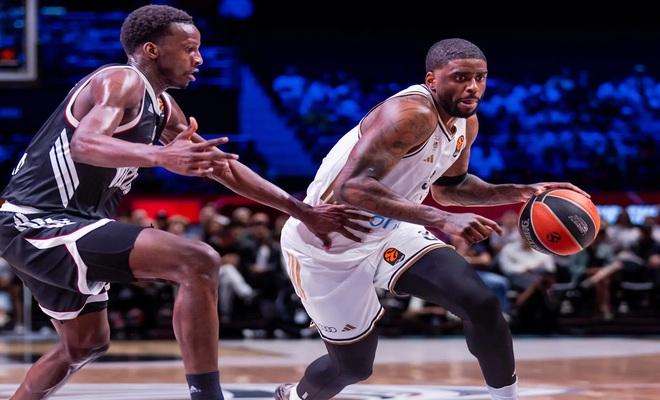
Real Madrid walked into the clásico with a clear physical edge, size across almost every position and a defensive plan that never wavered. The priority was Kevin Punter. Madrid went over every screen involving him and were happy to switch the other four players in any pick and roll action. From the opening tip, the tone was set.
The game itself took time to warm up. The first five minutes produced a combined eight points, both teams feeling each other out. Madrid broke the ice by going inside, repeatedly finding Walter through high low actions, and their first six points all came from him. Abalde drew the Punter assignment and was excellent, staying attached, denying comfort, and forcing Barcelona to search for offense elsewhere.
That offense briefly arrived through Thoko Shengelia. Barcelona punished a few missed communications with well worked sets that freed Shengelia for back to back threes, wide open looks created by defensive switches that never got sorted. Madrid answered quickly. Lyles came in with five points of his own, returning the favor and keeping the balance.
Barcelona adjusted by going smaller and more mobile. Laprovittola, Cale and Brizuela shared the floor with two rolling bigs, and the offense finally found some rhythm. The ball moved, the paint opened up, and scoring became easier. Madrid still had the advantage inside, getting to the rim with more ease than Barcelona, but Laprovittola looked closer to his old self, orchestrating and probing.
Midway through the second quarter, Barcelona was down nine. A couple of offensive rebounds, second chance points, and some timely defensive plays cut the margin to five and forced Scariolo to call timeout. That was the moment. After the stoppage, Walter’s impact grew on both ends. Madrid pushed the pace, controlled the glass, and the lead ballooned back to double digits. At halftime, Barcelona had been passive defensively and never found a consistent way to involve Punter, largely due to Madrid’s discipline and pressure.
The third quarter opened with Barcelona’s best stretch of the night. A 7 to 0 run forced Madrid into mistakes, late shots, and stalled ball movement. Scariolo responded immediately, bringing in Feliz and Garuba. The response was decisive. Madrid pressed more, the offense flowed again, and the physical gap widened. Garuba did a bit of everything. He knocked down threes, moved without the ball, switched seamlessly on defense, and picked up ball handlers with purpose. The pace became overwhelming, and Barcelona could not keep up.
By the fourth quarter, the outcome felt inevitable. What had started as a chess match ended as a demonstration of depth, size, and physicality.
Garuba finished with 16 points, but this was a collective statement. Madrid contained Kevin Punter, and without him, Barcelona leaned almost entirely on Brizuela and Laprovittola. After the game, Coach Pascual pointed to the rebounding gap and Madrid’s physicality. On this night, that difference was decisive.
Key Performances of the Past Week:
Saliou Niang vs Dubai BC
It’s time to give flowers to one of Europe’s most intriguing young prospects. Against Dubai BC, 21 year old Saliou Niang delivered the kind of performance that quietly announces itself to anyone who values the connective tissue of basketball as much as the highlights. The box score alone already demands attention. Seventeen points, seventeen rebounds with seven of them on the offensive glass, three assists, two steals and a block. A full stat sheet, yes, but the real value was in how those numbers came together.
Niang, a long and rangy forward, played with his athleticism turned all the way up. Defensively, he was a problem. One on one he held his ground, sliding well and using his length to make shots uncomfortable. In rotations he was even better, showing timing and awareness, shrinking passing lanes and arriving just in time to contest without overcommitting. He looked like a player who understands where the next action is coming from.
Offensively, the impact came without the need for shooting. Niang is still a non shooter, but he consistently found ways to matter. His cutting was sharp and purposeful, his off ball movement creating pressure on the defense and opening space for others. As a roller in pick and roll, he made quick, clean decisions, catching on the move and either finishing or moving the ball without hesitation.
The loudest part of the night, though, was on the offensive glass. Seven offensive rebounds, each one a small act of defiance, turning dead possessions into life. Those extra chances were crucial for Virtus, especially on the road, and Niang was at the center of it. Again and again he beat his man to the ball, extended possessions, and tilted the game with effort and instinct.
This was a do it all performance, the kind that doesn’t just help you win one game but hints at a much bigger picture. For Virtus, it was a key piece in an impressive road win. For Niang, it felt like a reminder that development is not always linear or flashy. Sometimes it looks like this. Length, energy, feel, and a young player figuring out how to bend a game without forcing it.
Usman Garuba vs Barcelona
Usman Garuba was one of the quiet drivers behind Real Madrid’s win against their biggest rival, even if the box score only hints at the full story. His energy was the kind that seeps into every possession and slowly overwhelms the opponent. Barcelona felt it from the moment he checked in.
Garuba did not just survive on offense, he delivered. He shot perfectly from the outside, knocking down two huge corner threes that punished Barcelona for loading up elsewhere. Those shots mattered, not only on the scoreboard but in how they stretched the floor and forced defensive decisions Barcelona did not want to make.
Defensively, he was everywhere. Garuba defended Barcelona’s ball handlers with discipline, switching, containing, and using his strength and mobility to take away comfort. He ran the floor relentlessly, turning defense into instant pressure the other way, and that pace was something Barcelona simply could not match for long stretches.
Sixteen points will not jump off the page in isolation, but that number undersells his night. Garuba’s impact lived in the margins, in the energy plays, in the defensive stops, in the way he accelerated the game on Madrid’s terms. Against a rival, in a game that demanded physicality and intensity, he delivered exactly that, and then some.
Standings Watch:
Panathinaikos have hit a rough patch at the worst possible time. Three defeats in the last four games have pushed the Greens down into the Play In spots after spending a long stretch of the season sitting comfortably in second place. In a league this tight, that kind of slide does not just cost you wins, it reshapes the entire outlook.
Things in Athens are clearly not in the best place right now. Injuries have not been kind, rotations have been disrupted, and the margin for error has evaporated. Every possession starts to feel heavier when the standings compress like this.
Home court advantage in the Playoffs matters, maybe more than ever in a season where separation is minimal and road wins are precious. If this skid lingers, what once looked like a given could turn into a mirage only. Panathinaikos still control parts of their destiny, but the cushion is gone, and the urgency is real.
Week 17 Games to Watch:
Real Madrid vs Monaco
Real Madrid and Monaco cross paths once again, this time in the Spanish capital, and this is the kind of matchup that rarely needs selling. These two teams always seem to bring out the best and the most complicated versions of each other.
They come into the week separated by just one win, with the Monegasques holding the edge in the standings. That small gap adds weight to every possession, every substitution, every late game decision. The talent level is off the charts on both sides, not only on the floor but also on the benches, where in game adjustments can quietly swing the night.
This is the type of game where details matter more than highlights, where one read or one defensive tweak can tilt the balance. A can’t miss game for sure.
Valencia vs Paris
These are not the flashiest clubs in the competition, and that is exactly why this game deserves attention. For anyone who craves pace, this is a must watch. Both teams sit at the top of the league pace wise, so expect a high scoring night with a healthy dose of anarchy on display.
The contrast in the standings is sharp. Paris come in sitting 17th, while Valencia are firmly planted in fourth. That gap is not accidental. Evan Fournier once called Valencia an upgraded version of Paris, and this matchup quietly explains why. Valencia combine that same speed with one of the best defenses in the league, and that puts players like Hifi in a very tough spot. On the other side, Paris defense has been low key bad, and against a team that plays this fast but also this organized, those cracks tend to show.
If the game turns into a track meet, Valencia are comfortable there. If it slows just a bit, their defense still gives them the edge. Expect Valencia to take this one.
What’s at Stake:
Every season has its list of underwhelming storylines, and this one starts in Belgrade with Devonte Graham. Expectations were not small, his own included, and right now he is not meeting them. The easy explanation is fit. Crvena Zvezda have a crowded backcourt and a clear hierarchy, but that argument cuts both ways. Graham is backing up players like Cody Miller, Nwora and Butler who are performing and absorbing the pressure. In theory, that should simplify his job. Come in, space the floor, hit shots. That part has not happened. There have been DNPs. There have been long stretches without a point. Adaptation time is real, but the clock is ticking and Red Star need a spark. Graham is supposed to be that guy. If it does not click soon, other options outside of Belgrade start to feel less hypothetical.
On the other side of the spectrum, Joel Bolomboy’s return quietly shifts the math. He made his comeback last Saturday in ABA League action after a ten month absence, logging nine minutes with four rebounds and a block. The numbers do not jump off the page, but the context matters. For Crvena Zvezda, his presence alone is significant. Bolomboy will need time to reach his top form, but he immediately gives coach Obradovic another reliable EuroLeague level center alongside Motiejunas and rookie Ibuka Izundu. That extra body changes lineup possibilities and strengthens the rotation at a moment when margins are thin. As the season moves into its decisive stretch, that kind of depth can be the difference between hanging onto a Play Off push and watching it slip away.
Biggest News Around EuroLeague
Injuries and roster tweaks are reshaping the landscape this week. Nigel Williams-Goss suffered a calf strain in Round 21 and is expected to miss the next two to three weeks, a tough blow for his team as they navigate the midseason grind. On the addition side, Bruno Caboclo joined Dubai from Hapoel on January 15, though he hasn’t yet been registered and it remains to be seen how quickly he can impact the rotation. And for teams looking for a boost, Dzanan Musa returned to action in the ABA League this past weekend after being sidelined since Round 3 with a knee injury. His comeback adds a familiar scoring option and depth for his squad just as the season enters its critical stretch.
This article was written by the European Hoops team: Tiago Cordeiro, João Caeiro and André Lemos. Make sure you give us a follow on Twitter at @EthosEuroleague!
- About the Author
- Latest Posts

From the cliffs of Porto Moniz to the forests of Latvia. With a degree in business and a background in finance, I traded balance sheets for projection models, following a lifelong love of the game. I’ve played it, I’ve lived it and I’ve had the privilege of working inside team front offices at both the club and national level.
For over 20 years, I’ve also been immersed in the world of Fantasy Basketball, studying trends, finding edges and living the grind season after season. That passion has brought me here, to SportsEthos, where I’m honored to be part of our management team alongside the great Aaron Bruski. My mission is simple: help SportsEthos thrive as the premier home for Fantasy Sports and sports coverage. A place where users get real value and where every member of the team can sharpen their craft, find joy in the work and build something special that feels like home.

Worldwide Sports Coverage • Fantasy • DFS • Gaming
