-
 January 13, 2026, 4:44 am
Last Updated on July 16, 2026 9:18 am by André Lemos | Published: January 13, 2026
The Games of week 15:
Panathinaikos vs EA7 Milano
Panathinaikos came back to OAKA carrying the emotional weight of the derby loss, and the idea was simple. Reset, reassert, move on. Milano arrived with a different agenda altogether. They were already up 1 0 in the season series and, despite missing Shavon Shields and Leandro Bolmaro, clearly believed this was a game they could control.
Giuseppe Poeta leaned into size right away, starting Ricci, Leday and Booker, while Ergin Ataman countered by putting Grant back in the starting five and tasking him with the Armoni Brooks assignment. Panathinaikos looked more versatile offensively than in recent outings, running cleaner sets and spreading responsibility. Milano, meanwhile, went hunting inside, especially after switches, trying to punish with Booker and Leday. It stayed tight, physical and messy in the right ways, with offensive rebounds everywhere. Seven of them in the quarter alone. Panathinaikos edged it 20 15, but nothing felt settled.
The second quarter was defined by momentum swings and whistles for time outs. Panathinaikos opened with a 5 0 run, Poeta stopped it. Milano answered with their own 5 0 burst in just 37 seconds, and now it was Ataman calling everyone over. This pattern repeated. Panathinaikos found mismatches in pick and roll, punished late rotations and briefly pushed the lead to double digits. Milano responded again, closing the half with another run to keep it at five. The game never breathed. It just jolted. Turnovers piled up, 17 combined in the half, and neither side ever fully grabbed control.
Milano came out of the locker room sharp and decisive. Seven unanswered points forced an early Ataman time out, and while an excellent ATO produced a Cedi Osman three, that shot represented three of the five Panathinaikos points over a six minute stretch. The Milano defense had shifted gears. More active, fewer mistakes, better discipline. The game tilted only when Ataman leaned into Yurtseven, whose impact as a roller sparked a 6 0 run and briefly flipped the lead again. Milano absorbed it. Lorenzo Brown took over the quarter, scoring eight and handing out four assists, and by the time the horn sounded the Italians were back in front 61 58.
The fourth quarter followed the same script, only louder. Milano opened with a 5 0 run fueled by defense and two Panathinaikos turnovers in the first minute. This is where experience matters, and Kostas Sloukas reminded everyone why. He authored a personal run, dragged the deficit down to three and forced Poeta into another huddle. Milano adjusted by leaning hard into Mannion and Nebo, a pairing that gave Panathinaikos real problems. Mannion made plays on both ends, including drawing two straight offensive fouls, while Nebo kept finishing.
Panathinaikos struggled badly in the half court. Turnovers, missed shots, no clean answers. Even the idea of isolating Ricci went nowhere, as he held up just fine. Then came the decisive stretch. Armoni Brooks hit back to back threes, the lead ballooned into double digits with just over two minutes left, and the air left the building. Sloukas found a lane for a layup out of the final time out, but Lorenzo Brown delivered the dagger, a three right in front of Ataman, effectively ending the game. The numbers told the story. Seven turnovers and five made field goals for Panathinaikos in the quarter. One turnover and six of twelve from deep for Milano. Final score 87 74, season sweep complete.
Juancho Hernangomez answered his critics the best way possible, leading Panathinaikos with 17 points and seven rebounds. Sloukas added a steady 13 and 10 assists. Kendrick Nunn had an off night, limited to 10 points with five turnovers. For Milano, Armoni Brooks was the engine again with 24 points, six rebounds and five assists. Lorenzo Brown chipped in 17 and five assists in what felt like a quiet revenge game, and Josh Nebo added 16 and seven.
Milano did not win this game with flash. They won it with control, adjustments and discipline, especially when it mattered most.
Crvena Zvezda vs Valencia
Belgrade delivered exactly what this matchup promised: fast, physical, and high-octane from the opening tip. Valencia arrived in full control of their identity: full-court pressure, relentless ball pressure, and a tempo that forced Crvena Zvezda’s guards into mistakes. Early on, Motiejunas provided a calming presence, scoring four quick points and bullying Neal Sako inside. But when Valencia started punishing the Serbians in pick-and-rolls, Obradovic went small, slotting Semi Ojeleye at the five and switching everything. Against a team like Valencia, that’s a dangerous experiment. Jean Montero went on a 5-0 personal run, the lead ballooned to ten, and a time-out barely slowed the onslaught. Zvezda closed the first quarter in the red, 34-20.
The second quarter gave a glimmer of hope for the home team. Zvezda scored the first four points, but Valencia’s intensity never wavered. Even as baskets fell for the Serbians, the visitors continued to press, force turnovers, and attack in transition. After the media time-out, Montero wreaked havoc again, and a 9-2 Valencia run pushed the lead to 17, forcing Obradovic into another time-out. Valencia ended the half in command at 54-37, capitalizing on five Zvezda turnovers in the quarter alone.
The third quarter started with Zvezda on a mission. They scored the first 13 points and held Valencia scoreless for over two minutes. Badio finally ended the drought from deep, sparking a 9-0 run that brought the lead back into double digits. Zvezda countered with a 6-0 burst of their own, largely thanks to Chima Moneke and Jordan Nwora, who combined for 23 of the team’s 27 third-quarter points. But Valencia landed the final punch, scoring the last nine points of the frame to keep the lead steady in double digits. Notably, Valencia committed as many turnovers in this quarter (4) as they had in the entire first half, a sign of the pressure Zvezda finally applied.
The fourth quarter began slow, with only three points scored in the first two minutes. But Valencia quickly regained rhythm, opening on a 9-3 run to extend the lead to 19 and force another Zvezda time-out. After that, the Red and White found some baskets, but Valencia’s in-sync offense controlled the pace, trading points efficiently and never letting the deficit shrink. The final score: 106-89 in favor of the visitors.
Crvena Zvezda’s 13 turnovers, eight of which led to Valencia steals and fast-break points, ultimately defined the game. Four Zvezda players scored in double digits, with Nwora leading the way at 22. Motiejunas, despite a strong start, played only five minutes. Valencia’s balance was stark: five players in double figures, with Jean Montero leading all scorers at 25 points and adding four steals, a perfect microcosm of why Valencia’s system thrives: pressure, pace, and unselfish, opportunistic offense.
This was a game where preparation met identity. Valencia executed theirs to near perfection; Zvezda struggled to adapt. In a league this tight, details like turnovers and pace can’t be ignored, and tonight they weren’t.
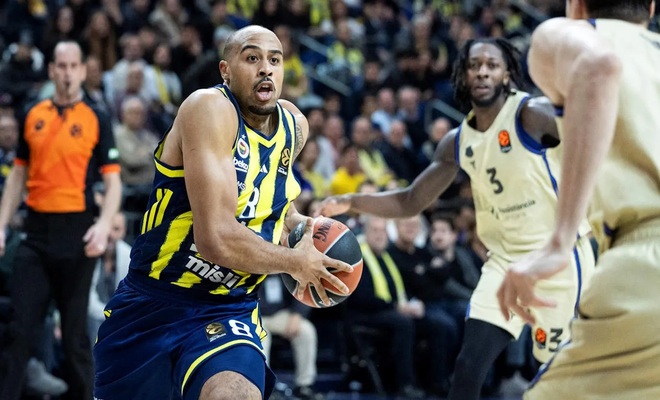
Fenerbahce vs Olympiacos
In a matchup that felt like a chess game at times, Fenerbahce used versatility, size, and intensity to grind down Olympiacos. Without Milutinov on the floor, Hall stepped up inside, scoring nine points in the first half, but the real story was Fenerbahce’s defensive approach. They switched everything, stayed just on the right side of the foul limit, and forced Olympiacos into uncomfortable positions. The Greek side struggled to find rhythm, particularly from deep, shooting just 11 percent in the first half, while Fener’s first three-pointer didn’t come until Melli hit a tough step-back that salvaged a possession and sent the Turkish arena into a frenzy.
Fenerbahçe’s offensive identity early in the game was less about the three-point line and more about creating high-quality opportunities through movement and spacing. THT led the charge, scoring in multiple ways and finishing the first half in double digits despite his team’s cold start from deep, going 0-for-13. Olympiacos’ second unit allowed Fenerbahçe to cut the deficit to just two possessions after trailing by almost double digits, highlighting the contrast in coaching philosophies. Coach Sarunas praised Olympiacos’ aggression and control, while Fenerbahçe’s coach emphasized the need to find pace to prevent stagnation against Olympiacos’ switches.
The third quarter was where Fener pulled away. They made six threes compared to Olympiacos’ one, exploiting defensive lapses and creating easier, rhythm-based shots. Olympiacos, meanwhile, became more isolation-heavy, a problem when their roster lacks creators like THT or Baldwin to consistently generate offense. By the end of the quarter, Fener had taken a slight lead heading into the fourth.
In the final ten minutes, Fenerbahçe pressed the gas. They attacked in transition after defensive stops, forcing Olympiacos to chase the game at a faster pace than they were prepared for. Brandon Boston made a difference, scoring, creating, and crashing the boards. To seal the game, Coach Sarunas ran an impressive set play from his playbook that led to an and-one on a Spanish-style pick-and-roll designed to engage the help-side defense. Boston’s energy and versatility turned what could have been a comfortable win into a statement about Fenerbahçe’s depth.
Baldwin orchestrated the offense like a seasoned veteran, finishing with seventeen points, eleven assists, and two steals. He has evolved into a two-way force, capable of carrying primary defensive assignments and creating efficiently on offense. Boston’s performance was equally eye-catching, though consistency remains the question mark. Sarunas’ touch as a coach also showed, subbing Boston out late to let the arena recognize his impact, a move that could pay dividends for the young player’s confidence.
Fenerbahce’s combination of defensive pressure, depth, and aggressive transition play was the defining factor. Olympiacos had to fight for every point, but the Turkish team’s size and rotation allowed them to maintain the intensity for forty minutes, a luxury few teams can match in Europe.
Monaco vs Valencia
This one had all the ingredients of a classic European battle. Monaco came in with four straight wins, Valencia with three, and both teams had rhythm, depth, and star power on the floor. From the opening tip, the game was a test of patience, pace, and execution.
Valencia pressed full court, switching aggressively on every pick and roll, with Darius Thompson glued to Okobo. Monaco, anticipating the pressure, tried to get back quickly after each basket, but early on the Spanish spacing overwhelmed them. Thompson scored seven of Valencia’s first nine points, mostly in transition, with one half-court three breaking the pattern. Monaco struggled with ball control and turnovers, and Valencia capitalized, racing out to an 11-0 run.
Spanoulis called a timeout, urging Monaco to push the pace, and the adjustments worked. Mirotic knocked down back-to-back threes to cut the deficit to six, and Monaco started to exploit pick-and-roll advantages, particularly through Hayes in the short roll. Valencia, meanwhile, shot poorly from deep early, only hitting three of nine in the first quarter.
The middle quarters turned messy. Both teams rushed shots, but Valencia’s turnovers piled up while Monaco took advantage with better defenders on the court and small-ball lineups that allowed them to control the tempo. Monaco built a double-digit lead, though Valencia never truly surrendered. They clawed back with size and intensity, trying to counter Monaco’s aggression, and at the end of the third quarter, Monaco still led, but Valencia’s resilience kept the scoreboard close enough to suggest a fight.
The fourth quarter, however, belonged to Nemanja Nedović. Trailing by six, he went on a scoring clinic, hitting consecutive threes to push the lead to nine, then a layup to make it eleven, and another three immediately after. In a span of a few possessions, Nedović scored 11 straight points, all while Valencia’s hopes for a comeback withered. His 11-2 run gave Monaco a 15-point cushion and effectively sealed the game with over seven minutes still to play.
From there, the final minutes were just clock management, intense but settled. Valencia had fought and pressured, but the second quarter’s chaos and Monaco’s early intensity had done the damage. Nedović’s fourth-quarter explosion ensured the Monegasques left with the win, turning what was a competitive game into a decisive statement.
Valencia’s turnovers were the story of the night, especially in crunch moments, while Monaco’s ability to capitalize and control the pace turned the tide. It was a perfect example of how effort, adjustment, and star execution, in this case Nedović, can tip a tight game in EuroLeague.
Key Performances of the Past Week:
Andreas Obst reminded everyone why he’s one of the most dangerous scorers in Europe. Bayern had been sliding, but Obst’s 37-point explosion versus Baskonia snapped them right out of it. Seven of eleven from deep, relentless movement, and the kind of scoring versatility that makes defenses chase shadows, this was the kind of game where Obst just reminds you he’s often too good for the EuroLeague.
Jean Montero gets an honorable mention for a performance equally electric in its context. The Dominican guard torched Crvena Zvezda for 25 points in only 20 minutes, missing a single shot inside the arc and hitting three of eight from deep. Timing was everything. He opened with a solo 5-0 run to put Valencia in double digits and then repeatedly stifled every run Crvena Zvezda tried to mount. Defensively, Montero was a certified bandit, picking pockets and snatching passes out of the air, finishing with four steals. In those 20 minutes, he controlled the rhythm on both ends of the floor.
And then there’s Nemanja Nedović, who reminded everyone of his T-Mac-like flare. Eleven straight points to extinguish Valencia’s hopes, finishing with 16 efficient points, three assists, and three steals. The scoring burst wasn’t just about numbers, it was about timing and intimidation, showing EuroLeague fans exactly how dangerous Nedović can be when he’s in that zone.
Standings Watch:
Crvena Zvezda’s last ten games read like a cautionary tale: three wins, seven losses, and a slide into dangerous territory. The Serbians are now perched on the final Play-In spot, tied with Milano, who for the moment are staring from the outside in. The big question is whether Zvezda can halt this skid or if they’ll continue sliding down the table. Every possession counts for the Red and Whites in the stretch run.
Below the playoff line, little has changed. The struggling teams remain mired at the bottom, and barring a sudden surge, their climb looks long and uncertain. Up top, the pecking order is holding: Hapoel sits at the summit, Valencia, Barça, and Monaco close behind, and with Hapoel having a game in hand versus Asvel on March 3, the top of the table could tighten even further. The middle and top of the EuroLeague are still moving steadily, while the fight to avoid the bottom looks like a marathon more than a sprint.
Week 16 Games to Watch:
EA7 Milano vs Crvena Zvezda
Two teams tied in the standings, but sitting on different sides of the Play-In line. That alone changes the stakes. Milano comes in with momentum, winners of their last two games including an impressive road performance against Panathinaikos. Crvena Zvezda, meanwhile, has won just three of their last ten and dropped the last two, so the pressure is palpable.
These teams are almost textbook contrasts. Milano leans on their offense, flowing through pick-and-rolls, spacing, and a mix of guards and wings who can create in a pinch. Zvezda is the other side of the spectrum: defense first, tough on the ball, willing to gamble and make every possession uncomfortable. The real intrigue will be whether Milano can crack that defense or if Zvezda’s stops dictate the rhythm.
Barcelona vs Real Madrid
The Spanish classic lands in Madrid, with Barça sitting fourth in the table and Real in sixth. Every possession here is about pride, league positioning, and revenge from past clashes. Last EuroLeague matchup, Madrid won thanks in part to Lyles’ huge night. On the domestic front, Pascual’s Barcelona already found a win, which sets up a balance of power heading into this one.
Barça is still waiting for Clyburn’s return, and that absence could be decisive, especially against Madrid’s size and versatility. Expect a tight, chess-like game with adjustments on every possession. These aren’t teams content to run and gun; every mismatch will be probed, every rotation tested.
Fenerbahçe vs Valencia
After El Clásico, this is the matchup that could define the round: two top-four teams, one winner, one loser. Both play elite defense: top-five in the league, but the contrast in style couldn’t be sharper. Valencia thrives in transition, supersonic in pace and ball movement, while Fenerbahçe prefers to slow it down, grind possessions, and let their defense dictate the flow.
Coaching will be key here. Every adjustment, every matchup tweak, every small decision could swing the game. If Valencia can push the tempo against a team that wants to control the clock, they might force cracks. If Fener can control pace and impose their defensive will, Valencia’s speed advantage may never matter. This is the kind of game where small edges compound into a huge result.
What’s at Stake:
For Fenerbahçe, the Bonzie Colson injury is more than a bump in the road. The Notre Dame alum is out three to six weeks with a patellar tendon strain, and that absence limits Sarunas Jasikevicius’ rotation flexibility. Colson isn’t just a three who can punish smaller defenders, he’s a small-ball four who stretches the floor, sets screens, and gives the team a different dimension. Now Biberovic is the only player who can fill that role, and it’s a completely different profile. Fenerbahçe can survive, but the absence could cost them home-court advantage in the Playoffs, or in a worst-case scenario, tilt a tight series the wrong way.
Meanwhile, over in Athens, Ergin Ataman was being Ataman. He put his job on the line publicly: if Panathinaikos doesn’t win either the EuroLeague or the Greek League, he’s out. It’s classic Ataman, part bravado, part psychological edge, but it’s also a statement of faith in his roster. PAO has the budget, the talent, and the expectations, so the bar is set sky-high. The Greek League caveat? That’s just smart insurance. But make no mistake: he’s betting the big one on his team delivering when it matters most.
Biggest News Around EuroLeague
Monte Morris’ arrival in Europe was one of the more intriguing stories of the season, and he was just getting comfortable before running into bad luck. The American guard got injured against Bayern and faces up to four weeks on the sidelines, which is a huge blow for his team’s backcourt rhythm and offensive flow.
In other Greek news, Kostas Antetokounmpo has left Olympiacos, a move that, frankly, feels inevitable given his track record with Greek contenders and will join Aris, making his EuroCup debut. That’s a notable addition for Aris, giving them size, athleticism, and upside in a competition where every edge counts.
Finally, James Nunnally, a former Partizan player, is signing with AEK Athens for the remainder of the season. That’s another player with EuroLeague experience entering the Greek League, adding firepower and depth to a league that’s quickly becoming unmissable. Between these moves, the Greek domestic scene is shaping up to be a must-watch for anyone following European basketball.
This article was written by the European Hoops team: Tiago Cordeiro, João Caeiro and André Lemos. Make sure you give us a follow on Twitter at @EthosEuroleague!
- About the Author
- Latest Posts

From the cliffs of Porto Moniz to the forests of Latvia. With a degree in business and a background in finance, I traded balance sheets for projection models, following a lifelong love of the game. I’ve played it, I’ve lived it and I’ve had the privilege of working inside team front offices at both the club and national level.
For over 20 years, I’ve also been immersed in the world of Fantasy Basketball, studying trends, finding edges and living the grind season after season. That passion has brought me here, to SportsEthos, where I’m honored to be part of our management team alongside the great Aaron Bruski. My mission is simple: help SportsEthos thrive as the premier home for Fantasy Sports and sports coverage. A place where users get real value and where every member of the team can sharpen their craft, find joy in the work and build something special that feels like home.

Worldwide Sports Coverage • Fantasy • DFS • Gaming
